From 10% Chance of Success to $2 Trillion Market Cap: SpaceX’s Historic IPO

Published: June 13, 2026 | Business, Technology & Space
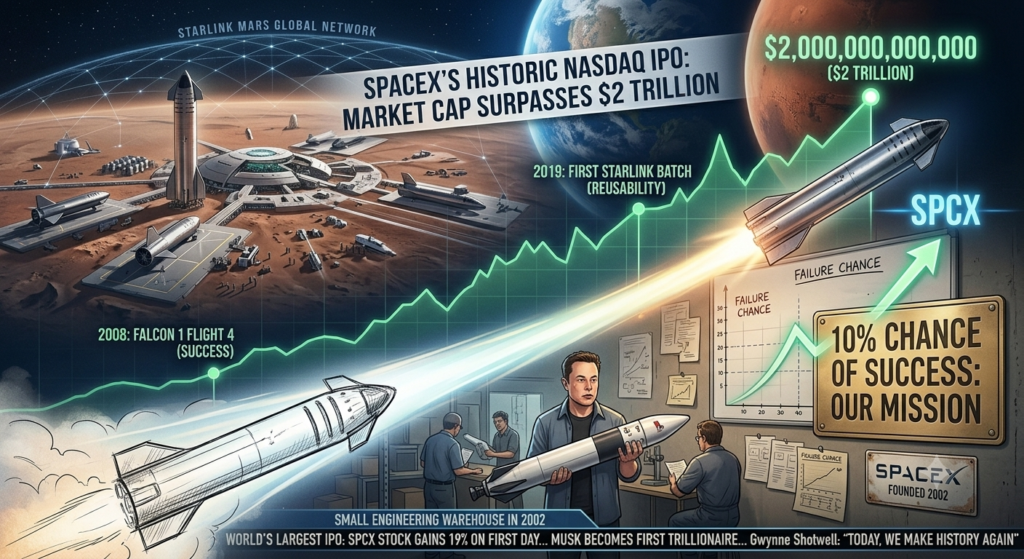
Shortly before the opening bell rang at the Nasdaq on the morning of June 12, 2026, Elon Musk stepped in front of a cheerful crowd of thousands at SpaceX’s company town in Starbase, Texas. Behind him, the vast industrial machinery of the most ambitious private aerospace venture in human history hummed with its usual quiet intensity. Ahead of him, on live screens across America and around the world, the moment that finance, technology, and the cosmos had been converging toward for over two decades was about to arrive.
“It is certainly hard to believe that little company that started in a warehouse in El Segundo is now going public with the largest IPO ever,” Musk told the assembled crowd in Starbase.
Then came a line that instantly became the defining quote of one of the most remarkable days in modern financial history:
“I gave SpaceX less than a 10% chance of succeeding at all, to be clear.”
The man who once gave his own company a one-in-ten shot at survival had just watched it list on the Nasdaq with a market capitalization surpassing $2 trillion — instantly making SpaceX the sixth most valuable company in the United States, and crowning Elon Musk as the first trillionaire in recorded human history.
The Numbers That Rewrote the Record Books
The statistics alone are staggering enough to induce a kind of financial vertigo.
SpaceX priced its shares at $135 on Thursday evening, selling 555.6 million shares to investors and raising $75 billion — more than double Saudi Aramco’s 2019 record of $29.4 billion, the previous holder of the title of largest IPO in history. The offering itself happened Thursday night, a day before any public trading commenced.
When the markets opened on Friday, June 12, SpaceX shares began trading at $150 — roughly an 11% premium over the IPO price — and continued climbing. By the end of the trading day, the stock closed at $160.95, representing a gain of nearly 19% over the IPO price. The market cap sat firmly above $2 trillion. In after-hours trading, shares climbed further still, reaching $166.76 by 6:30 p.m. ET, pushing the market cap to approximately $2.2 trillion.
More than 500 million SpaceX shares changed hands throughout the day — a volume approaching Facebook’s market debut in 2012, when roughly 580 million shares were traded, a record at the time. The SpaceX ticker, SPCX, became the most-bought stock by retail traders on net in Friday’s trading, according to data from VandaTrack. It was also among the most-discussed stocks in Reddit’s popular WallStreetBets forum in the days leading up to the IPO.
Demand had been nothing short of ferocious. Reports indicated the IPO book was roughly 3.3 times oversubscribed, with total demand exceeding $250 billion — including over $100 billion in retail orders and a $5 billion-plus order from BlackRock alone. Initial indications of interest suggested the stock could open around $175, a 30% gain from the IPO price. That enthusiasm translated into a real-world number that almost no one had predicted even five years ago: a company worth more than $2 trillion that began life in a rented warehouse.
A Company Born of Stubbornness and Audacity
To understand the magnitude of this moment, you have to go back to 2002, when a PayPal co-founder with a physics background and an apparently unshakeable belief in the multiplanetary destiny of the human species walked into a metal warehouse in El Segundo, California, and decided to build rockets.
The idea seemed preposterous to almost everyone who heard it. Private spaceflight was the domain of governments with virtually unlimited budgets and decades of institutional knowledge. The history of rocket science was littered with catastrophic failures, and the industry’s barriers to entry were almost comically high. Musk himself later admitted he had gone into the venture with eyes wide open to the probability of failure — giving his own company less than a 10% chance of making it.
In the early years, those odds seemed generous. SpaceX’s first three launches of the Falcon 1 rocket all failed. The company came within a single launch of bankruptcy. Musk, who had also co-founded Tesla around the same time, was funding both companies simultaneously and watching his personal savings evaporate. In 2008, the year of the global financial crisis, both Tesla and SpaceX came to the edge of collapse.
They didn’t. The fourth Falcon 1 launch succeeded. NASA awarded SpaceX a Commercial Orbital Transportation Services contract. And from that narrow ledge, over the following decade and a half, Musk built what is now, on paper, the sixth most valuable company in America.
The Architecture of a $2 Trillion Empire
What investors were actually buying on June 12, 2026, when they purchased shares of SPCX, was not simply a rocket company. It was something far more complex — a vertically integrated empire spanning orbital launches, satellite internet, artificial intelligence, social media, and digital assets.
The S-1 prospectus, publicly filed on May 20, 2026, revealed the full anatomy of this enterprise. At the segment level, SpaceX operates as three businesses with radically different financial profiles operating under the same stock price.
The Starlink Engine: Starlink, the satellite broadband service, is the undisputed financial heartbeat of the company. It generated $11.4 billion in revenue in 2025, representing 61% of the company’s total revenue, and produced $4.4 billion in operating income at a margin of approximately 39%. At an average revenue per user of $81 per month across roughly 10 million subscribers, Starlink generates nearly $810 million in monthly revenue from consumer subscriptions alone — with enterprise contracts and hardware sales adding meaningfully beyond that. The company has been building out significant AI and cloud service capabilities, including collaborations with Google’s Gemini. In May 2026, SpaceX raised Starlink plan prices for the first time, signaling a potential shift toward more aggressive monetization of its massive installed base.
The Launch Business: The space segment — rocket launches for commercial and government customers — generated $4.1 billion in 2025 revenue but ran a $657 million operating loss, almost entirely driven by the $3 billion invested in Starship research and development. The launch business, however, is globally dominant in a way that borders on monopolistic: SpaceX completed approximately 165 Falcon 9 launches in 2025, holding roughly 90% of the global commercial launch share by mass-to-orbit. Of those launches, fewer than half were for external customers — the majority served Starlink’s own constellation internally. On the very morning of its IPO, SpaceX launched its flagship Falcon 9 rocket from Cape Canaveral Space Force Station, sending 29 Starlink satellites into low Earth orbit — a reminder that for SpaceX, the IPO was just another day at the office.
The AI Frontier: In February 2026, Elon Musk announced the merger of xAI — his artificial intelligence startup and creator of the Grok chatbot — with SpaceX at a combined valuation of $1.25 trillion. The acquisition brought xAI, the Grok large language model, and X (formerly Twitter) under the SpaceX corporate umbrella. SpaceX’s Colossus 1 data center, housing 220,000 Nvidia GPUs across 300 megawatts of power and built in just 120 days, has already secured a deal with Anthropic worth $1.25 billion per month through May 2029 — a contract worth approximately $40 billion over its life. The AI segment, incorporating all of xAI’s computing infrastructure, generates revenue from cloud compute, AI subscriptions, and X’s advertising and subscription base.
The S-1 also disclosed something that caught many observers off guard: SpaceX holds 18,712 Bitcoin as a treasury asset, with a reported fair value in the roughly $1.3–$1.5 billion range as of early 2026, placing it among the largest corporate holders of Bitcoin globally, alongside Tesla, MicroStrategy, and Block.
Overall, the company disclosed $18.7 billion in total revenue in 2025 and a net loss of $4.9 billion — profitable on an adjusted EBITDA basis at $6.6 billion in 2025, but posting GAAP net losses because of stock-based compensation, depreciation on the Starlink satellite constellation, and heavy AI infrastructure investment.
The Addressable Market That Made a Finance Professor Blink
SpaceX’s S-1 contained a number that stopped market analysts and academics in their tracks: a stated total addressable market of $28.5 trillion across space, connectivity, and AI.
That figure — which doesn’t include other literal moonshots like space tourism, asteroid mining, manufacturing in orbit, or transportation to Mars — is the kind of number that makes traditional valuation frameworks feel almost quaint. Aswath Damodaran, a New York University finance professor widely regarded as one of the world’s leading authorities on corporate valuation, said after seeing the figure that it made him think about the company in an entirely different way.
At a $2 trillion market cap and $18.7 billion in 2025 revenue, SpaceX trades at a forward revenue multiple that dwarfs traditional aerospace companies and even most tech firms. But investors are clearly not paying for today’s revenue — they are paying for the possibility that SpaceX’s stated addressable market is real, and that the company’s unique combination of vertical integration, operational scale, and Musk’s strategic direction gives it a credible claim on a significant slice of it.
The numbers are staggering precisely because they require you to believe in a future that is genuinely science fiction: a company that builds the rockets, owns the satellites, runs the AI that processes the data, hosts the social network, and eventually sells you a ticket to Mars.
The Man Behind the Market Cap: The First Trillionaire
Elon Musk retains about 84–85% of voting control of SpaceX through super-voting shares and other governance mechanisms that ensure his effective control post-IPO, making SpaceX a “controlled company” in SEC parlance. He also holds an estimated 42–43% economic stake in the company.
At a $2 trillion valuation, that stake alone is worth north of $850 billion. Combined with his existing holdings in Tesla — whose market cap stands at around $1.5 trillion — and his other ventures, the SpaceX IPO officially pushed Musk’s net worth past the trillion-dollar mark. SpaceX CEO Elon Musk became the world’s first trillionaire in the first 20 minutes of trading on Friday.
The moment was celebrated with characteristic Musk theatricality. While SpaceX President and COO Gwynne Shotwell rang the opening bell at the Nasdaq in New York City, Musk remained in Starbase, Texas, connecting remotely via a JPMorgan Chase livestream. The symbolism felt deliberate: the man who changed the space industry was watching his company go public from the very ground where Starships are being built for a Mars mission.
“Whoever you are watching this, SpaceX wants to be able to take you to the moon, take you to Mars and ultimately beyond,” Musk said during his address to employees. “We want to be able to take anyone who wants to go to the moon, anyone who wants to go to Mars — not just a few astronauts, I mean, you, literally you.”
And then, in a moment that captured both the ambition and the absurdity of the whole enterprise, the Elton John classic “Rocket Man” began to play over the speakers.
The Ripple Effects: Winners, Losers, and the Next Dominoes
The SpaceX IPO did not exist in a vacuum. Its reverberations spread across multiple asset classes and industries on Friday.
The Winners: Goldman Sachs, the lead-left bookrunner on the SpaceX transaction, climbed more than 2% in Friday’s session, with traders applauding its role in what is now the largest IPO in history. Among the early investors sitting on historic gains are veteran stock picker Ron Baron, Cathie Wood’s Ark Invest, and mutual fund giant Fidelity Investments — which holds approximately $2.7 billion in SpaceX stock in its Contrafund alone. Venture firms including Founders Fund, Sequoia Capital, and Andreessen Horowitz, as well as hedge funds D1 Capital Partners and Coatue Management, are also major beneficiaries. “They were taking a chance on Elon, and it came up aces for them,” said Greg Martin, co-founder and managing director of Rainmaker Securities.
The IPO is expected to mint thousands of new millionaires and multiple new billionaires among SpaceX’s long-tenured employees who hold equity in the company.
The Losers: Not everyone celebrated. Shares of space industry stocks tumbled as investors shifted focus to SpaceX. Redwire and Rocket Lab slid more than 11% and 10%, respectively, in Friday’s session. The message from the market was clear: in a world with a publicly traded SpaceX, the appetite for smaller space-adjacent names is significantly diminished.
The Next Wave: In closing the day up 19% and consistently holding well above the offer price, SpaceX’s IPO lifted confidence in potential deals later this year from artificial intelligence model giants OpenAI and Anthropic, which are each valued at close to $1 trillion on the private market. Former Nasdaq CEO Robert Greifeld said he “would definitely bet” that OpenAI and Anthropic will go public in 2026. Both companies announced this month that they confidentially filed IPO paperwork. The success of SPCX has effectively opened the door to a remarkable IPO trifecta — a sequence of offerings that could collectively reshape the global technology investment landscape.
The Retail Revolution: Getting In — or Being Left Out
One of the most widely discussed stories around the SpaceX IPO was the battle for retail allocation. Retail traders raced to get in on SpaceX’s offering given their broad support for Musk following Tesla’s success. Yet SpaceX allocated a smaller-than-expected portion of its IPO to the retail class — a decision that frustrated many individual investors who had waited years for the chance to own a piece of the company.
“Market sentiment is reflecting a book that looks like it was pretty robust,” said Dan Alpert, founding managing partner of Westwood Capital. “The folks who only got a portion of the shares they asked for are now looking for a stable market in which to buy.”
The dynamic created a secondary rush in the public markets, as investors who failed to receive IPO allocations — or received smaller allocations than they requested — bid up shares in the open market. This demand pipeline is part of what kept SPCX trading well above the $135 IPO price throughout the day and into after-hours trading.
The Vision That Started It All: Mars and Beyond
For all the financial engineering, the governance structures, the AI investments, and the satellite deployments, the animating vision behind SpaceX remains as audacious as it was in 2002 — arguably more so.
Musk told investors on a JPMorgan Chase livestream before the IPO that SpaceX had been cash-flow positive since around 2015 and that he wanted to take SpaceX public now to raise capital for “a significant growth phase,” with plans to put over 100,000 satellites in orbit for communications and to build artificial intelligence data centers in space, among other initiatives.
That last phrase — artificial intelligence data centers in space — is the kind of sentence that would have sounded like science fiction twenty years ago and now appears in SEC filings. It encapsulates something fundamental about what SpaceX has become: a company where the boundaries between the possible and the impossible are perpetually being renegotiated.
SpaceX’s stated total addressable market of $28.5 trillion does not include space tourism, asteroid mining, or manufacturing in orbit. It does not include transportation to Mars. These are not rounding errors in SpaceX’s business plan — they are potential future revenue categories that the company takes seriously enough to build technology for, even if no one can reliably put a financial model to them today.
In 2012, Musk told Bloomberg there was “a good chance that SpaceX goes public next year.” A few years later, he reversed course, saying the company would only go public after the Mars Colonial Transporter — the precursor to Starship — began shuttling humans to Mars. The actual timing landed somewhere between those two poles, driven by the practical reality that building Starship, deploying 100,000 Starlink satellites, and integrating xAI’s AI infrastructure requires more capital than even the most creative private funding rounds can provide.
“That’s what SpaceX is all about,” Musk said on Friday, “is take science fiction and create an exciting, inspiring future for everyone.”
What the 10% Tells Us
There is something profoundly instructive about that number — 10% — that Musk kept returning to on the day of his company’s triumphant public debut.
It was not false modesty. Anyone who has followed the early history of SpaceX knows that the 10% estimate was, if anything, optimistic. The company nearly died at least twice. It succeeded not because success was inevitable, but because a small group of engineers worked with extraordinary intensity on an almost unimaginably difficult problem, funded by a founder who had made the peculiar decision to risk his personal fortune on the probability that he was one of the very few people in the world who might actually solve it.
The $75 billion raised, the $2 trillion market cap, the first trillionaire — these are the outputs of that bet. But the inputs were something older and harder to model: a refusal to accept that the odds are fixed, a willingness to be laughed at and nearly bankrupted, and the stubbornness to keep launching rockets even after the first three had exploded.
In a market that often rewards financial engineering as much as genuine innovation, SpaceX is a reminder that the biggest returns sometimes come from people who are genuinely trying to do something that most experts think is impossible.
That is a lesson that investors will be studying for a long time. So will the aerospace industry, the AI sector, and anyone who still believes that the most important journeys in history are the ones nobody thought would make it off the ground.
A New Chapter, Not an Ending
The SpaceX IPO is, in every meaningful sense, the end of one story and the beginning of another. The story that ends is the private-company chapter — the era of tender offers, secondary markets, and venture capital patience. That era produced extraordinary returns for a small group of prescient investors, and it gave SpaceX the freedom to fail and iterate without the quarterly scrutiny of public markets.
The story that begins is something else entirely. A publicly traded SpaceX is a new kind of institution — one with obligations to millions of shareholders, subject to the discipline and distortions of public markets, but also armed with more capital than it has ever had access to. How Musk navigates the tension between the long-term, multi-decade thinking that built SpaceX and the short-term pressures of a publicly traded stock will be one of the defining business stories of the coming decade.
The markets, for now, are betting that he figures it out. Retail traders are betting on it. BlackRock is betting $5 billion on it. And somewhere in a data center in Texas built in 120 days, 220,000 Nvidia GPUs are running the AI workloads that the next chapter of this story will be built on.
Musk himself, standing in Starbase while Elton John played in the background, offered perhaps the most honest summary of what this all means:
“If people had told me this was going to happen, I’d be like, you must be smoking some really good crack.”
The man who gave his company a 10% chance of success now runs a $2 trillion company. The rocket that launched from Cape Canaveral on Friday morning, carrying 29 Starlink satellites into orbit, will have traveled farther by the time you read this.
Some companies go public. Others go interplanetary. SpaceX, apparently, is doing both.
This article was compiled from breaking financial and technology news reports across CNBC, Space.com, Fortune, The Daily Caller, NPR, TheStreet, CryptoBriefing, KraneShares, Investing.com, and Polymarket as of June 12–13, 2026. All figures reflect first-day trading data.