When Markets Crash, People Break: The Human Cost of the June 2026 Stock Market Collapse

How Wall Street’s Perfect Storm Shattered Millions of Lives While Screens Screamed “CRASH”
The Moment Everything Changed
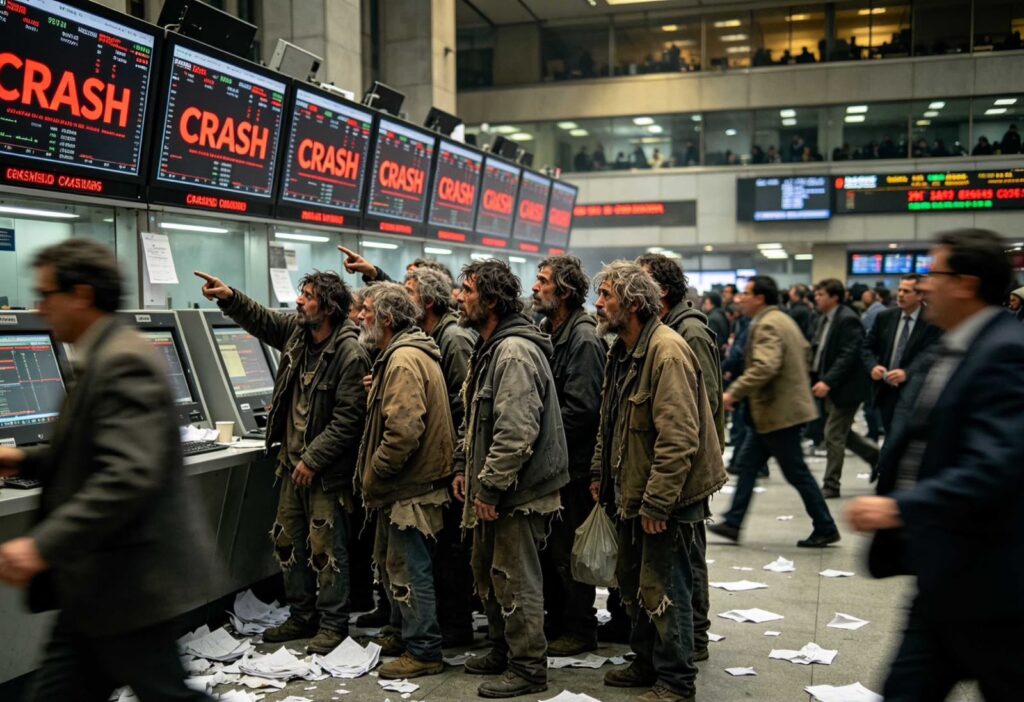
In the predawn hours of June 10, 2026, stock traders gathered before the opening bell at financial exchanges worldwide. By noon, the scene had transformed into one of organized chaos—a desperate scramble as billions in wealth evaporated in real time. The electronic boards that usually display incremental changes now flashed a single, brutal word: CRASH.
But while Wall Street witnessed the collapse of portfolios and pension funds, an entirely different catastrophe was unfolding in living rooms, apartment buildings, and shelters across the nation. The market’s implosion sent shockwaves far beyond the trading floor, triggering a cascade of consequences that would fundamentally alter the lives of millions of ordinary Americans with no stake in the stock market whatsoever.
Five distinct forces hit simultaneously on the June 2026 market: an earnings guidance miss that cracked a dominant narrative, a jobs report that pushed rate cuts further off the table, a liquidity drain from the largest IPO, geopolitical escalation driving oil prices above $93 USD per barrel, and semiconductor disappointments that shattered the narrative of AI market invincibility.
The Perfect Storm: Understanding What Went Wrong
The Accumulation of Pressure
The June 2026 market crash was not a sudden surprise but rather the inevitable consequence of mounting pressures that had been building for months. The economic landscape heading into summer 2026 was already fragile—a delicate structure vulnerable to collapse if the right—or rather, the wrong—combination of events occurred.
The U.S.-Iran war that began on February 28, 2026, sent oil prices surging 66% in just over a week, from $67 to over $111 per barrel. Iran’s closure of the Strait of Hormuz disrupted roughly 20% of global petroleum exports, triggering the fastest oil price spike in more than 40 years.
Simultaneously, tariff policies had pushed average rates from 2% to 12%, with Goldman Sachs estimating that consumers would absorb 67% of these costs, effectively creating a consumption tax during an already challenging period.
The Jobs Report That Shocked the Market
On Friday, June 5, the Bureau of Labor Statistics released May non-farm payroll data. The US economy added 172,000 jobs, nearly double what markets had expected. Unemployment held at 4.3%. For anyone waiting on a Federal Reserve interest rate cut, this was the opposite of good news, because when employment is strong, consumer spending tends to stay elevated, which keeps inflation pressure alive.
Markets responded by repricing their rate expectations sharply. The probability of a Fed rate hike by December 2026, as tracked by CME FedWatch, jumped to roughly 43%, up from near zero just a month earlier.
The AI Bubble Bursts
For months, the artificial intelligence narrative had carried the stock market higher. Promises of revolutionary technology, unlimited growth potential, and transformative future earnings kept valuations inflated despite warning signs. But in early June 2026, the “AI is invincible” illusion shattered. First, Broadcom’s refusal to raise its full-year AI semiconductor forecast broke the narrative. Additionally, IDC reported that 2026 global smartphone shipments are projected to drop 13% year-over-year to a 10-year low, deepening the memory chip crisis.
Meanwhile, Apple announced WWDC reveals for “Apple Intelligence” and the AI-upgraded Siri that failed to meet sky-high market expectations, as the VIX spiked to 21.51, well above its historical average of 16.
The Instant Aftermath: A Nation Watches in Horror
As stock prices plummeted, the human implications became immediately apparent to those paying attention. The large-cap stock index fell roughly 7% year to date, while the Dow Jones Industrial Average slipped about 8%, and the tech-heavy Nasdaq Composite fell more than 10%.
For the majority of Americans without significant stock holdings, the initial impact seemed distant. But it would not remain that way for long.
The Cascading Consequences: How a Market Crash Becomes a Human Crisis
The Employment Collapse
The relationship between market crashes and job losses is not coincidental—it is causal and swift. Financial panic triggers corporate cost-cutting, and the first target is always the workforce.
Technology accounted for the largest share of May job cut announcements, with artificial intelligence cited as the leading reason for cuts for the third consecutive month, as U.S.-based employers announced 97,006 job cuts in May, up 16% from April and the highest May total since 2020.
But this was merely a precursor. As the June crash unfolded, corporate layoff announcements proliferated with grim speed. Tech companies—having hired aggressively in the AI boom—suddenly faced the harsh reality of unfulfilled promises and cut their workforces ruthlessly.
The labor market shows deterioration. Unemployment has climbed while monthly job additions have slowed. Young workers faced particularly brutal conditions, with the unemployment rate for 16–24-year-olds having been above 10 percent and rising for six months, and the share of unemployed workers out of a job for six months or more tied with the pre-2009 record.
The Household Budget Squeeze
For families already struggling with affordability, the crash delivered a devastating one-two punch. Rising energy costs combined with job insecurity created what economists delicately describe as “household budget pressure”—a euphemism for families choosing between heating their homes and feeding their children.
When surging energy costs from the Iran conflict combined with high tariff rates, household budgets faced a double squeeze. Consumer spending, which had been the engine of economic growth, began to contract as uncertainty paralyzed purchasing decisions.
Grocery stores reported declining foot traffic. Restaurants struggled as discretionary spending evaporated. Small businesses dependent on consumer spending began posting job cuts. The recession, if not already present, was becoming inevitable.
The Housing Crisis Emerges
While experts debated whether a housing market crash would occur, the reality for individual families was more immediate: the inability to afford rent or mortgage payments as incomes disappeared and job prospects darkened.
If unemployment rose rapidly and homeowners couldn’t afford their mortgage payments, they could lose their homes to foreclosure if they couldn’t sell them. A large increase in foreclosures would bring home values down, potentially triggering a broader housing collapse.
This was not theoretical risk management—it was the lived experience of millions of families facing sudden unemployment or wage cuts in the weeks following the crash. For renters, the situation was even more precarious. Eviction notices began appearing with increasing frequency as landlords, facing their own cash flow crises, moved to remove tenants unable to pay.
The Inequality Amplifier: Why the Crash Hits the Poorest Hardest
The painful truth about financial crashes is that their consequences are profoundly unequal. The wealthy can weather volatility through diversified holdings and financial cushions. The poor have neither luxury.
Research has consistently demonstrated this brutal reality. Income inequality is a significant driver of homelessness at the local level, operating through both an “income channel”—by leading to the crowding out of low-income households from the rental market—and a “price channel” through which inequality leads to rising home prices. Broader policy efforts to reduce income inequality are likely to have the collateral effect of reducing homelessness.
The June 2026 crash operated through both channels simultaneously. Job losses concentrated in entry-level and service sector positions eliminated the precarious income that low-wage workers depended upon. Simultaneously, landlords and creditors—themselves facing financial stress—tightened lending and moved aggressively to collect debts or seize assets.
Historical Echoes: Lessons from the Great Depression and 2008
The June 2026 crash was not unprecedented. History provided grim parallels that few wanted to acknowledge.
Following the stock market crash of 1929, Congressional efforts to address homelessness halted. Consequent to the Great Depression of the 1930s, there was a significant increase in the number of persons experiencing homelessness in America and a greater need to address poverty and to improve the quality and affordability of housing.
The 2008 financial crisis provided a more recent—and therefore more relevant—case study. Karla Garcia became homeless after her father lost his job during the 2008 financial crisis. First, the family sold everything in the house. The jewelry. The couch. The mattress. At night, all her siblings crowded into one room to preserve heat. Eventually, homelessness itself became unavoidable.
The trajectory from job loss to homelessness typically moves quickly—30 to 90 days of missed payments before eviction proceedings begin, followed by a rapid descent into homelessness. June 2026’s crash, with its severity and breadth, suggested that millions might trace similar paths in the coming months.
The Visible and Invisible Costs
Mental Health Crisis
Beyond the concrete—the loss of housing, food insecurity, medical care becoming unaffordable—came the invisible but profound psychological toll.
Job loss triggers a cascade of documented health consequences: elevated rates of depression and anxiety, increased substance abuse, elevated suicide rates. During the 2008 crisis, researchers documented measurable increases in these outcomes corresponding with unemployment spikes. The June 2026 crash, with its magnitude and psychological shock, suggested a similar or worse outcome.
Parents who had maintained financial dignity suddenly faced the shame of food banks and welfare offices. Teenagers watched their parents’ confidence crumble alongside market valuations. Families fractured under financial stress. The human cost was not measured in basis points but in broken relationships and broken spirits.
Healthcare Access Collapses
For Americans dependent on employer-provided health insurance—the majority of the insured population—job loss meant immediate loss of coverage. In the years following 2008, researchers documented the human cost: delayed medical care, avoided medications, untreated chronic conditions, and preventable deaths.
The June 2026 crash, hitting the healthcare sector particularly hard as medical device companies and healthcare IT firms reduced headcount, suggested a repeat of this pattern. Ironically, precisely when economic stress increased healthcare needs, job losses eliminated healthcare access.
The Corporate Response: Austerity and Cruelty
In the immediate aftermath of the crash, corporate America’s response was predictable: aggressive cost-cutting. But the manner of execution—mass layoffs with minimal notice, elimination of benefits, acceleration of automation to reduce head count—revealed the harsh reality of modern corporate priorities.
Companies that had benefited from years of strong revenue under AI hype suddenly abandoned employees who had driven that growth. Startups that had promised transformative technology overnight became cautionary tales of capitalist excess, leaving thousands of workers searching for employment in a suddenly contracted market.
The cruelty was not intentional but structural—survival imperatives in a capitalist system that reserves dignity only for shareholders.
What It Looks Like on the Ground: Portraits of Collapse
The Software Engineer’s Fall
Meet Michael, 34, who worked at a mid-tier tech company in San Francisco. His compensation package—$350,000 including stock options—had made him feel wealthy for the first time in his life. He and his wife had purchased a house with a $450,000 mortgage. They were expecting their second child.
By mid-June, his company announced a 30% workforce reduction. Michael was not in the protected layers of management—he was an individual contributor. By Friday of that week, he was terminated with two weeks of severance.
Within 48 hours, the stock options that comprised half his compensation package had declined 40% in value. His wife, an equally well-compensated engineer at another tech company, received notice of her firm’s hiring freeze. Both incomes had evaporated.
By early July, with mortgage payments due and no new income, they consulted with a bankruptcy attorney. The house that represented their dreams was now a liability they could not afford.
The Restaurant Worker’s Crisis
Maria, 28, worked as a server at a mid-range restaurant in Austin. Her income—$20,000 in base wages plus approximately $15,000 in tips annually—kept her and her daughter in a modest one-bedroom apartment. The margins were tight, but she had achieved stability.
As the market crash triggered broader economic contraction, her restaurant’s customer count declined 35% in the week following the crash. The owner, facing his own cash flow crisis, reduced her hours from 40 per week to 25. Her income, already precarious, dropped from $2,900 monthly to approximately $1,800.
Rent was $1,400. Her daughter’s childcare, essential for her to work, was $800. Utilities, insurance, and food consumed the remainder. There was no margin for error, and error had arrived in the form of a market crash she did not cause and could not prevent.
By early July, she was behind on rent and facing eviction.
The Pensioner’s Loss
Robert, 68, had worked in manufacturing for 42 years. His pension, though modest at $2,100 monthly, had been intended to carry him through retirement. He had a small home with no mortgage. Healthcare was covered by Medicare.
The market crash struck his wife’s investment portfolio—her 401(k) that contained their intended legacy for their grandchildren. But worse was the economic contraction that followed. The manufacturing facility where Robert had worked for decades was located in a rust belt region entirely dependent on industrial jobs. As the broader economy contracted, the facility announced a permanent closure, moving production to Mexico.
Local unemployment in Robert’s county, which had been 4.2%, spiked to 6.8% within three weeks. Commercial real estate values plummeted. The value of Robert’s home, purchased for $180,000 in 2015, declined to approximately $140,000.
His pension remained stable—a genuine relief. But the broader community collapsed around him. The restaurant where he ate breakfast was shut down. The medical clinic reduced hours. The school his granddaughter attended was facing budget cuts. The human community that had provided meaning and connection fragmented.
The Policy Failure
As the human crisis unfolded, government response was fractured and inadequate. There were calls for intervention—stimulus measures, loan programs, unemployment expansion. But policy moved slowly while reality moved at market speed.
The Federal Reserve faced impossible choices: aggressive rate cuts would acknowledge the severity of the crisis but might reignite inflation; maintaining rates would preserve inflation credibility but allow depression to deepen. Either choice involved human suffering.
Congress debated relief packages that would prove insufficient by the time they passed, addressing yesterday’s crisis while tomorrow’s deepened. The political gridlock that had become endemic to American governance prevented the coordinated, rapid response that economic emergencies demanded.
Meanwhile, ordinary people could not wait for policy debates. They faced immediate eviction, immediate hunger, immediate healthcare needs.
The Long Shadow: Cascade Effects
Education Disruption
As families lost incomes, school districts faced dramatic funding changes. Property tax revenue—the funding mechanism for most American schools—contracted as real estate values plummeted. Simultaneously, more families requested free and reduced-price meals, stretching cafeteria budgets.
Teachers saw their pensions threatened. Schools delayed maintenance and repairs. Students in under-resourced districts—already disadvantaged—faced further deterioration in educational opportunity at precisely the moment they needed stability most.
Community Infrastructure Collapse
Non-profit organizations that provided essential services to vulnerable populations faced funding crises as donations declined and government funding contracted. Homeless shelters operated beyond capacity. Food banks struggled to meet demand. Mental health services became impossible to access.
In rural areas, the situation was particularly acute. Rural healthcare providers, already struggling with thin margins, faced patient base contraction as people moved or accessed care elsewhere. Rural schools faced similar pressures. The geographic unevenness of the crisis—hitting some regions with devastating severity while others recovered more quickly—created secondary migration patterns as people sought opportunity, fragmenting communities further.
Healthcare System Strain
Hospitals and healthcare systems, while not directly tied to stock valuations, nonetheless faced pressure through multiple channels: patient non-payment as unemployment rose, investment portfolio losses impacting financial stability, staffing challenges as healthcare workers themselves faced economic stress.
Emergency rooms, which had been functioning as de facto mental health services and primary care for the uninsured, saw increased utilization. Healthcare workers, facing patient volume increases and emotional toll increases, began burning out at elevated rates.
The Question Nobody Wanted to Ask
As the immediate shock of the crash faded into the chronic pain of recession, a question that had haunted American consciousness since the 2008 crisis re-emerged: Why do we accept this?
Why did financial markets—ultimately measuring the relative value of different pieces of paper and digital entries—have the power to determine whether millions of people could afford housing, food, and medical care?
Why did volatility in asset prices, divorced from any fundamental change in productive capacity or resources, trigger unemployment, homelessness, and human suffering?
The question was not rhetorical. It was existential and political.
Global Dimensions: The Crash Goes Worldwide
The June 2026 crash was not isolated to American markets. When global sentiment sours, the diversification benefit between different markets compresses, sometimes sharply. If you hold both US and Indian equities, you experienced correlation risk firsthand.
Emerging markets faced particular pressure as the strongest currency—the US dollar—appreciated sharply as investors sought safety. Companies in developing nations that had borrowed in dollars found their debt burden increasing in local currency terms precisely when their export demand contracted.
Supply chains, already stressed by the Iran-US conflict and energy shock, fractured further. Companies sourcing from emerging markets faced delivery delays and cost increases. Manufacturing facilities in developing nations, dependent on export orders from developed markets, announced layoffs.
The global interconnectedness that had been promoted as beneficial—allowing efficiency and economies of scale—revealed its shadow side: the transmission of crisis across borders at the speed of information.
Lessons from the Image: The Disconnect Between Screens and Suffering
The photograph that captured this moment—traders in worn, tattered clothing standing before screens displaying “CRASH” while the financial system around them imploded—was not merely powerful. It was revelatory.
The image captured the profound disconnect between financial markets and human reality. The screens flashed catastrophic information measured in basis points and portfolio percentages. But the human figures, literally and figuratively ragged, represented the lived experience of economic catastrophe that no chart could fully capture.
The crash was real. The suffering was real. The question of whether markets should have this much power over human lives remained unanswered—and increasingly urgent.
The Recovery Question: Who Benefits, Who is Left Behind
History provided grim precedent. After the 2008 crisis, recovery statistics showed robust GDP growth, unemployment eventually declining, market valuations rebounding. Yet for millions who experienced homelessness during the crisis, recovery was not restoration—it was a different life.
Once-housed people, even when employment returned, faced obstacles to housing: damaged credit, gaps in rental history, criminal records acquired during homelessness, trauma from the experience itself. They recovered into poverty, not prosperity.
The June 2026 crash suggested a repeat pattern. In the coming months and years, official statistics would show recovery. But millions would remain broken by the experience—their careers disrupted, their confidence shattered, their relationships fractured, their health damaged.
Conclusion: The Unavoidable Question
As the immediate shock of the June 2026 crash faded, a more profound question emerged: At what point do societies decide that this system—in which paper and digital entries can determine human welfare—requires fundamental change?
The suffering triggered by the crash was not inevitable. Resources existed. Housing stock existed. Food production existed. The problem was not scarcity but distribution, allocation, and the political economy that prioritized asset valuations over human dignity.
The image of traders before screens displaying “CRASH” will endure as a symbol of this disconnect. But symbols alone change nothing. Only political will—collective decisions that human welfare takes precedence over financial market efficiency—could create fundamental change.
Until that political moment arrives, markets will continue to crash. People will continue to suffer. The screens will continue to flash their cold messages of catastrophe. And society will continue to discover, again and again, that the prosperity captured by markets was always an incomplete measure of human thriving.
Sources and References
- Medium – “The June 2026 Market Crash Explained: Five Forces That Hit Your Portfolio at Once”
- Motley Fool – “Stock Market Crash in 2026? The S&P 500 Sounds an Alarm”
- Financer – “Will The Stock Market Crash in 2026? Risks & Outlook”
- PowerDrill AI – “Why the US Stock Market Suffered Its Worst Drop of 2026”
- U.S. Bank – “Job Market’s Effect on the Economy”
- Yahoo Finance – “Is the Housing Market Going to Crash in 2026?”
- Roosevelt Institute – “2026 Economic Preview”
- Boston University – “A Rising Tide Drowns Unstable Boats: How Inequality Creates Homelessness”
- NCBI – “The History of Homelessness in the United States”
- Department of Labor – “Job Cuts and Unemployment Data 2026”