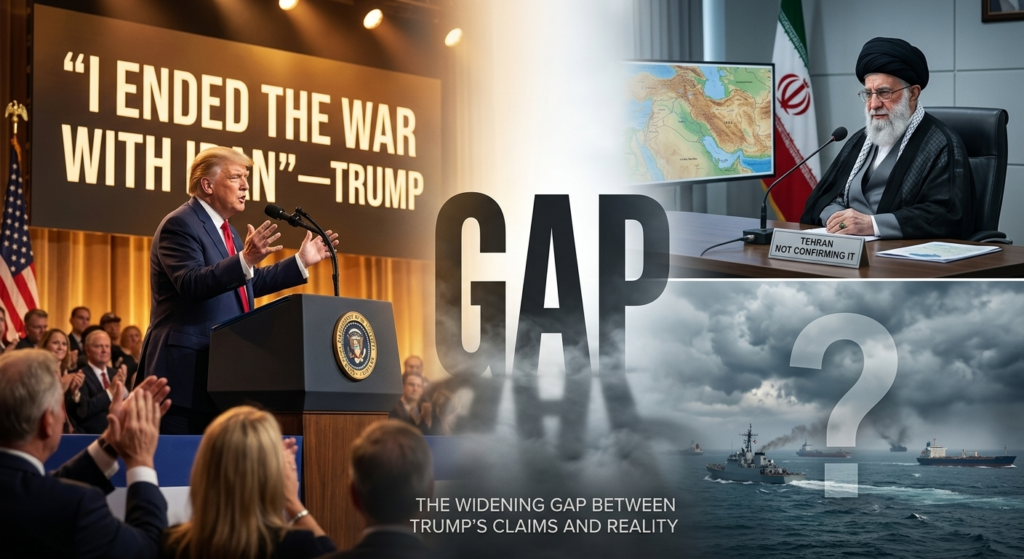
“I Ended the War with Iran”—But Tehran Isn’t Confirming It: The Widening Gap Between Trump’s Claims and Reality

As the US President Declares Victory, Iranian Officials Deny Any Final Deal Has Been Reached in the 100-Day Conflict
The Announcement That Wasn’t
On Thursday, June 11, 2026, a day that will likely be remembered as a turning point—or another false dawn—in the three-month-old US-Iran war, President Donald Trump made a stunning declaration. Speaking at a campaign rally supporting Georgia Lt. Governor Burt Jones, Trump proclaimed with characteristic confidence:
“I don’t know if you heard, but we ended the war with Iran today. They have agreed never to have a nuclear weapon, something that we insisted on; that was the whole purpose. That was 95 percent of it.”
The statement sent shockwaves through global markets. Oil prices, which had been hovering above $93 per barrel due to the conflict, trembled at the prospect of reduced geopolitical risk. Financial markets, already reeling from the June 2026 crash, momentarily rallied on hope that one of the war’s major economic headwinds might be resolving.
But by evening, a crucial detail emerged that would undermine the triumph Trump had declared: Iran had not confirmed any deal.
The Denial: What Actually Happened
Within hours of Trump’s announcement, the façade began to crack. A senior Iranian official linked with the talks told media outlets that Iran has not yet agreed to any memorandum of understanding or framework of a deal with the United States.
This was not a minor disagreement over details. This was a categorical denial from Tehran that a final agreement had been reached. While Trump had proclaimed victory and cancelled planned military strikes, the Iranian government was signaling that fundamental gaps remained unresolved.
The discrepancy raised an uncomfortable question that would haunt the coming days and weeks: Had Trump simply announced something that hadn’t actually happened?
The Pattern: Three Months of False Declarations
To understand the gravity of this June 11 moment requires examining the broader pattern of Trump’s statements about the war since it began on February 28, 2026. This was not the first time the President had declared the conflict over or imminent resolution.
March 24: “The War Has Been Won”
In March, President Donald Trump said the Iran war “has been won,” stating “They’re totally defeated” when asked whether he was hopeful a peace deal would be successful in ending the war in Iran.
The conflict did not end in March. Military operations continued, casualties accumulated, and the regional situation remained volatile.
March 31: “Two to Three Weeks”
Trump said on March 31 that the U.S. could end its military campaign against Iran within two to three weeks, telling reporters that the exit could take place “within two weeks, maybe two weeks, maybe three.” He added that Tehran does not have to make a deal with Washington to end the conflict—that the requirement was simply that Iran be “put into the stone ages,” without the ability to soon acquire a nuclear weapon.
Two weeks, then three weeks, then a month passed. The war continued.
April Through May: Repeated “Days Away” Claims
As the weeks turned into months, Trump’s rhetoric became increasingly repetitive. U.S. President Donald Trump repeated the claim that a deal to end the war in Iran could be reached in “two or three days,” and that the critical Strait of Hormuz would reopen “immediately” after such a deal.
Each iteration of “the deal is days away” proved false. May turned to June with the war still ongoing, missiles still flying, ships still unable to transit the Strait of Hormuz, and global economies still suffering the consequences.
The June 11 Escalation: From Claims to Cancellations
What made June 11 different was not merely another false claim about imminent peace. Trump had escalated his statements to the point of operational consequence.
Earlier Thursday, Trump and Defense Secretary Pete Hegseth had warned that the US would launch “bigger” and “more powerful” military strikes on Iran that evening. The President had posted warnings on social media and signaled through military channels that a major new offensive was coming.
Then, abruptly, Trump reversed course. President Donald Trump on Thursday withdrew threats to take Iran’s most critical oil terminal “in the not too distant future,” after fresh attacks on U.S. bases in the region.
Instead of following through with strikes, Trump announced on Truth Social that talks with Iran “have been brought to the highest level of Iranian leadership and approved,” implying that a breakthrough had been achieved.
Within hours, this too was contradicted.
The Reality on the Ground: Fighting Continues Despite Claims of Peace
Even as Trump declared the war over on June 11, the military reality told a different story. The previous 48 hours had seen intensified military exchanges between the US and Iran.
The United States launched new attacks against Iran on Thursday, prompting Tehran to retaliate, as U.S. leaders accused their counterparts of dragging out negotiations for a deal to end the three-month war. The Jordanian military said it had intercepted 20 Iranian missiles launched towards Azraq, where an American military base is located, on Thursday.
Pakistan, which had been actively mediating the conflict, made its own assessment of the situation. Pakistan’s foreign ministry said Thursday the country’s leaders were still engaged in mediation efforts to end the U.S.-Iran war despite a surge in conflict, calling for a “negotiated settlement”. “It is hard to be an optimist in the new exchange of hostilities. We haven’t lost hope, we remain engaged,” foreign ministry spokesman Tahir Andrabi told journalists.
Even as the Pakistani intermediary spoke, missiles were being fired and intercepted. The “surge in conflict” that Tahir Andrabi referenced made mockery of Trump’s peaceful declarations.
The Sticking Points: Why a Deal Remains Elusive
Despite months of negotiations, fundamental disagreements persist between the US and Iran on key issues. Understanding these disagreements helps explain why Trump’s announced “victory” was premature or false.
The Nuclear Question
Trump has consistently demanded that Iran agree to never acquire a nuclear weapon. According to Trump’s characterization, Iran has agreed “conceptually” to allow the US to secure nuclear materials and to stop pursuing a nuclear weapon.
However, Iranian officials have offered more cautious language. Iranian state news outlet Fars pushed back on Trump’s post, saying it “raised issues that contradict the provisions of the agreement’s text.”
This discrepancy—Trump saying Iran has agreed to something while Iran denies agreeing to it in the terms Trump describes—is a recurring pattern in these negotiations.
The Strait of Hormuz
The US demands that the Strait of Hormuz, currently effectively blocked by Iranian naval forces and proxy activities, be “immediately open” to unrestricted shipping traffic. The U.S. is demanding that Iran agree to never acquire a nuclear weapon and immediately open the strait. The Iranians are demanding an immediate end to hostilities on multiple fronts and for the U.S. to end its naval blockade of Iranian ports.
Opening the Strait is not simply a technical issue—it represents a surrender of Iran’s primary economic leverage. Iran is unlikely to agree to this without significant concessions in return.
The Blockade and Sanctions
While the US focuses on nuclear weapons and the Strait, Iran has centered its demands on ending the US naval blockade of its ports and relief from economic sanctions. These demands have not been addressed in the way Iran considers necessary.
The Conceptual vs. Final Agreement Gap
Tellingly, Trump described the alleged deal as “a little conceptual”—suggesting that even according to his own characterization, what has been agreed upon is preliminary and incomplete. Trump described the deal as “a very strong memorandum of understanding,” adding it was “a little conceptual, but it’s something that’s going to get done”.
Describing a peace deal to end a war as “conceptual” is a remarkable admission that no actual final agreement exists.
Trump’s Credibility Problem
The June 11 situation illuminates a deeper problem: Trump’s credibility on Iran negotiations is severely damaged, if not destroyed.
The President has repeatedly announced breakthroughs that did not materialize. He has declared wars won while fighting continued. He has promised resolution in days or weeks when months of conflict remained. Whether through overconfidence, wishful thinking, or intentional misrepresentation, Trump’s track record suggests that his declarations about the war should be treated with extreme skepticism.
For market participants, this creates a hazardous situation. Investors cannot rely on Trump’s statements as indicators of when the conflict might actually resolve. Each announcement of a deal must be treated as unverified until independently confirmed by Iranian officials—and even then, with caution.
Iran’s Negotiating Position: Why Tehran Resists Trump’s Framework
Understanding why Iran continues to resist Trump’s framework requires examining the power dynamics and incentives that have shaped this conflict.
The Death of Ayatollah Ali Khamenei and Succession
The dynamics of Iranian politics changed dramatically early in this war. The previous Supreme Leader, Ayatollah Ali Khamenei, was killed in the opening days of the conflict. His son, Mojtaba Khamenei, assumed the role of Supreme Leader—an unusual succession and one that created new uncertainties in Iranian decision-making.
Khamenei was named the supreme leader in Iran after his father, Ayatollah Ali Khamenei, was killed on the first day of fighting. Trump said that despite U.S.-Israeli strikes killing his father and other members of his family, he expects that Khamenei would be a “professional.”
Trump’s assumption that a man whose father and family members were killed by US and Israeli strikes would behave as a “professional” negotiator reveals a troubling lack of empathy and understanding of human psychology. Ayatollah Mojtaba Khamenei has no incentive to reward Trump’s military aggression with favorable terms.
Historical Precedent: Why Iran Distrusts American Promises
Iran’s reluctance to commit to final agreements with the Trump administration reflects historical experience. Trump himself withdrew from the Iran nuclear deal (JCPOA) in 2018 after his predecessor had painstakingly negotiated it. The U.S. president said he would meet the Iranian leader if a deal is reached to end the U.S.-Iran war, which has dragged on into its fourth month.
For Iranian negotiators, the lesson is clear: agreements with the Trump administration are not reliably binding. The President who withdrew from the previous nuclear deal and initiated this war is now promising a new deal. Why should Iran trust these promises when the same man has already demonstrated willingness to abandon previous agreements?
Strategic Leverage: Why Iran Maintains the Blockade
The Strait of Hormuz remains closed or severely restricted—the one significant leverage point Iran possesses in these negotiations. Opening it would eliminate Iran’s primary economic weapon at precisely the moment when it needs maximum leverage.
For Iran to agree to open the Strait, it would need assurances worth the sacrifice. Thus far, Trump’s framework has not provided those assurances.
The Economic Fallout: Why the War’s Continuation Matters Globally
The disagreement between Trump’s declared deal and Iran’s refusal to confirm it matters far beyond the Middle East. The global economic consequences of a continuing war are severe and measurable.
The ongoing Iran war is projected to slow global economic growth to its weakest pace since the Covid-19 pandemic and renewed hostilities could cause it to slump further, according to a report released by the World Bank on Thursday. Global economic growth is forecast at 2.5% this year, down from 2.9% in 2025. “A renewed escalation of hostilities or more prolonged disruptions to commodity flows could further raise commodity prices, intensify inflationary pressures and food insecurity, trigger financial stress, and lower growth. If energy supply disruptions prove more severe than assumed and are accompanied by substantial financial stress, global growth could fall to just 1.3% in 2026,” the World Bank added.
The difference between 2.5% growth and 1.3% growth represents the economic cost of renewed war—a cost borne by millions of people in developing nations dependent on energy imports, by consumers everywhere facing elevated commodity prices, and by investors facing financial stress.
Oil, gas and fertilizer prices have spiked as shipping through the Strait of Hormuz remains effectively blocked.
The continuation of this blockade—which would certainly continue if Iran rejects whatever “deal” Trump has announced—ensures that these elevated commodity prices persist, that inflation remains pressurized, and that global growth remains depressed.
The Media and Information Environment: How False Claims Propagate
One of the more troubling dimensions of the June 11 situation is how readily media outlets initially reported Trump’s claims without adequate skepticism.
The sequence was typically: Trump announces deal → financial markets initially respond positively → hours later, Iran denies → markets adjust downward → the story becomes “Trump announces deal, Iran denies.”
But this framing obscures an important reality: Trump had announced something that was not true, or at minimum was not confirmed. The initial market reaction was based on misinformation.
This pattern has repeated throughout the conflict. Trump makes an announcement. Markets react. Hours or days later, the announcement proves false or premature. But by then, the damage is done—traders have repositioned, volatility has spiked, and confidence in information sources has eroded further.
Pakistan’s Mediation Efforts: The Quiet Diplomat
Amid the noise of Trump’s claims and Iranian denials, Pakistan has maintained a lower-profile mediation effort. Pakistan’s foreign ministry said Thursday the country’s leaders were still engaged in mediation efforts to end the U.S.-Iran war despite a surge in conflict, calling for a “negotiated settlement”.
Pakistan’s approach—continuing engagement despite setbacks, calling for “negotiated settlement” rather than declaring victory—represents a more grounded and realistic approach to conflict resolution.
For a deal to actually be reached, it likely will not come through Trump’s dramatic announcements but through the patient, unglamorous work of mediators like Pakistan who understand that real agreements require genuine consensus, not declarations made at political rallies.
The Military-Industrial Dimension: Who Benefits from Continued Conflict?
Another factor worth examining is who benefits from the war’s continuation. While most of humanity suffers economic harm from the conflict, certain actors benefit significantly.
Defense contractors receive lucrative contracts for replacement weapons systems. Military leaders see budgets increase and relevance maintained. Political figures use the conflict to rally supporters and distract from domestic failures (as Trump appears to be doing at campaign rallies).
These structural incentives toward continued conflict create headwinds against genuine peace efforts. When powerful interests profit from war, peace becomes more difficult to achieve.
Looking Forward: What Actually Needs to Happen
For a real end to the war—not Trump’s announced end, but an actual cessation of hostilities—several conditions must be met:
1. Good-Faith Negotiation
The US must negotiate honestly, not through Trump’s characteristic bluffing and exaggeration. This requires acknowledging Iran’s legitimate concerns and security interests, not simply demanding capitulation.
2. Verifiable Agreements
Any agreement must include verification mechanisms that both sides trust. Historical experience shows that vague agreements inevitably generate disputes. A real deal requires specificity.
3. International Mediation
Pakistan, Turkey, and other regional powers should play expanded roles in mediation. Their credibility with both sides makes them valuable intermediaries in ways that US negotiators cannot be while simultaneously conducting military operations.
4. Addressing Root Causes
This war did not emerge from nowhere. It reflects decades of US-Iran antagonism, regional power struggles, and nuclear proliferation concerns. Any durable peace must address these underlying issues, not simply impose a temporary ceasefire.
5. Economic Incentives
Both sides need economic incentives to make peace more attractive than continuing conflict. Sanctions relief, trade normalization, and access to markets could provide these incentives—but only if the US is willing to offer them.
The Broader Context: Why Americans Should Care About This
From an American perspective, the failure to achieve genuine peace in the Iran conflict has multiple consequences:
Military Costs: Every day of conflict risks American lives and costs millions in military expenditures.
Economic Costs: The elevated oil prices resulting from the war increase costs for American consumers and reduce economic growth.
International Credibility: Trump’s repeated false claims about progress toward peace damage American credibility. Future negotiating partners will be skeptical of American claims.
Political Division: The war is becoming a point of political contention, with some questioning why the US initiated the conflict and whether the military strategy is sound.
Distraction from Domestic Issues: The conflict diverts attention and resources from domestic priorities—infrastructure, education, healthcare—that could be addressed if military spending were reduced.
Conclusion: The Gap Between Claim and Reality
The events of June 11, 2026, illustrate a fundamental problem with the Trump administration’s approach to the Iran conflict: a persistent gap between rhetoric and reality.
Trump declares the war over. Iran says it isn’t.
Trump announces a “very strong memorandum of understanding.” Iran says it’s “a little conceptual”—translator’s note: not finalized.
Trump claims Iran’s Supreme Leader has approved the deal. Iran’s officials say no such approval has been given.
This gap between Trump’s claims and actual reality has consequences. Markets swing on false information. Strategic planners cannot rely on stated commitments. Investors face impossible uncertainty.
The war that Trump declared won in March continues. The conflict that he said would be over “in two or three days” in May still rages in June. The war that he announced had “ended” on June 11 was still killing people by evening.
Until Trump’s announced peace becomes a reality confirmed by both the US and Iranian governments, it remains—like so much else from this administration—a claim disconnected from verifiable fact.
For the global economy, for regional stability, and for the millions of people affected by this conflict, the hope is that the patient, unglamorous work of actual negotiators will eventually succeed where Trump’s dramatic announcements have consistently failed.
But hope is not a strategy. And claims are not agreements.
Sources and References
- CNN Live Updates – “Trump says US ‘ended the war with Iran,’ though Tehran has yet to confirm a deal”
- Reuters – “Trump says he believes Iran’s supreme leader has approved deal with US”
- CBS News – “U.S. and Iran trade attacks again after Trump pledges Tehran will ‘pay the price’ for not accepting deal”
- CNBC – “Trump repeats claims that Iran deal is only ‘days’ away, despite recent strikes”
- Washington Post – “Trump says he has canceled plans to strike Iran, claiming deal is near”
- MS NOW Live Blog – “Citing new talks, Trump says he has canceled strikes on Iran tonight”
- CNBC – “Trump ends Iran meeting without announcing ‘final determination’ on deal”
- Reuters – “Trump says U.S. could end Iran war in two to three weeks”
- Euronews – “Iran Trump says Iran war could end in ‘two weeks’, with or without deal”
- The Hill – “Trump says Iranian supreme leader approved deal”
- World Bank Report on Global Economic Growth June 2026