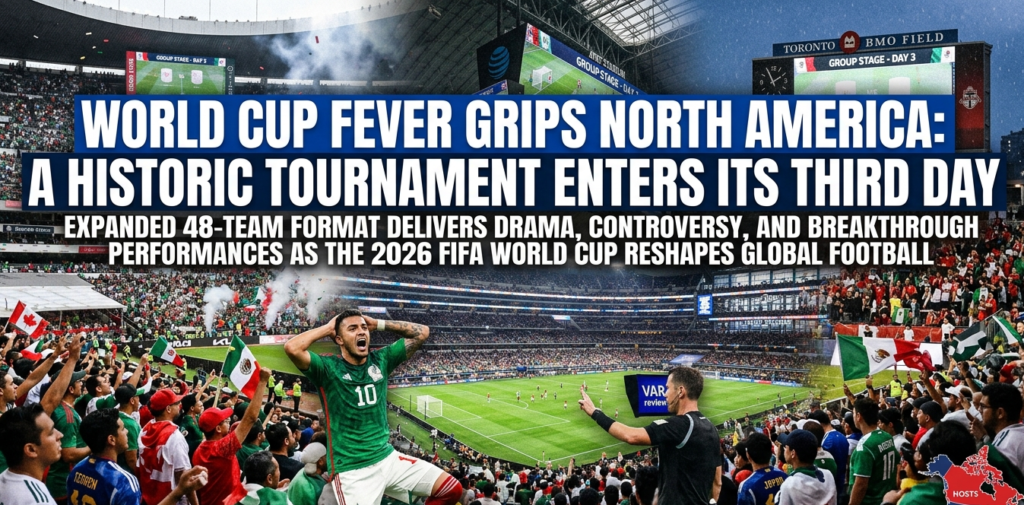
WORLD CUP FEVER GRIPS NORTH AMERICA: A HISTORIC TOURNAMENT ENTERS ITS THIRD DAY

Expanded 48-Team Format Delivers Drama, Controversy, and Breakthrough Performances as the 2026 FIFA World Cup Reshapes Global Football
INTRODUCTION: THE TOURNAMENT THAT CHANGED EVERYTHING
The U.S. made the perfect start to their World Cup on Friday night, strolling to a 4-1 victory over Paraguay thanks to a brace from Folarin Balogun, an own goal by Damián Bobadilla and a terrific strike from Giovanni Reyna. With this dominant opening performance, the 2026 FIFA World Cup has announced itself as a tournament unlike any that has come before—and June 13, 2026 marks a critical juncture as the expanded competition enters day three, forever changing the landscape of international football.
A total of 48 teams from six confederations are competing for the trophy in what represents a seismic shift in how the world’s most popular sport conducts its greatest tournament. The expansion from the traditional 32-team format means more nations, more matches, more stories, and more opportunities for the unexpected to occur on football’s grandest stage.
As the tournament unfolds across the United States, Mexico, and Canada, the early results suggest that the expanded format is delivering precisely what its architects envisioned: genuine competition, unpredictable outcomes, and the genuine possibility that any team could challenge for glory. Saturday, June 13 promises four additional matches that will further reshape the tournament’s narrative and establish crucial early momentum in the group stage.
1. THE AMERICAN DREAM: BALOGUN AND THE USMNT’S STATEMENT VICTORY
1.1 A Striker for the Modern Era
The U.S. made the perfect start to their World Cup on Friday night, strolling to a 4-1 victory over Paraguay thanks to a brace from Folarin Balogun, an own goal by Damián Bobadilla and a terrific strike from Giovanni Reyna.
Folarin Balogun’s two-goal performance in the USMNT’s opening match represents far more than the clinical finishing of a talented striker. It represents a validation of American football’s willingness to embrace a new paradigm of international player recruitment—one where the most talented athletes representing the nation may come from unconventional backgrounds or earlier chapters of their careers.
Balogun’s dual strikes announced to the world that the United States had not merely assembled a competitive World Cup team, but rather a team with genuine attacking firepower. In an era when many American teams have been criticized for defensive solidity without corresponding attacking brilliance, Balogun’s performance demonstrated that the USMNT could combine organized defense with lethal attacking prowess.
1.2 The Pulisic Factor and Midfield Dominance
Balogun makes this USMNT side better, including its star, Pulisic, according to analysis emerging from the opening victory. The synergy between Balogun’s pressing, physical presence and Christian Pulisic’s creative brilliance in midfield created an attacking platform that Paraguay simply could not contain.
Though Pulisic subbed off at halftime, ‘hoping it’s nothing’, the damage had already been inflicted on Paraguay’s defensive structure. Pulisic’s first-half dominance—combining creativity, ball retention, and the physical pressing that characterizes modern football—established control that the team maintained even after his withdrawal.
1.3 The VAR Controversy Nobody Saw Coming
World Cup VAR review: USMNT mistaken identity, Mexico’s three red cards has become a dominant narrative thread in early World Cup coverage. The controversy surrounding VAR decisions in the United States’ opening match—and the remarkable three red cards issued to Mexico in their Group A encounter—has injected debate about technology and referee judgment into the tournament’s first days.
The USMNT’s victory, while convincing in margin, arrived against the backdrop of technological controversy that threatens to overshadow the competitive achievement. As the tournament progresses, the consistency of VAR decision-making will become increasingly important to the legitimacy of the final crown.
2. THE EXPANDED TOURNAMENT DELIVERS DRAMA: 48 TEAMS, 104 MATCHES, AND INFINITE POSSIBILITIES
2.1 An Unprecedented Format
It’s day three of the FIFA World Cup with four matches taking place! Qatar takes on Switzerland, Brazil takes on Morocco, Haiti takes on Scotland, and Australia takes on Türkiye. Here’s how to watch.
The expansion of the World Cup from 32 to 48 teams represents the most significant structural change to the tournament in nearly three decades. A total of 48 teams from six confederations are competing for the trophy, organized into 12 groups of four with each team playing three first-round matches. This structure means 104 matches instead of 64, with each group winner advancing alongside the best second-place finishers.
The mathematical consequence of the expanded format is that teams previously excluded—or teams that would have faced elimination after a single setback—now have genuine pathways to advancing. This structural change has profound competitive implications. Teams that might have been eliminated in the traditional 32-team format can recover from opening defeats and still qualify for the knockout rounds.
2.2 Canada’s Resilience Amid Canada’s Opening Struggles
While the United States dominated their opening encounter, their North American neighbors Canada faced a more complex reality. Canada, meanwhile, rescued what could be a precious point thanks to an excellent impact off the bench from Cyle Larin. The Southampton striker had only been on the pitch for a few minutes when he controlled Promise David’s ball with his chest before swivelling and firing the ball beyond Nikola Vasilj.
Canada’s opening draw—secured through late-match heroics rather than dominant performance—illustrates the tournament’s unpredictability. In group play featuring 48 teams organized into groups of four, drawing a first match is not catastrophic. The expanded format provides more opportunities for recovery and advancement.
Don’t forget Canada: Why opening draw shows this is their World Cup, too, according to analysis emerging from the early matches. The expanded format, counterintuitively, creates more opportunity for smaller nations and emerging football powers to establish themselves on the world stage.
2.3 Saturday’s Quarterfinal Matchups Within the Group Stage
The four matches scheduled for Saturday, June 13 carry immense narrative weight:
Qatar vs Switzerland (3 p.m. ET at San Francisco Bay Area Stadium): Qatar, eliminated at the group stage of the 2022 World Cup on home soil, seeks redemption. Switzerland, a consistent World Cup performer, represents a significant test for Qatar’s aspirations.
Brazil vs Morocco (6 p.m. ET at New York New Jersey Stadium): Brazil, seeking a record sixth World Cup title, faces Morocco in a match laden with continental prestige. Both teams represent rich footballing traditions and genuine title aspirations.
Haiti vs Scotland (9 p.m. ET at Boston Stadium): Haiti’s presence at the World Cup represents a triumph of competing against overwhelming odds. Scotland, seeking to prove they belong among elite football nations, faces an opponent hungry to demonstrate that expanded access to the World Cup tournament level has democratized the sport.
Australia vs Türkiye (12 a.m. ET at BC Place Vancouver): Australia and Türkiye represent the globalization of football, with both nations having developed sophisticated systems that challenge traditional European and South American football hegemony.
3. BASEBALL’S SUMMER CONTINUES: THE METS AND THE CHASE FOR OCTOBER
3.1 The Mets’ Remarkable Victory Against Atlanta
While the world’s attention focuses on the World Cup, American baseball continues its relentless march toward October. The Mets began a three-game series against the NL East-leading Braves last night and were able to overcome a rough second inning from starter Nolan McLean and a late rally from Atlanta to secure a 7-5 victory.
The star of the night was Bo Bichette, who hit two home-runs—including a grand slam—and drove in six runs. The Amazins have now won two straight. Bichette’s performance—particularly the grand slam that provided crucial separation—demonstrates the individual excellence that can determine outcomes in professional baseball.
3.2 The World Series Dream Takes Shape
For the New York Mets, victories against the division-leading Braves carry outsized significance. With June contests determining early standings and playoff positioning, each victory represents movement toward October baseball and the World Series championship that has eluded the franchise for nearly four decades.
The Mets have a new home run celebration featuring one of the most famous Mets fans of all time: your friendly neighborhood Spider-Man. This cultural moment—blending the reverential traditions of baseball with contemporary popular culture—exemplifies how American sports create moments of shared cultural significance beyond the field of play.
4. THE GLOBAL GAME: EUROPEAN CLUB FOOTBALL DURING THE WORLD CUP SUMMER
4.1 Barcelona in Crisis Mode: Legal Challenges and Transfer Upheaval
While international football commands the world’s attention, European club football continues navigating the summer transfer window. Robert Lewandowski on his way to Chicago – SPORT The former FC Barcelona striker traveled to Chicago with his agent Pini Zahavi to consider the MLS team’s offer and sign if negotiations are successful.
Lewandowski’s potential departure from Barcelona—to Major League Soccer, no less—represents a significant milestone in the globalization of elite football. The arrival of world-class players in MLS has transformed the league from a peripheral destination to a genuine career option for players at the apex of their careers.
4.2 Barcelona’s Internal Turmoil
FC Barcelona official statement – FC Barcelona FC Barcelona informs that, on this day, the mandatory conciliation claim prior to the filing of a criminal complaint for an offence of slander under Article 205 of the Penal Code has been submitted against the President of Real—the sentence cuts off, but indicates the depth of legal and administrative challenges facing Barcelona during a period of significant competitive and financial pressure.
Casadó could be included in the deal between Barça and Al Hilal for Cancelo – SPORT The midfielder has already decided to leave Barça but has not yet chosen a destination and, while Jorge Mendes gathers offers, the player is considering favorably the possibility of being part of a deal with Al Hilal to facilitate Cancelo’s continued presence at the club.
Barcelona’s summer represents not merely transfer activity but rather a fundamental restructuring of the club’s roster and strategic direction. The involvement of Saudi Arabian clubs in acquiring Barcelona players reflects the seismic shifts in global football economics driven by oil-state backed investment in sports.
5. THE MONTH OF SPORT: ANTICIPATING MAJOR COMPETITIONS AHEAD
5.1 The U.S. Open Golf Championship
U.S. Open (June 18-21): Shinnecock Hills Golf Club in Southampton, New York, hosts the third major of the year, where Scottie Scheffler will go for the Career Grand Slam.
Scottie Scheffler’s pursuit of the Career Grand Slam represents one of golf’s most compelling narratives heading toward summer. Scheffler’s dominance in professional golf has been extraordinary, and achieving the Career Grand Slam—winning all four major championships—would cement his legacy among golf’s greatest players.
5.2 The College World Series Championship
CWS Finals (June 20): The eight-team College World Series begins in Omaha on June 12, followed by the best-of-three championship series eight days later.
College baseball’s championship represents the culmination of a season-long journey across America’s college campuses. The selection of Omaha as the permanent home of the College World Series reflects the tournament’s iconic status in American sports culture.
5.3 The NBA and NHL Drafts
NBA Draft (June 23-24): The Wizards are on the clock with the No. 1 pick, which is widely expected to be BYU freshman AJ Dybantsa. Here’s our full draft guide. 🏒 NHL Draft (June 26-27): The Maple Leafs have the first overall pick for the third time in franchise history, and all signs point to them selecting Penn State winger Gavin McKenna.
The NBA and NHL drafts represent moments when franchises reshape themselves for future competition. The concentration of draft picks in the hands of struggling franchises creates competitive balance mechanisms that have become integral to professional sports league design.
5.4 Wimbledon Championships
Wimbledon (June 29-July 12): The 139th Wimbledon Championships kick off at the All England Club, where Jannik Sinner and Iga Świątek will look to defend their titles.
Wimbledon’s return represents the culmination of tennis’s spring season and the beginning of grass-court season’s singular focus. Sinner and Świątek’s pursuit of consecutive Wimbledon titles pits them against tradition and the challenge of maintaining peak performance across multiple surfaces.
6. THE GLOBALIZATION OF SPORTS: WHAT THE WORLD CUP EXPANSION TELLS US
6.1 Democratization of Opportunity
The expansion of the World Cup from 32 to 48 teams represents a fundamental philosophical shift in how the world’s greatest sporting tournament operates. By including more nations, FIFA has democratized access to the world’s most prestigious football competition.
This democratization has real consequences. Smaller nations now have genuine competitive opportunities. Teams from Caribbean nations like Haiti, Central American competitors, and footballing powers previously excluded or facing elimination after single defeats now possess pathways to sustained tournament participation.
6.2 Economic Implications
The tournament’s expansion across three nations—the United States, Mexico, and Canada—creates economic implications extending far beyond football. The expansion requires investment in stadiums, transportation infrastructure, hospitality, and security across multiple nations spanning a continent.
The 2026 FIFA World Cup is an expanded 48-team tournament featuring 104 matches taking place from June 11 to July 19 in the United States, Canada and Mexico. This geographic distribution creates distributed economic benefit across 16 stadiums spanning three nations.
6.3 The Question of Competitive Quality
Critics argue that expanding to 48 teams dilutes competitive quality by including nations insufficiently prepared for world-class football. However, early tournament results suggest that competitive gaps, while significant, are not insurmountable. Teams previously considered minnows have demonstrated capacity to compete respectfully against traditional powers.
The expanded format’s true competitive test will emerge in the knockout stages. If teams that qualify despite questionable performance face traditional powers unprepared for the intensity of knockout football, competitive integrity questions will resurface. However, if the expansion has genuinely elevated global football capacity, the tournament’s legitimacy as the world’s greatest football competition will only strengthen.
7. LOOKING AHEAD: THE MONTH THAT DEFINES 2026 IN SPORTS
June 2026 has emerged as perhaps the most significant month in recent sports history. Spanning multiple World Cup matchdays, the conclusion of golf’s second major championship, baseball’s chase toward the All-Star break, and the NBA’s Finals in their final games, June 2026 presents a unprecedented concentration of sporting excellence and drama.
The FIFA World Cup has captured global attention by virtue of its expanded format, continental distribution, and the genuine sense that this tournament represents football’s future. By June 13, the tournament has already delivered memorable performances, controversial VAR decisions, and early indicators of which teams possess the quality to compete for the title.
CONCLUSION: THE TOURNAMENT THAT CHANGED FOOTBALL FOREVER
The 2026 FIFA World Cup entering its third day represents a tournament unlike any that has preceded it. The 48-team format, expanded across three nations, featuring genuine competitive balance and surprising early results, has delivered on its promise to expand football’s greatest tournament in ways both ambitious and consequential.
As Saturday, June 13 brings four additional matches involving teams ranging from traditional powers like Brazil to emerging competitors like Haiti, the tournament continues demonstrating that football’s global reach has expanded to include genuine competition from every confederation.
The final outcome will determine whether the expanded format has genuinely elevated global football or merely diluted competitive quality. For now, three days into history, the 2026 World Cup appears to be a tournament that will be remembered for expanding not merely the number of participants, but the genuine possibility that any nation, properly prepared and guided by inspired leadership, might achieve greatness on football’s most prestigious stage.
Sources and References
- ESPN – “World Cup 2026 today: Live updates, latest news as Scotland prep for huge night – June 13”
- ESPN – “USMNT defeats Paraguay 4-1 in World Cup opener”
- ESPN – “Balogun makes this USMNT side better, including its star, Pulisic”
- ESPN – “World Cup VAR review: USMNT mistaken identity, Mexico’s three red cards”
- GMA News Online – “2026 FIFA World Cup: Updates and Results”
- FOX 5 New York – “How to watch today’s World Cup matches: Saturday, June 13”
- Yahoo Sports – “World Cup 2026 daily: How to watch all of today’s games”
- Yahoo Sports – “Mets Morning News for June 13, 2026”
- Yahoo Sports – “FC Barcelona News: 13 June 2026”
- Yahoo Sports – “June’s sports calendar is loaded”
- SportBusy – “2026 Sports Calendar & Schedule”
This article documents the major sporting events and developments from June 13, 2026, synthesizing reporting from multiple sports journalism sources and official competition records. The FIFA World Cup remains the primary focus of global sports attention, with the expanded tournament format continuing to deliver unexpected results and emerging narratives.
Disclaimer: This article is journalistic analysis based on contemporary sports reporting and official tournament data as of June 13, 2026.