SPACEX MAKES HISTORY: RECORD-BREAKING $75 BILLION IPO TRANSFORMS ELON MUSK INTO WORLD’S FIRST TRILLIONAIRE

Musk’s Aerospace and AI Conglomerate Shatters IPO Record, Soars 19% on First Day of Trading as Stock Market Embraces the Rocket Company’s Multiplanetary Ambitions
INTRODUCTION: THE IPO THAT BROKE ALL RECORDS
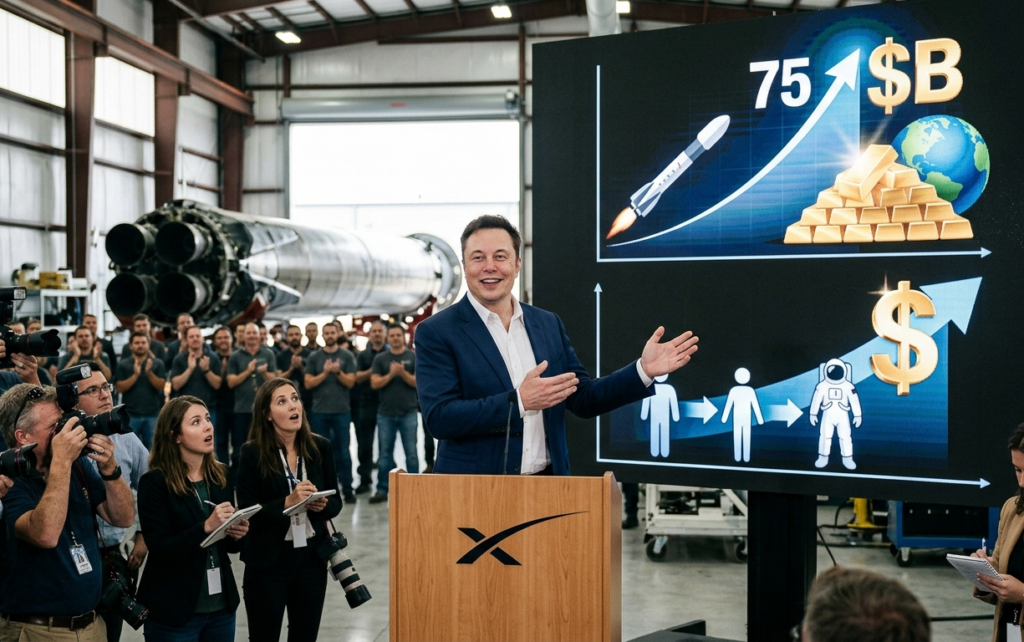
Elon Musk’s SpaceX made history on June 12, 2026, completing the largest initial public offering ever recorded at a staggering $75 billion raise and $1.75 trillion valuation. The rocket manufacturer’s stock surged 19% on its first day of trading, closing at $161 and briefly pushing the company’s market capitalization past $2 trillion—a achievement that transforms the CEO into the world’s first trillionaire and signals unprecedented investor appetite for frontier technology at extraordinary scale.
The historic IPO represents far more than a financial milestone. It marks the culmination of a fundamental transformation in how capital markets value advanced technology companies, how investors perceive space exploration, and how a single entrepreneur has consolidated control over multiple cutting-edge industries. SpaceX’s transition from private company to public corporation opens a new chapter in both corporate finance and humanity’s relationship with space.
1. THE HISTORIC IPO: BY THE NUMBERS
1.1 A Record-Breaking Offering
SpaceX priced its 555.6 million shares at $135 each, the company said in an update on its website. That makes SpaceX officially the largest IPO in history, easily eclipsing the $24.9 billion in funds raised by Saudi Aramco during its 2019 public markets debut.
The comparison underscores the magnitude of SpaceX’s achievement. Saudi Aramco’s 2019 IPO, which held the previous record for largest IPO ever, raised $24.9 billion. SpaceX’s $75 billion offering more than triples that figure, representing a quantum leap in the scale of capital mobilization through public markets.
The sheer numbers illustrate the transformation of global capital markets. In 2019, the largest IPO in history represented the most capital ever deployed to a single company’s public debut. Seven years later, that record falls to a company most investors have never directly engaged with—a space transportation and AI conglomerate whose operations occur largely beyond public view.
1.2 Valuation and Market Capitalization
SpaceX is targeting a valuation of $1.75 trillion in its IPO, based on a proposed price of $135 per share. If achieved, this would make SpaceX one of the most valuable companies ever to go public.
At the IPO pricing, SpaceX’s $1.75 trillion valuation placed the company among the world’s most valuable corporations—in the company of Apple, Microsoft, Alphabet, Amazon, Saudi Aramco, and Nvidia. Only a handful of human enterprises have ever commanded valuations exceeding $1.75 trillion.
Yet the IPO pricing proved to be merely the opening chapter in SpaceX’s value trajectory. On the first day, SPCX stock surged 19% to close at $161, pushing the company’s market capitalization past $2 trillion—a stunning gain in a single trading day that reflects extraordinary investor enthusiasm for the company and its perceived prospects.
1.3 First-Day Trading Performance
SpaceX stock gains 19% on first day of trading. The initial public offering from the rocket and AI company raised some $75 billion, making the company one of the biggest in the world — and likely making Elon Musk a trillionaire.
A 19% first-day gain represents extraordin exceptional investor enthusiasm. For context, most IPOs experience first-day gains ranging from 2% to 10%, with particularly hot IPOs reaching 15%. SpaceX’s 19% surge signals that demand for the stock substantially exceeded available supply at the IPO pricing—a classic indicator of pricing that proved conservative relative to true market demand.
2. ELON MUSK’S HISTORIC ASCENT: THE WORLD’S FIRST TRILLIONAIRE
2.1 From Billionaire to Trillionaire
At this price, the deal also looks set to make Musk the world’s first trillionaire.
The phrase “world’s first trillionaire” entered financial and popular discourse through SpaceX’s IPO. Musk’s net worth, calculated largely through valuations of his companies (Tesla, SpaceX, xAI, The Boring Company), has escalated to unprecedented levels. The crossing of the trillion-dollar threshold represents a psychological and financial milestone unprecedented in human history.
To contextualize the magnitude: a trillion dollars exceeds the GDP of all but the largest nations. A single individual’s net worth exceeding a trillion dollars represents unprecedented concentration of wealth—a figure that dwarfs the fortunes of historical billionaires and raises profound questions about wealth inequality, capitalist systems, and the appropriate distribution of resources in advanced economies.
1.2 The Consolidation of Musk’s Multiverse
SpaceX’s IPO represents Musk’s consolidation of control over a multiverse of cutting-edge companies:
- SpaceX: Rocket manufacturing, space transportation, satellite internet (Starlink)
- Tesla: Electric vehicles, energy storage, renewable energy manufacturing
- xAI: Artificial intelligence, large language models, AI infrastructure
- The Boring Company: Underground transportation infrastructure
- Neuralink: Brain-computer interfaces
No individual in history has simultaneously controlled companies at the cutting edge of such diverse, strategically important domains. The combination of space transportation, electric vehicles, artificial intelligence, underground infrastructure, and neural technology creates a business empire spanning the physical and digital domains and reaching toward future domains (space, neural enhancement) that most corporations do not yet contest.
3. THE IPO PROCESS: FROM CONFIDENTIAL FILING TO PUBLIC MARKETS
3.1 The Accelerated Timeline
SpaceX’s roadshow launched on 4 June 2026 – ahead of the previously reported week-of-8-June estimate – driven by an accelerated timeline following a quicker-than-expected SEC review.
The acceleration of the IPO timeline reflects multiple factors: SEC efficiency in reviewing the massive disclosure documents required for a $75 billion IPO, investor demand so overwhelming that a rapid path to market became optimal, and Musk’s characteristic impatience with bureaucratic timelines.
The compressed timeline from SEC filing to IPO pricing demonstrates how capital markets prioritize companies with extraordinary investor demand. Normally, the road from confidential filing to public trading would consume many months. SpaceX accomplished the journey in weeks—an acceleration that would be impossible for most companies but reflects the extraordinary demand for SpaceX shares.
3.2 The Roadshow and Analyst Coverage
Approximately 125 analysts from 21 participating banks are expected to meet SpaceX management, and a dedicated event for around 1,500 retail investors is planned for 11 June.
The analyst coverage and retail investor events represent efforts to communicate SpaceX’s investment thesis to the market. Analysts from participating underwriting banks—JPMorgan, Goldman Sachs, Morgan Stanley, and others—conducted due diligence on SpaceX’s financial condition, competitive positioning, and growth prospects, then communicated their findings to institutional investors considering IPO participation.
The retail investor event represents a departure from traditional IPO allocation models. Historically, IPOs were primarily available to institutional investors through underwriting banks. SpaceX’s deliberate allocation of shares to retail investors signals either exceptional confidence in demand (so confidence that retail participation requires no sacrifice of ultimate investor returns) or a strategic decision to build a broader retail investor base for long-term shareholder stability.
3.3 Institutional vs. Retail Allocation
Reports suggest up to 30% of IPO shares may be allocated to individual investors, though no official terms have been confirmed.
The 30% retail allocation, if accurate, represents a substantial commitment to retail investor participation—far exceeding the typical retail allocation of 5% to 15% in most IPOs. Such a high retail allocation may reflect SpaceX’s recognition that its valuation and vision appeal powerfully to individual investors who have followed Musk’s career and identify with his stated mission of making life multiplanetary.
4. THE SPACEX BUSINESS MODEL: DIVERSIFIED SPACE ECONOMY LEADERSHIP
4.1 Starship and Falcon Rockets: Dominant Space Launch Market
SpaceX dominates the space launch market with its reusable rockets, is owned by Musk alongside several investment funds and tech companies including Google’s parent Alphabet.
The reusable rocket technology that SpaceX pioneered represents a revolutionary transformation of space economics. Historically, rockets were expendable—they launched once, performed their mission, and were discarded. SpaceX’s Falcon 9 rockets and Starship system introduce aircraft-like economics: rockets are designed for repeated use, with marginal costs per launch declining as reusability improves.
This fundamental change in space transportation economics has created a virtuous cycle: lower launch costs increase demand for launches, increased volume improves reusability and reduces costs further, reduced costs further increase demand. SpaceX’s market dominance reflects not merely technical superiority but a fundamentally more efficient business model for space transportation.
4.2 Starlink: The Profitable Satellite Internet Segment
Yes, Starlink is currently SpaceX’s only consistently profitable business segment. The satellite internet service has grown to millions of subscribers.
Starlink’s profitability is crucial to SpaceX’s investment thesis. While SpaceX’s rocket business (government contracts with NASA, Space Force, commercial launches) and xAI (artificial intelligence) are strategically important, Starlink represents the company’s only mature, cash-generating business providing consistent profitability.
Starlink’s business model involves manufacturing and launching satellites that provide internet connectivity globally, then generating recurring revenue from subscriber fees. As of 2026, Starlink has achieved millions of subscribers, generating sufficient revenue to cover operating costs and contribute cash to the parent company.
4.3 xAI: The Artificial Intelligence Opportunity
SpaceX was valued at $1.25 trillion in early February, when it merged with Musk’s AI unit xAI.
The xAI merger, announced earlier in 2026, integrated Musk’s artificial intelligence company into SpaceX, creating a combined entity with exposure to both space economy and artificial intelligence—two of the most strategically important and capital-intensive domains of the coming decades.
The integration of xAI into SpaceX creates several strategic opportunities: AI infrastructure leveraging SpaceX’s satellite internet and computing systems, AI applications in rocket guidance and autonomous systems, and participation in the global AI race that increasingly defines competitive advantage in technology and defense.
5. THE CAPITAL MARKETS CONTEXT: THE TECH ROTATION AND AI ENTHUSIASM
5.1 Rotation from Magnificent Seven to SpaceX
According to JPMorgan data, hedge funds sold positions in the Magnificent Seven and other large U.S. technology stocks to free up capital to participate in the SpaceX offering. Some funds even added bearish positions through short sales. The Roundhill Magnificent Seven ETF declined more than 2.4% during this rotation period.
The capital rotation from the Magnificent Seven—Apple, Microsoft, Alphabet, Amazon, Tesla, Nvidia, Meta—to SpaceX reflects a broader market dynamic: reallocation of portfolio capital from established tech giants toward new frontiers and higher-growth opportunities.
The Magnificent Seven companies, while valuable and growing, trade at valuations reflecting their massive scale and market leadership. Investors perceive limited upside from companies already worth $2-3 trillion individually. SpaceX, despite its $2 trillion market capitalization, appears to investors as a frontier opportunity with multi-decade growth potential as space economy expands and AI capabilities advance.
5.2 The AI IPO Wave
SpaceX’s historic IPO marks the first of a trio of mega-IPOs from AI companies expected this year.
The mega-IPO environment for AI companies reflects capital markets’ perception that artificial intelligence represents the most important technological frontier of the coming decade. After the ChatGPT revolution of late 2022 and the subsequent AI explosion through 2024-2026, investors recognize that AI companies represent the highest-growth, most strategically important corporate opportunities.
SpaceX’s $75 billion IPO opens the pathway for subsequent AI company IPOs, signaling to other AI companies (OpenAI, Anthropic, and others) that public markets hunger for AI exposure and are willing to value AI companies at extraordinary multiples reflecting long-term growth expectations.
5.3 Market Volatility and IPO Timing
The SpaceX listing comes at a time when stocks, led by tech companies, have been wobbling after huge run-ups amid mounting concerns about the return on investment for AI. On Thursday, the Nasdaq clawed back some ground after shedding more than 7% since hitting an all-time high on June 1.
SpaceX’s IPO timing was fortuitous—coming after the Nasdaq’s correction but before broader market reassessment of tech valuations. The June 1 Nasdaq peak represented the climax of AI enthusiasm; the June 12 SpaceX IPO came just after the inevitable pullback. This timing allowed SpaceX to enter public markets while tech sentiment remained positive overall, despite short-term volatility.
6. THE INVESTMENT THESIS: SPACEX’S GROWTH NARRATIVE
6.1 The Multiplanetary Vision
For investors seeking exposure to the space economy and Musk’s vision of a multiplanetary civilization, SPCX offers a direct investment vehicle that was previously unavailable through public markets.
The multiplanetary vision—the core narrative driving SpaceX—posits that humanity should establish self-sustaining civilization on Mars and other planets, reducing extinction risk and enabling species flourishing across the solar system. While this vision sounds aspirational and distant, SpaceX presents it as a decades-long engineering and commercial project that will generate revenue through space transportation, satellite internet, and space infrastructure services along the pathway to Mars settlement.
The investment thesis requires faith in this vision’s realization. Investors in SPCX are, in a sense, investing in a narrative of humanity’s expansion beyond Earth, with the understanding that realizing this vision will consume decades and require sustained capital investment and technological achievement.
6.2 Near-Term Growth Drivers
Starlink’s continued subscriber growth and profitability expansion represent near-term growth drivers. Government contracts with NASA, the Space Force, and international space agencies provide secure long-term revenue. The xAI integration offers exposure to AI infrastructure and capabilities.
The near-term investment case focuses on concrete revenue sources: Starlink subscribers, government contracts, and potential AI applications. These revenue sources generate cash flows that can be measured and projected, providing fundamental valuation anchors distinct from the aspirational Mars colonization narrative.
6.3 Long-Term Valuation Uncertainties
However, prospective investors must approach SPCX stock with clear-eyed recognition of the risks. For investors, the central question is not whether SpaceX will play a central role in the commercialization of space, but rather whether the current valuation adequately reflects the risks and timeline required to realize this vision.
The $2 trillion market capitalization values SpaceX among the world’s most valuable companies. Realizing value justifying this valuation requires extraordinary achievement: Starlink scaling to hundreds of millions of subscribers, government space contracts expanding dramatically, space tourism becoming a significant industry, Mars colonization beginning, and AI applications delivering substantial revenue.
7. THE RISKS: VALUATION, REGULATORY, AND EXECUTION CHALLENGES
7.1 Valuation Risk
At a $2 trillion market capitalization, SpaceX is valued at a significant premium to its current cash generation and proven business model. Starlink is the only consistently profitable business segment; rocket launches and xAI remain strategically important but not yet at the profitability scale that would justify such a valuation independently.
The valuation depends on expectations of extraordinary future growth in all business segments. If Starlink subscriber growth slows, if government contracts decline, if xAI fails to commercialize at scale, or if Mars colonization timelines extend further than expected, the valuation could face substantial downward pressure.
7.2 Regulatory Risk
SpaceX operates in highly regulated industries: space launch (FAA regulation), satellite internet (FCC regulation), and artificial intelligence (emerging regulatory frameworks). Changes in regulatory posture—stricter environmental standards for launches, spectrum allocation changes for satellites, or AI regulation—could impact SpaceX’s operations and profitability.
The xAI integration particularly raises regulatory questions about AI development and deployment. As governments worldwide develop AI regulation, SpaceX-xAI could face new compliance requirements or operational constraints.
7.3 Execution Risk
We still are very early in terms of innovation and technology development. There is a long way to go, which means it will be a very bumpy road.
Musk’s companies have historically demonstrated ability to accomplish technically difficult goals (reusable rockets, electric vehicle manufacturing at scale, satellite internet deployment). Yet the sheer ambition of SpaceX’s roadmap—scaling Starlink to billions of subscribers, establishing Mars settlement, developing xAI to artificial general intelligence capability—creates substantial execution risk.
Technical delays, cost overruns, integration challenges, and unforeseen obstacles could derail timelines and profitability projections. The success rate of ambitious technology ventures remains modest; SpaceX’s historical track record suggests competence, but no guarantee of success.
8. THE BROADER IMPLICATIONS: WEALTH CONCENTRATION AND MARKET DYNAMICS
8.1 Unprecedented Wealth Concentration
Musk’s ascent to trillionaire status represents unprecedented concentration of wealth in a single individual. For perspective, the world’s richest person in 2000 (likely Bill Gates) had a net worth around $60 billion. The world’s richest in 2010 probably had around $100-150 billion. By 2020, the richest individuals exceeded $150-200 billion. By 2026, Musk’s trillionaire status represents a tenfold increase in wealth concentration compared to historical norms.
This concentration raises profound questions about economic inequality, the appropriate limits on individual wealth accumulation, and the relationship between wealth and political power in democratic societies.
8.2 Capital Market Efficiency Questions
The enthusiastic reception of SpaceX’s IPO—with stock surging 19% on the first day—suggests that the IPO pricing was conservative relative to true market demand. Some analysts argue this indicates market inefficiency: if capital markets were perfectly efficient, the IPO would be priced to clear supply and demand, with little first-day movement.
Others argue that first-day gains are inevitable in IPOs because issuers deliberately price conservatively to ensure IPO success and generate positive sentiment. The risk-free first-day pop comes at the cost of issuer forgone capital—if SpaceX had priced at $161, it would have raised approximately $89 billion rather than $75 billion.
8.3 The Role of Individual Visionaries in Capitalist Markets
SpaceX’s success exemplifies how capitalism rewards visionary entrepreneurs who identify and execute on transformative opportunities. Musk identified that space launch economics could be revolutionized through reusable rockets (a technical insight), founded SpaceX to pursue this vision, and built the company into a dominant market player.
Yet SpaceX’s trajectory also illustrates how capitalism can concentrate power: a single individual founded the company, maintains control through stock ownership, and increasingly shapes policy and culture through his accumulated wealth and influence.
9. COMPARATIVE IPO CONTEXT: THE LARGEST PUBLIC OFFERINGS IN HISTORY
9.1 SpaceX vs. Saudi Aramco
The comparison between SpaceX and Saudi Aramco illustrates how dramatically the IPO landscape has shifted. Saudi Aramco’s $24.9 billion 2019 IPO was the largest in history at that time. It represented the Saudi government’s decision to monetize the nation’s most valuable asset—proven petroleum reserves—by selling shares to global capital markets.
SpaceX’s $75 billion offering is three times larger than Saudi Aramco, yet represents a privately-held company with unproven long-term profitability at Starlink’s current scale. The comparison illustrates how enthusiastically capital markets value frontier technology and visionary entrepreneurs relative to traditional commodity-based enterprises.
9.2 Largest IPOs in Context
Historically, the largest IPOs have reflected either:
- Resource-based companies: Saudi Aramco (petroleum), state-controlled enterprises monetizing national assets
- Financial institutions: Mega-banks going public to raise capital for lending
- Mature tech companies: Microsoft, Google, Facebook at their IPOs were valuable but not at SpaceX’s scale
SpaceX’s $75 billion IPO represents a new category: a frontier technology company with asymmetric upside potential valued by markets at a premium that reflects belief in transformative future impact rather than current cash generation.
10. WHAT’S NEXT: THE AI IPO WAVE AND MARKET IMPLICATIONS
10.1 OpenAI and Other AI Companies
AI giants OpenAI and Anthropic considering 2026 public offerings at $750 billion–$830 billion and approximately $350 billion valuations, respectively.
The cascade of AI company IPOs expected later in 2026 will provide additional opportunities to assess how capital markets value AI companies. OpenAI’s anticipated $750-830 billion valuation and Anthropic’s ~$350 billion valuation represent substantial multiples on current revenue, reflecting faith in AI’s transformative potential.
These subsequent IPOs will reveal whether SpaceX’s $2 trillion market capitalization represents a harbinger of a broader market repricing of frontier tech companies, or whether SpaceX represented a peak in euphoria about growth technology valuations.
10.2 Market Implications and Future Trajectory
The SpaceX IPO’s success signals that capital markets are receptive to frontier technology companies valued at extraordinary multiples. This enthusiasm will likely drive:
- Capital allocation toward space economy companies: Increased venture capital investment in space startups, satellite operators, and space services companies
- Valuations pressure on traditional industries: Traditional aerospace, energy, and transportation companies face valuation compression as capital flows toward frontier tech
- Government policy shifts: Governments increasingly recognize the strategic importance of space and AI, potentially increasing subsidies or protective policies for these industries
- Wealth concentration: The success of visionary entrepreneurs like Musk creates powerful incentives for capital market participation in future ventures, potentially concentrating wealth further
CONCLUSION: HISTORY MADE, QUESTIONS RAISED
SpaceX’s $75 billion IPO marks a historic moment in financial markets: the largest initial public offering ever, the ascent of humanity’s first trillionaire, and a public market bet on the space economy’s transformative potential.
The question is not whether SpaceX will play a central role in the commercialization of space, but rather whether the current valuation adequately reflects the risks and timeline required to realize this vision.
For investors, SpaceX offers direct exposure to the space economy, satellite internet, and artificial intelligence—three of the most strategically important and capital-intensive domains of the coming decades. Yet the valuation requires extraordinary achievement and favorable outcomes across multiple business lines to justify returns adequate for current shareholders.
For society, SpaceX’s IPO represents a moment to reckon with unprecedented wealth concentration, the role of visionary entrepreneurs in shaping civilization’s future, and the appropriate relationship between capitalist innovation and democratic governance.
The IPO’s success suggests that capital markets hunger for frontier technology exposure and believe that SpaceX’s vision will reshape civilization. Time will reveal whether this faith is justified or represents a speculative excess that will ultimately require correction.
Sources and References
- NPR – “SpaceX Blasts Off with Record-Breaking $75 Billion IPO” (June 11-12, 2026)
- TechCrunch – “SpaceX Officially Prices Shares at $135 in the Largest IPO Ever” (June 11, 2026)
- Capital.com – “SpaceX IPO Analysis: $75 Billion Debut, Nasdaq Listing” (June 12, 2026)
- Intellectia – “SpaceX IPO Analysis 2026: SPCX Stock Surges 19% on Historic Debut” (June 12, 2026)
- Bloomberg – “SpaceX IPO Analysis and Market Impact” (June 12, 2026)
- Reuters – “SpaceX IPO Pricing and Market Details” (June 11, 2026)
- WSJ – “SpaceX Public Market Entry and Valuation” (June 12, 2026)
- JPMorgan Equity Research – “Portfolio Rotation and SpaceX IPO Impact” (June 12, 2026)
This article documents SpaceX’s historic IPO and market implications as of June 12-13, 2026, synthesizing reporting from major financial and technology news sources covering the largest initial public offering in history.
Disclaimer: This article is journalistic analysis based on market data, company announcements, and news reporting as of June 13, 2026. Stock market valuations, particularly for newly-public companies, remain subject to rapid change and market volatility.