SWITZERLAND’S IMMIGRATION SHOWDOWN: A NATION VOTES ON CAPPING POPULATION AT 10 MILLION—AND POTENTIALLY BREAKING WITH EUROPE

As the Wealthy Alpine Nation Prepares for a Historic Referendum, The Vote on Immigration Restrictions Threatens to Trigger Europe’s Newest “Brexit Moment” and Reshape Decades of Swiss-EU Relations
INTRODUCTION: SWITZERLAND’S MOMENT OF RECKONING WITH IMMIGRATION
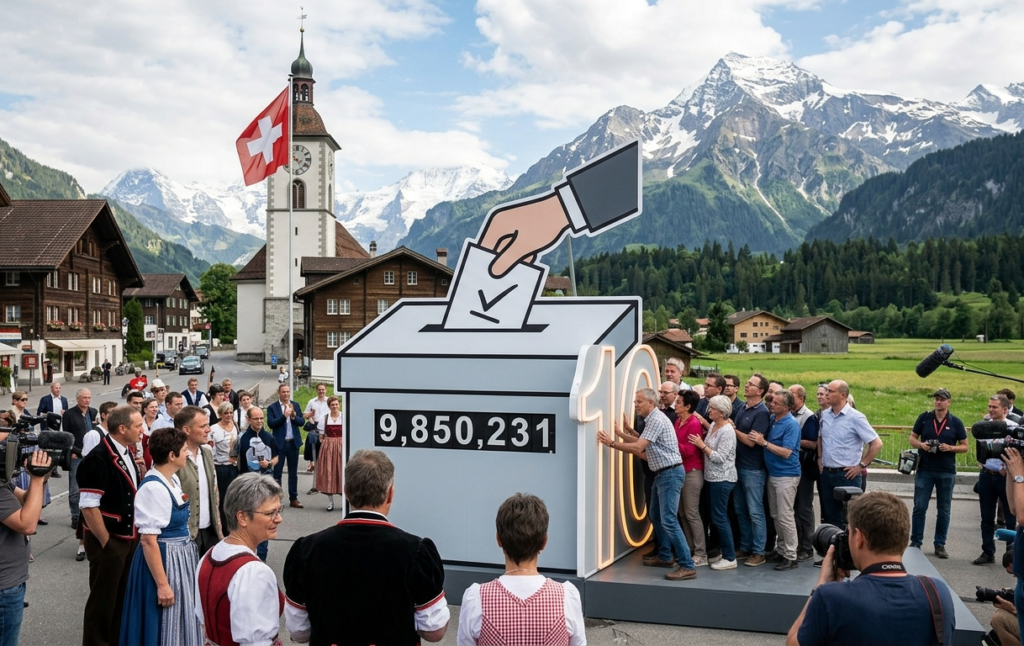
Switzerland will hold a referendum on Sunday, June 14, 2026, on whether to cap its population at 10 million people, a proposal that could fundamentally transform the wealthy Alpine nation’s relationship with the European Union, reshape its labor market, and trigger one of the most consequential political decisions in Swiss history.
The vote represents a critical juncture for a country that has historically embraced free movement, international commerce, and cosmopolitan values. Yet it also reflects genuine anxieties about rapid population growth, infrastructure strain, housing affordability, environmental pressure, and the cultural implications of demographic transformation in a nation where foreign-born residents now constitute 27% of the population.
Federal Council member Beat Jans, a member of the body that runs Switzerland, was quoted by the Zurich-based Tages-Anzeiger newspaper as saying: “On June 14, we will experience Switzerland’s Brexit moment. A ‘yes’ vote would put us in isolation.”
The comparison to Brexit is deliberate and profound. Just as Britain’s 2016 referendum on European Union membership triggered irreversible political, economic, and social consequences, Switzerland’s population cap vote could fundamentally alter the nation’s place within Europe and reshape its relationship with the EU, despite Switzerland’s unique status as a non-member bound to the EU through bilateral agreements rather than formal membership.
1. THE CURRENT SITUATION: SWITZERLAND’S RAPID POPULATION GROWTH
1.1 A Nation Bursting at the Seams
Switzerland had a population of 9.1 million people by the end of the third quarter of 2025, according to the federal statistics office. The country’s population increased 10% in the 10 years up to the end of 2025.
This 10% growth in a single decade represents an acceleration of demographic change that many Swiss citizens perceive as unsustainable. For a wealthy, densely-populated Alpine nation with limited geographic expanse and finite infrastructure, a 10% population increase within ten years creates visible strain: longer commute times, more crowded public transportation, fuller hospitals and schools, reduced housing availability, and escalating housing costs.
The growth trajectory appears likely to continue if current immigration patterns persist. Switzerland’s natural population growth (births minus deaths) is modest—the nation, like other wealthy European countries, has below-replacement fertility rates. The 10% population growth therefore reflects almost entirely immigration rather than natural increase.
1.2 The Immigration Composition
People born abroad have made up about 30% of the population in recent years, with most having come from European Union countries. The proposal would enshrine into law rules that Switzerland’s permanent resident population—both Swiss citizens and foreigners with residency papers—must not exceed 10 million before 2050.
The foreign-born population comprises multiple categories: EU citizens who have immigrated for work, asylum seekers and refugees fleeing conflict or persecution, family members reunifying with prior immigrants, and international students and highly-skilled workers recruited by Swiss employers.
The SVP, the right-wing Swiss People’s Party that holds the most seats in parliament, said that more than 1 million immigrants from the European Union came to Switzerland in 2024. This figure represents not net immigration but gross flows—the number of EU citizens who immigrated in a single year. It underscores the scale of immigration pressure on Swiss institutions and labor markets.
1.3 The SVP’s Framing: “Our Small Country is Bursting at the Seams”
The party called the situation “uncontrolled immigration,” saying that “the majority of the Swiss population suffers” from increased demand on environmental resources and infrastructure.
The SVP’s messaging crystallizes the concerns of immigration opponents: “Our small country is bursting at the seams. Nature is being paved over. There are ever more traffic jams on the roads, overburdened public transport, overburdened schools, housing shortage and rising rents, massively increasing crime and exploding costs for Swiss taxpayers.”
This framing shifts the debate from abstract immigration policy to concrete quality-of-life concerns that resonate with Swiss voters experiencing daily impacts of population growth: traffic congestion, crowded trains, competition for housing, educational overcrowding, and fiscal pressures.
2. THE REFERENDUM PROPOSAL: WHAT WOULD HAPPEN IF THE MEASURE PASSES
2.1 The Core Proposal: A Population Cap by 2050
The proposal would enshrine into law the rule that Switzerland’s permanent resident population, including both Swiss citizens and foreigners with residency permits, must not exceed 10 million by 2050.
The key elements of the proposal are:
- Population ceiling: 10 million permanent residents (both Swiss citizens and foreign residents with permits)
- Timeline: By 2050 (providing 24 years to implement restrictions)
- Current distance: 9.1 million as of end 2025, leaving approximately 900,000 residents of capacity before the ceiling is reached
The 10 million figure was carefully chosen: it represents a manageable increase from the current 9.1 million (10% growth) while providing a temporal horizon (2050) far enough in the future to allow for implementation planning while remaining within political lifetime of current leaders.
1.2 Two-Phase Implementation
If the population reaches 9.5 million before then, the government would take steps to limit it such as through measures on asylum, family reunification, residency permit issuance and renegotiating international agreements.
The proposal establishes a two-phase enforcement mechanism:
Phase One (9.5 million): When the population approaches 9.5 million, the government must:
- Restrict asylum access
- Limit family reunification policies
- Reduce residency permit issuance
- Renegotiate international agreements that drive population growth
Phase Two (10 million): Should the government fail to arrest growth and the population reaches 10 million, the government would be forced to end its free-movement agreement with the European Union.
The phased approach theoretically allows the government to address population growth through incremental measures before resorting to the nuclear option of terminating the EU free-movement agreement. However, this structure creates a collision course: unless Austria, Germany, or other EU neighbors voluntarily accept fewer emigrations to Switzerland, the physics of labor market equilibrium would likely force the government toward Phase Two actions.
1.3 Terminating the EU Free-Movement Agreement: The “Brexit Moment”
Should the 10-million threshold be crossed, however, the government would terminate an agreement with the European Union (EU) — which Switzerland is currently not a part of — to allow the free movement of people.
The termination of the bilateral free-movement agreement would represent Switzerland’s most consequential break with European integration since the nation voted to join the United Nations in 2002. The agreement, signed between Switzerland and the EU, allows citizens of both parties to live, work, and establish residence freely across borders without requiring visas or work permits.
This agreement has been fundamental to Switzerland’s economic model for over two decades. The elimination of free movement would:
- Terminate the ability of EU citizens to work in Switzerland without work permits
- Restrict the ability of Swiss citizens to work in the EU
- Require Swiss employers to navigate visa and residency permit bureaucracy for recruiting EU workers
- Potentially trigger reciprocal EU responses affecting Swiss citizens’ ability to work in the EU
- Fundamentally alter the economic integration between Switzerland and surrounding European economies
3. WHY SWITZERLAND IS VOTING ON THIS: THE DEMOCRATIC MECHANISM AND POLITICAL CONTEXT
3.1 Switzerland’s Direct Democracy: The Popular Initiative
The vote is part of Switzerland’s direct democracy that gives voters a direct say in policymaking, usually four times a year, through the ballot box. Proponents of the initiative, led by the anti-immigration Swiss People’s Party that has the most seats in parliament, tallied enough petition signatures to put the issue on national ballots on June 14.
The Swiss system of direct democracy is globally unique. Any group of citizens collecting 100,000 petition signatures can force a nationwide referendum on any policy question. This powerful mechanism ensures that dissatisfied constituencies can bypass parliament and appeal directly to the electorate.
The SVP’s ability to collect the requisite signatures reflects genuine grassroots concern about immigration among Swiss voters. The party’s political dominance—holding the most seats in parliament—combined with the popular initiative mechanism, ensures that anti-immigration constituencies can force the issue onto the ballot regardless of parliament’s views.
3.2 Political Opposition from the Federal Council and Parliament
Switzerland’s Parliament and Federal Council have already voted against the proposal. Both bodies representing official Swiss governance oppose the population cap, viewing it as economically damaging and diplomatically risky.
The opposition from institutional leadership reflects several concerns:
- Economic risk: Restricting immigration would tighten labor markets, limit economic growth, and undermine competitiveness
- Diplomatic cost: Terminating the EU free-movement agreement would trigger cascading consequences in Swiss-EU relations
- Governance challenge: Implementing population limits would require novel bureaucratic mechanisms
- International obligations: The proposal might conflict with existing international agreements
Yet parliament’s opposition matters less than public opinion in Switzerland’s direct democracy system. If voters approve the measure, parliament must implement it—regardless of disagreement.
3.3 The SVP’s Long Anti-Immigration Campaign
For years, the party — known by its German-language acronym SVP — has sought to curb a rise in migration into the rich Alpine country with mixed results.
The population cap represents the latest in a series of SVP initiatives attempting to restrict immigration:
- 2009: SVP led successful campaign for stricter asylum laws
- 2014: SVP campaign against mass immigration
- 2020: Multiple SVP immigration initiatives
- 2026: Population cap initiative
Each campaign has built political momentum and cultural salience for immigration restriction. The current initiative represents the culmination of years of sustained anti-immigration political mobilization.
4. THE ECONOMIC ARGUMENT: WHY BUSINESSES ARE ALARMED
4.1 Labor Market Dependence on Immigration
Businesses have warned that limiting immigration will weigh on Switzerland’s growth and competitiveness. When the economy is strong, companies struggle to find enough workers within Switzerland. Companies, as well as public institutions like hospitals and care homes, often recruit the skilled workers they need from the EU.
Switzerland’s service-oriented economy—banking, pharmaceuticals, high-tech manufacturing, hospitality, healthcare—depends on accessing talent pools beyond national borders. The Swiss unemployment rate is historically low (around 2-3%), leaving limited domestic labor surplus for employers to recruit.
Key sectors dependent on EU immigration include:
- Healthcare: Nurses, doctors, and care workers from Germany, Italy, France, and other EU nations constitute substantial portions of Swiss hospital and care home workforces
- Hospitality: Hotels and restaurants rely heavily on EU workers for seasonal and permanent positions
- Construction: Construction firms depend on EU workers for specialized trades
- Manufacturing: High-tech manufacturers and pharmaceutical companies recruit skilled workers internationally
- Finance: Banks and financial services firms rely on access to international talent
1.2 Economic Growth Projections Under Immigration Restrictions
The population cap would fundamentally alter Switzerland’s economic model. Growth projections become pessimistic if immigration is restricted:
- Labor shortage: Employers unable to recruit from the EU would face constrained hiring, reduced production, and competitiveness challenges
- Wage pressure: Tight labor markets would drive wage inflation, increasing costs for employers and consumers
- Economic growth stagnation: Restricted labor supply would reduce GDP growth below historical averages
- Innovation impact: Technology and pharmaceutical sectors relying on international talent recruitment would face talent acquisition challenges
- Fiscal consequences: Reduced economic growth would lower tax revenues, constraining public services
Swiss economic researchers have modeled immigration restrictions and consistently project negative economic consequences of material magnitude.
1.3 Sectoral Warnings
Different business sectors have issued specific warnings about the consequences of immigration restriction:
- Healthcare sector: Hospitals warn of staff shortages in nursing, specialist medicine, and care services
- Hotel and restaurant associations: Warn of difficulty staffing seasonal positions and restaurant kitchens
- Manufacturing and pharmaceutical: Warn of talent acquisition challenges in specialized fields
- Construction sector: Warns of worker shortages in specialized trades
- Financial services: Warn of difficulty recruiting specialized financial professionals
5. THE ENVIRONMENTAL AND QUALITY-OF-LIFE ARGUMENT: SVP’S FRAMING
5.1 Environmental Sustainability Arguments
Proponents argue that the population cap would protect the environment and natural resources from strains of population growth. The idea, they say, is to help protect the environment, natural resources, infrastructure and the social safety net from strains of population growth.
The environmental framing includes several arguments:
- Land use: Rapid population growth drives urban expansion, reducing agricultural land and natural habitats
- Transportation emissions: Growing population drives more cars, more congestion, and higher transportation-related emissions
- Resource consumption: More people consume more water, electricity, and resources
- Waste generation: Larger population generates more waste, straining waste management systems
- Agricultural land loss: Population growth pressures convert agricultural land to urban and suburban use
The SVP’s messaging emphasizes environmental stewardship and sustainability—framings that appeal to voters concerned about climate change and environmental degradation.
5.2 Infrastructure Strain Arguments
“Nature is being paved over. There are ever more traffic jams on the roads, overburdened public transport, overburdened schools, housing shortage and rising rents, massively increasing crime and exploding costs for Swiss taxpayers.”
The quality-of-life arguments focus on immediate, visible impacts of rapid population growth:
- Housing affordability: Population growth drives housing demand, increasing prices and rents
- Transportation congestion: Rapid population growth strains transit systems and creates road congestion
- School overcrowding: More children create pressure on school systems
- Public service strain: Hospitals, police, and social services face increased demand
- Crime: SVP claims that immigration increases crime rates (though empirical evidence on this is contested)
6. THE POLITICAL COMPLEXITY: SWITZERLAND’S RELATIONSHIP WITH THE EU
6.1 Switzerland’s Unique Position: In Europe But Not of Europe
Switzerland is not a member of the European Union. Yet through bilateral agreements negotiated since the 1990s, Switzerland has integrated progressively with the EU through specific sectoral agreements: free movement of persons, trade access, agricultural integration, and others.
This unique relationship emerged from Switzerland’s historical neutrality and preference for independence. Rather than joining the EU formally, Switzerland negotiated bilateral agreements allowing selective economic integration without political integration into EU governance.
The free-movement agreement represents the most economically significant of these arrangements. It allows EU citizens and Swiss citizens reciprocal rights to live, work, and establish residence across borders—effectively creating a shared labor market despite Switzerland’s non-EU status.
6.2 The Risk of “Unraveling” Swiss-EU Relations
The termination of the free-movement agreement would likely trigger cascading consequences in Swiss-EU relations. The EU has structured its bilateral relationship with Switzerland on a basis that individual agreements are interconnected—violating or terminating one agreement could threaten others.
Key risks include:
- Reciprocal restrictions: The EU might restrict Swiss citizens’ ability to work in EU countries or establish residence
- Trade consequences: The EU might restrict Swiss trade access or impose tariffs in response to immigration restrictions
- Financial services: Banking and financial services access to EU markets could be jeopardized
- Research collaboration: EU research funding and collaboration frameworks might be affected
- Agricultural trade: Agricultural market access agreements could be renegotiated
- Air transport: Switzerland’s aviation agreements with the EU could be affected
Federal Council opposition to the referendum partly reflects these concerns: a yes vote would not merely restrict immigration but potentially trigger a broader rupture in Swiss-EU relations.
6.3 Comparison to Brexit
The comparison to Brexit reflects several parallels:
- National sovereignty: Both involved voters asserting national control over immigration policy
- Economic consequences: Both votes risked substantial economic disruption
- Institutional opposition: Both faced strong opposition from institutional leadership
- EU rupture: Both involved potential fundamental breaks with European integration
- Identity politics: Both campaigns emphasized national identity and cultural concerns about immigration
Yet differences exist: Switzerland’s non-membership status means negotiating new arrangements differs fundamentally from Britain’s exit from EU membership.
7. POLLING AND EXPECTATIONS: WHAT THE VOTE MIGHT REVEAL
7.1 Recent Polling Data
Latest polls reveal Swiss anti-immigration initiative has strong voter support, according to reports from December 2025 and January 2026.
The polling data suggesting strong support for the population cap reflects the political environment the SVP has cultivated through years of anti-immigration campaigning. However, Swiss polling has historically proven volatile on immigration issues—voters’ stated preferences in surveys sometimes diverge from actual voting behavior when confronted with concrete consequences.
The outcome remains genuinely uncertain. No recent comprehensive polling data from June 13-14 has been released, leaving genuine ambiguity about whether support identified in winter polling persists through spring.
7.2 Regional Variation
Support for immigration restriction likely varies substantially by region:
- Rural Switzerland: More likely to support population cap, viewing immigration as threatening traditional communities
- Urban centers (Zurich, Geneva, Basel): More likely to oppose, recognizing economic benefits and cosmopolitan values
- Eastern Switzerland: Mixed, with specific sectoral interests affecting regional positions
- Western Switzerland: Potentially more favorable to EU-integrated approaches
- Italian-speaking Ticino: Potentially supportive, given Ticino’s geographic proximity to Italy and population concerns
8. THE IMPLEMENTATION CHALLENGE: HOW WOULD SWITZERLAND ACTUALLY ENFORCE A POPULATION CAP?
8.1 The Bureaucratic Challenge
If enshrined into law, implementing a population cap requires novel bureaucratic mechanisms. Switzerland would need to:
- Monitor population flows: Track immigration and emigration to calculate whether thresholds are being approached
- Administer permit restrictions: Implement permit denial systems at 9.5 and 10 million thresholds
- Determine priority access: Decide which categories of immigrants (family, work, asylum) receive prioritized access to remaining permits
- Enforce restrictions: Prevent undocumented immigration and monitor compliance
- Negotiate exceptions: Potentially negotiate EU exemptions for specific categories of workers (healthcare, etc.)
1.2 The Political Economy of Exceptions
Once implementation begins, political pressure for exceptions would immediately arise. Business sectors dependent on immigration—healthcare, hospitality, agriculture—would lobby for exemptions. Political parties might demand priority access for specific groups.
The history of immigration policy suggests that categorical restrictions quickly become riddled with exceptions and special provisions, undermining the stated objective.
1.3 International Negotiation Requirements
Implementing phase two (terminating the free-movement agreement) would require formal negotiation with the EU. Switzerland would need to propose how two decades of integrated labor markets would be restructured.
The EU might resist, demanding reciprocal restrictions on Swiss citizens’ EU work rights. Switzerland might seek compromise arrangements, such as sector-specific exemptions for healthcare or specialized fields.
9. THE DEEPER QUESTIONS: WHAT THE VOTE REVEALS ABOUT SWITZERLAND
9.1 Immigration and National Identity
The referendum raises fundamental questions about Swiss national identity: What does it mean to be Swiss? How much immigration is compatible with Swiss identity and community?
For some voters, rapid population growth from immigration threatens Swiss cultural cohesion, linguistic integrity, and social solidarity. For others, Switzerland’s traditional cosmopolitanism and economic dynamism depends on openness to immigration and cultural pluralism.
9.2 Direct Democracy and Representation
The vote also highlights tensions within Switzerland’s direct democracy system. Polls show that Swiss voters’ direct democratic instinct may conflict with their economic interests and their institutions’ considered judgment.
Parliament and the Federal Council oppose the measure based on economic analysis and diplomatic assessment. Yet voters might support it based on quality-of-life concerns and cultural anxieties. The vote will reveal whether direct democracy vindicated or confounded institutional judgment.
9.3 Europe’s Immigration Future
Switzerland’s vote occurs amid broader European grappling with immigration. From Italy to Hungary to France, right-wing parties have successfully politicized immigration and achieved restrictions. Switzerland’s vote provides a referendum on whether wealthy, economically-developed European nations will embrace or restrict immigration in the coming decades.
CONCLUSION: A NATION AT THE CROSSROADS
On June 14, 2026, Switzerland will vote on a proposal that could fundamentally reshape the nation’s future. The vote represents a collision between quality-of-life concerns about rapid population growth and economic interests dependent on immigration and labor market integration with Europe.
A yes vote would commit Switzerland to implementing novel restrictions on immigration and potentially terminating the free-movement agreement with the EU—triggering Europe’s newest “Brexit moment” and forcing renegotiation of fundamental Swiss-EU relationships.
A no vote would represent a validation of economic integration, cosmopolitan openness, and the institutional judgment of parliament and federal leadership.
The outcome remains genuinely uncertain. The referendum encapsulates fundamental questions about national identity, economic priority, environmental sustainability, and Switzerland’s place within Europe—questions that extend far beyond Switzerland to all wealthy European nations grappling with immigration in the coming decades.
Sources and References
- CNBC – “Switzerland is voting on whether to cap its population at 10 million. Here’s what to know” (June 13, 2026)
- CNN – “Switzerland’s ‘Brexit moment’: Vote on population cap sets up potential collision with EU” (June 13, 2026)
- Swiss Federal Government (admin.ch) – “No to a Switzerland with 10 million! (Sustainability Initiative)” (June 13, 2026)
- Wikipedia – “2026 Swiss referendums” (Updated June 13, 2026)
- Northeastern University News – “Why a Swiss population cap baffles experts” (March 2, 2026)
- Fox News – “European nation votes to cap population at 10M in major immigration crackdown referendum” (February 12, 2026)
- Associated Press / AOL News – “Swiss to vote on proposal by anti-immigration party to cap population at 10 million” (2026)
- Euronews – “Switzerland to vote on proposal to cap population at 10 million by 2050” (February 12, 2026)
- The Local – “Latest polls reveal Swiss anti-immigration initiative has strong voter support” (December 9, 2025)
This article documents Switzerland’s historic referendum on population caps scheduled for June 14, 2026, synthesizing reporting from multiple international news sources covering immigration policy, economic implications, and Swiss-EU relations as of June 13, 2026.
Disclaimer: This article is journalistic analysis based on official government sources, news reporting, and political positioning statements as of June 13, 2026. The referendum results remain pending as of publication date.