THE ARTIFICIAL INTELLIGENCE DIVIDE: CHINA’S ALTERNATIVE VISION FOR GLOBAL TECHNOLOGY GOVERNANCE EMERGES AS G7 CHARTS DIVERGENT PATH

A Comprehensive Analysis of How Beijing’s Push for Inclusive AI Frameworks Reflects Fundamental Disagreements About Technology’s Future—and the Long-Term Implications for Innovation, Regulation, and Global Economic Power
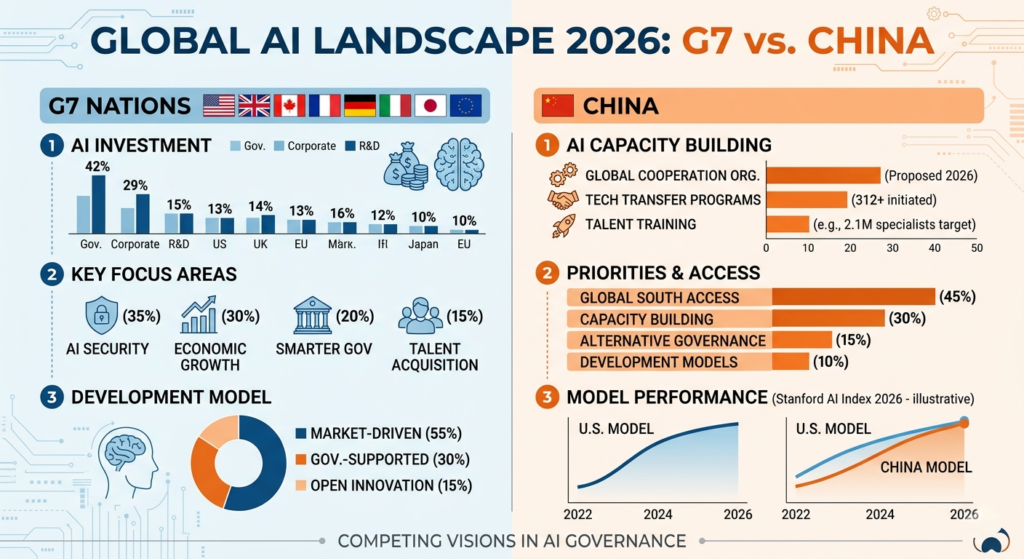
As the Group of Seven concluded its 52nd annual gathering in the Alpine resort town of Évian-les-Bains, France, in mid-June 2026, the absence of one voice reverberated through discussions of artificial intelligence that dominated the three-day summit. While the world’s leading industrialized democracies debated how to position themselves in the rapidly advancing technology landscape, China—notably absent from the membership table—was simultaneously unveiling an alternative architecture for governing artificial intelligence development on the global stage. This parallel dynamic illuminates a fundamental fracture in how the world’s largest economies envision the future of technological advancement, regulatory frameworks, and the distribution of benefits from artificial intelligence breakthroughs.
Wang Yi, China’s top diplomatic official, stood before international media on Wednesday in Beijing and articulated his nation’s position with calculated clarity. “China is accelerating the establishment of a global AI cooperation organization, and welcomes all parties to join,” he stated, according to official translations of his remarks. The announcement represented far more than a rhetorical position; it signaled a deliberate strategy to position Beijing as a champion of inclusive technology governance even as G7 nations constructed frameworks from which Beijing remained structurally excluded. The timing, coordination, and messaging all suggest a carefully orchestrated effort to reshape perceptions of who should have voice and influence in determining how artificial intelligence develops and how its benefits distribute across the international community.
The contrast between these simultaneous developments—one in the Alpine quietude of a G7 retreat and the other in the calculated spaces of Beijing’s diplomatic apparatus—reveals essential truths about the contemporary technology landscape. The world is no longer negotiating a singular framework for artificial intelligence governance. Instead, multiple competing visions are crystallizing: one centered on Western democratic governance approaches and national economic competitiveness, another promoting inclusive global cooperation with emphasis on supporting developing nations and alternative development models. Understanding which vision eventually prevails—or whether hybrid approaches emerge—may prove as consequential as the artificial intelligence technologies themselves.
The narrative of exclusion and inclusion that characterizes this particular moment in technology history carries significant implications for how innovation resources flow, how talent is cultivated and retained, how regulatory standards develop, and ultimately, how the extraordinary economic value generated by artificial intelligence advancement distributes across national boundaries. These are not merely technical questions; they are fundamentally questions about power, legitimacy, and the future architecture of the international system.
Beijing’s AI governance proposals did not emerge spontaneously in mid-June. They represent the culmination of strategic positioning that accelerated through 2025 and intensified across the first half of 2026. Chinese President Xi Jinping introduced the “Global Governance Initiative” at a gathering of the Shanghai Cooperation Organization (an organization that initially focused on regional security matters but has expanded to encompass economic cooperation among member states including Russia and Iran) during the summer of 2025. Building on this foundation, Premier Li Qiang announced during an artificial intelligence conference in Shanghai earlier in 2026 that Beijing proposed establishing a World Artificial Intelligence Cooperation Organization. The proposal positioned this hypothetical organization as the mechanism through which governments, companies, and research institutions could coordinate on development strategies, governance approaches, and technical standards for artificial intelligence advancement.
The specific wording of these proposals merits careful examination because language reveals underlying assumptions about how technology governance should function. Beijing has emphasized several key themes across its various articulations: artificial intelligence should be accessible to all nations rather than concentrated in the hands of technologically advanced Western economies; development and access should not be conditioned on alignment with Western political systems or values; developing nations require capacity-building support to participate meaningfully in AI advancement rather than remaining passive recipients of Western technology; and governance frameworks should be universal and overseen by inclusive organizations rather than clubs of wealthy democracies. These are not marginal positions within technology policy discussions—they represent a fundamental challenge to the post-World War II architecture in which a small number of advanced economies essentially determine the rules governing global technology development.
The Group of Seven, by contrast, has charted a notably different direction in its approach to artificial intelligence. The summit’s primary artificial intelligence deliverable—a document titled “Leaders’ Statement on AI for Prosperity”—reflects a substantial reorientation of priorities compared to earlier G7 gatherings and international technology discussions. Where previous technology summits and initiatives had emphasized potential risks associated with artificial intelligence development and the regulatory frameworks necessary to address those risks, the 2026 G7 statement emphasizes economic opportunities, growth potential, and competitive advantages available to nations that embrace artificial intelligence advancement. The language of the statement prioritizes words such as “growth,” “prosperity,” and “competitiveness” far more frequently than terms relating to governance, oversight, or risk mitigation.
This linguistic shift reflects a broader recalibration of priorities among advanced Western economies. The earlier British AI Safety Summit of 2023 and the subsequent AI Seoul Summit of 2024 had positioned artificial intelligence governance and risk mitigation as central concerns worthy of international coordinated attention. The 2025 Paris AI Action Summit had already begun pivoting toward emphasizing economic opportunities and innovation incentives. By 2026, the trajectory had completed its arc: the summit’s flagship initiatives included a “GovAI Grand Challenge” designed to accelerate government adoption of artificial intelligence systems and a G7 AI Adoption Roadmap specifically targeting small and medium-sized enterprises, recognizing that widespread deployment of AI systems across economic sectors represents the most direct path to competitive advantage.
This reorientation did not occur in isolation from broader geopolitical and economic dynamics. The United States, under Trump administration leadership, made unambiguously clear its opposition to multilateral agreements that might constrain American technological advantage. The Biden-era AI Risk Management Framework was shelved; the AI Diffusion Framework, which had attempted to create tiered access to advanced semiconductor chips based on national alignment with American interests, was repealed. The renaming of the UK AI Safety Institute to the UK AI Security Institute and the rebranding of the American equivalent to the Center for AI Standards and Innovation both signal a conscious reframing of priorities from safety-focused risk mitigation to security-oriented competitive advantage.
The European Union, meanwhile, pursued a different but complementary direction. The European Commission released its “European Tech Sovereignty” package in early June 2026, just as G7 discussions were being finalized. The initiative focuses on accelerating European development of chip manufacturing capacity and cloud computing infrastructure indigenous to Europe, reducing technological dependence on American firms that have historically dominated these sectors. The emphasis on open-source technologies and public investment in technology infrastructure reflects a European strategic calculation: maintaining technological independence requires not merely regulatory frameworks but substantial capital investment and institutional commitment to developing domestic technological capacity.
Canada, participating as a G7 member under Prime Minister Mark Carney, unveiled its own national artificial intelligence strategy shortly before the summit. The Canadian approach emphasizes public investment in nationwide AI infrastructure and coordination with international partners to ensure that Canadian interests are represented in emerging technology governance structures. The Canadian positioning reflects what analysts increasingly describe as a “Middle Powers” movement, in which nations positioned between the largest technological superpowers attempt to develop sufficient independent capacity and influence to avoid subordination to either American or Chinese technology frameworks.
All of these developments—Beijing’s inclusive governance proposals, Western emphasis on AI prosperity and growth, European technological autonomy initiatives, Canadian infrastructure investments, and the underlying repositioning of why technology governance matters—reflect awareness that artificial intelligence represents not merely a technological frontier but a structural determination of future economic and geopolitical positioning. The distribution of artificial intelligence capabilities across nations and the frameworks governing how those capabilities develop carry implications extending far beyond the technology sector itself. Whoever controls the institutions establishing artificial intelligence governance standards, whoever leads in artificial intelligence talent cultivation, whoever develops the most capable artificial intelligence systems, and whoever sets the terms on which artificial intelligence technology is shared or restricted will possess structural advantages across multiple domains extending well beyond technology itself.
The question of China’s exclusion from G7 membership itself carries significant historical and ongoing implications. China was deliberately excluded from the original Group of Seven gatherings in 1975, when the organization was established to coordinate economic policy among the world’s most developed industrialized democracies. At that historical moment, China was economically peripheral, technologically underdeveloped, and politically distant from the democratic alliance that dominated Western institutions. The intervening five decades have witnessed a fundamental transformation: China has become the world’s second-largest economy, operates the world’s largest artificial intelligence research ecosystem in terms of total investment and talent concentration, manufactures the majority of global consumer electronics, and exercises influence extending across multiple continents through trade relationships, investment, and development assistance.
Several analysts and observers have openly questioned whether the continued exclusion of China from G7 structures reflects outdated institutional assumptions rather than contemporary geopolitical reality. “China’s absence from G7 summits seems increasingly odd given its global economic influence,” one analysis noted, capturing a sentiment that extends well beyond China specialists into mainstream economic commentary. Yet admitting China to full G7 membership would fundamentally alter the organization’s dynamics, potentially fracturing the consensus-based decision-making processes that have characterized the group. Individual members might find incentive to negotiate special arrangements with Beijing on economic matters, mineral access, digital technology partnerships, and other substantive issues—exactly the outcome that remaining members view as contrary to their collective interests.
This structural reality explains why China remains excluded even as its technological capabilities increasingly shape the development of artificial intelligence systems globally. The exclusion itself becomes one of the most powerful arguments for Beijing’s alternative governance proposals. If the world’s most influential and technologically advanced nations are coordinating artificial intelligence policy within an institution that systematically excludes the second-largest economy, developing nations reasonably ask why they should accept governance frameworks established without their meaningful participation. If the premise underlying G7 coordination is that advanced democracies should establish the rules for technology governance, what legitimacy do those rules possess in a world where roughly 85 percent of human population lives outside advanced democratic structures?
Beijing’s “AI Capacity Building for All” initiative, by contrast, directly addresses this legitimacy question. The initiative provides technology transfer and talent development support to developing nations, explicitly positioning artificial intelligence as a public good rather than a competitive advantage to be restricted through access limitations. This framing proves particularly appealing to developing nations that have historically experienced technology advancement patterns in which access to cutting-edge capabilities remained restricted to advanced economies and required subordination to Western technology companies and governance frameworks. The Chinese proposal suggests an alternative: artificial intelligence advancement need not follow this pattern; developing nations need not accept a subordinate position in the global technology system.
Concurrent with Beijing’s public AI governance proposals, Chinese officials emphasized their nation’s efforts to deepen international AI cooperation through established multilateral organizations. The Shanghai Cooperation Organization, originally focused on regional security matters in Central Asia, has expanded to encompass economic cooperation and technology coordination among its member states. The BRICS coalition of large developing economies has become an increasingly consequential forum for discussing economic alternatives to Western-dominated institutions. China’s establishment of a “China-BRICS AI Development and Cooperation Center” signals intent to develop technology cooperation frameworks within the Global South that operate entirely outside Western governance structures.
The substantive positioning of these institutions matters more than their names or organizational structures. Shanghai, the proposed headquarters for China’s proposed World Artificial Intelligence Cooperation Organization, is positioned as an attractive venue precisely because it is not Washington, Brussels, London, or any other Western capital. The very fact of hosting the organization outside the Western sphere signals that this is not a Western-dominated institution imposed upon other nations but a genuinely neutral forum. This geographic positioning carries enormous symbolic weight in international negotiations, particularly among developing nations that have experienced decades of technology governance dominated by Western capitals and Western institutions.
The technical capabilities underlying Beijing’s artificial intelligence proposals also deserve examination. Stanford researchers’ annual AI Index report concluded in its 2026 edition that “the U.S.-China AI model performance gap has effectively closed,” representing a significant recognition of Chinese technological capability development. This closure of the performance gap occurred despite American technological advantages in advanced semiconductor manufacturing and despite restrictions on China’s access to cutting-edge microprocessors. Chinese companies including Alibaba, Tencent, Baidu, and newer firms such as Zhipu AI and DeepSeek have developed large language models and foundation models that perform at levels comparable to the most advanced American systems. The development occurred through a combination of algorithmic innovation, talent recruitment from around the world, and massive capital investment by both private companies and state institutions.
This technological parity matters for the credibility of Beijing’s governance proposals. China cannot be dismissed as an advanced nation attempting to constrain competitors; Beijing possesses genuine technological capability that validates its voice in governance discussions. The emergence of DeepSeek as a lower-cost alternative to American systems like OpenAI’s GPT and Google’s models represents particularly significant development because it demonstrates that artificial intelligence advancement need not concentrate exclusively within American technology companies. The existence of capable alternative systems reduces the practical dependency on American artificial intelligence platforms and validates the possibility of alternative technology development pathways.
The first half of 2026 witnessed both American and Chinese diplomatic outreach attempting to shape bilateral artificial intelligence cooperation frameworks. In May, American and Chinese representatives announced that the two nations would cooperate on establishing artificial intelligence guardrails—essentially safety and responsible development guidelines. However, the specifics of this cooperation remained deliberately vague. Neither nation published detailed terms or commitment mechanisms; instead, both countries acknowledged that cooperation was possible while leaving open the possibility of diverging substantially on implementation details. This pattern of simultaneous engagement and strategic ambiguity characterizes the broader technology relationship between the world’s two largest economies.
The longer-term implications of these competing artificial intelligence governance visions extend well beyond immediate policy outcomes. If developing nations increasingly participate in technology advancement and governance through Chinese-led institutions and frameworks rather than Western-dominated ones, the distribution of benefits from artificial intelligence breakthroughs shifts substantially. Technology talent flows to locations where opportunities for meaningful participation and advancement exist; companies expand operations in regions where the regulatory environment proves favorable; investment capital concentrates in markets perceived as offering the strongest returns. Over decades, these microeconomic decisions aggregate into civilizational-scale shifts in technological capability, economic capacity, and geopolitical positioning.
The question of whether artificial intelligence development occurs within frameworks emphasizing universal access and capability distribution or within frameworks emphasizing competitive advantage and restriction shapes not only who possesses artificial intelligence capabilities but how those capabilities are deployed. Systems developed and governed through inclusive frameworks might emphasize applications enhancing human capabilities across diverse contexts and addressing challenges affecting all populations—disease, agricultural productivity, environmental restoration, educational access. Systems developed within competitive frameworks emphasizing national advantage might concentrate on applications increasing competitive positioning relative to perceived rivals, potentially including surveillance, autonomous systems applications, and information management technologies whose implications extend beyond their immediate utility into deeper questions about governance and social control.
The absence of comprehensive data on these longer-term implications represents one of the significant challenges in technology governance. The decisions being made in 2026—about whether to participate in Western-led or Chinese-led artificial intelligence governance frameworks, about whether to encourage technology talent to remain in home countries or to pursue opportunities in advanced economies, about whether to invest in indigenous technology development or to rely on imported systems—will determine technology landscapes for decades. Yet the immediate consequences remain partially obscured; the full implications only become visible as systems operate at scale across multiple domains and interact with social, political, and economic institutions in complex ways.
What seems clear from the vantage point of mid-2026 is that the international community is not converging on unified artificial intelligence governance approaches. Instead, multiple frameworks are crystallizing in parallel: Western-led institutions emphasizing prosperity, growth, and competitive advantage; Beijing-led institutions emphasizing inclusive participation and technology distribution; European institutions emphasizing technological sovereignty and independence; and emerging coalitions among developing nations seeking to ensure that artificial intelligence advancement benefits their populations and respects their developmental priorities. Whether these frameworks eventually coordinate, remain in tension, or fragment further into additional competing visions will substantially shape how artificial intelligence technologies integrate into global society across the remainder of the 2026-2030 period and beyond.
The G7 Summit of June 2026 represented a significant marker in this unfolding trajectory: a moment when advanced democracies explicitly prioritized artificial intelligence prosperity and growth over governance and risk mitigation; when technological sovereignty and competitive advantage became more salient concerns than universal access or inclusive development; when the emphasis shifted toward determining how nations and companies could maximize benefits from artificial intelligence advancement rather than how to ensure that advancement served universal human interests. Simultaneously, Beijing’s articulation of alternative governance architectures represented a direct challenge to the implicit assumption that Western democratic institutions and Western-shaped governance frameworks should govern global technology development.
The ultimate resolution of these competing visions remains contingent on multiple factors extending well beyond technology policy itself. Geopolitical relationships, trade dynamics, the availability and distribution of critical resources including advanced semiconductors and rare earth minerals, the cultivation and retention of scientific talent, public investment levels in technology development, and ultimately, the success or failure of different artificial intelligence systems in addressing real-world challenges—all will influence which governance frameworks gain legitimacy and adoption across the international system.
What appears certain is that the notion of a unified global artificial intelligence governance framework coordinated through Western-dominated institutions and reflecting Western values and priorities has become substantially less plausible in mid-2026 than it appeared when the first significant international artificial intelligence discussions occurred in 2023-2024. Instead, the world is witnessing the emergence of distinct technology governance ecosystems, each shaped by different institutional assumptions, different value priorities, and different calculations about how technology advancement serves national and international interests. How these distinct ecosystems interact, whether they develop mechanisms for coordination and compatibility or whether they remain in parallel development, and what this fragmentation means for the ultimate trajectory of artificial intelligence development and deployment across global society will constitute one of the defining questions for the remainder of this decade and far beyond.
SOURCES AND REFERENCES
- CNBC – “China pushes for AI safety as G7 summit wraps up without Beijing,” June 17, 2026
- WION Decodes – “Why China isn’t in the G7—and why it still looms over every discussion,” June 2026
- ABC News – “Trump and other G7 leaders are meeting without China. Is that a mistake?”
- CNBC – “Trump and Xi face a test over AI control,” May 2026
- Washington Times – “Why Trump and other G7 leaders meeting without China might be a mistake,” June 14, 2026
- TechPolicy.Press – “G7 Summit Set to Kick Off Amidst Allies’ Widening Rift Over AI Sovereignty,” June 2026
- RAND Corporation – “The G7 Summit Missed an Opportunity for Progress on Global AI Governance,” June 2025
- AI Safety in China Newsletter – “AI Safety in China #15 and #23,” 2026
- Reuters – “China’s Xi pushes for global AI body at APEC in counter to US,” 2026
- UPSC Current Affairs – “G7 Summit 2026: Key Issues Global Significance and Implications,” June 2026
- Substack/Stanford AI Index – “2026 Annual AI Report: U.S.-China AI Model Performance Gap Analysis”
This analysis is based on publicly available reporting, official statements from government officials and international organizations, and research from technology policy institutions as documented in June 2026. The assessment reflects the state of knowledge and positioning as of mid-June 2026 and anticipates that these dynamics will continue evolving as new developments emerge. This article is written for informational and analytical purposes and does not constitute policy advocacy or represent endorsement of any particular approach to artificial intelligence governance.
The framing of this analysis seeks to present multiple perspectives on artificial intelligence governance approaches objectively, recognizing that legitimate disagreements exist about optimal governance frameworks and that reasonable people holding different values and priorities may reach different conclusions about technology policy approaches. The article aims to enhance reader understanding of contemporary technology governance dynamics rather than persuade readers toward particular policy positions.