2026 World Cup: Blue Samurai Cruise Past Tunisia, Japan Edge Closer to Knockout Stage Berth

Monterrey, Mexico — June 21, 2026
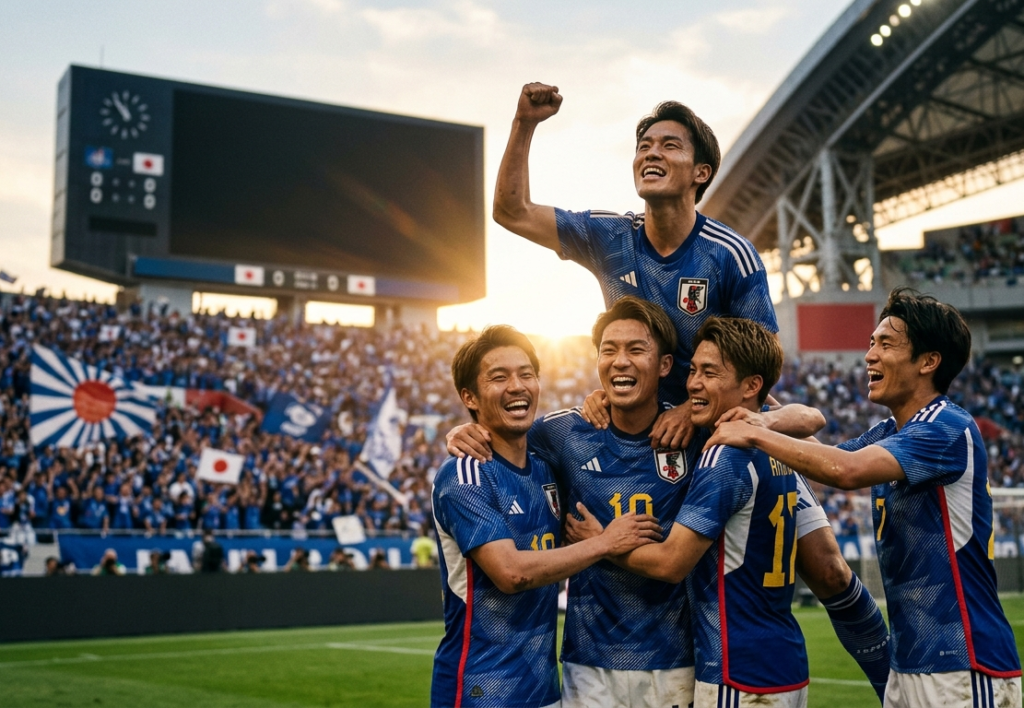
There are blowouts, and then there are statements. On a humid Saturday night at Estadio Monterrey, Japan delivered the latter, dismantling a hapless Tunisia side 4-0 in a result that did far more than fill the scoreline. It pushed the Blue Samurai level on points with the Netherlands at the top of Group F, eliminated Tunisia from contention before the final round of matches had even been played, and reaffirmed something football analysts have been saying with increasing confidence since the draw was made: this Japan squad is not here to make up the numbers. It is here to do real damage.
The match also carried a quietly historic footnote. It was the 1,000th game in the history of the FIFA World Cup, a tournament that has expanded this year to 48 teams and a sprawling new format. That Japan chose this particular fixture to produce its most emphatic result of the group stage feels, in hindsight, fitting. Few national teams have built their modern footballing identity as deliberately, as patiently, and as methodically as Japan has over the past two decades. Saturday’s win in Monterrey was less an aberration than a checkpoint on a long, carefully constructed road.
A Performance Built on Precision, Not Fortune
Football matches that end 4-0 can sometimes flatter the winning side — a couple of fortunate bounces, an early red card, a goalkeeping mistake that snowballs into something larger. Saturday’s result was not that. Japan marked the 1,000th game in the history of the World Cup with a thorough dismantling of Tunisia, closing in on a place in the last 32. The dominance was structural, not incidental.
The pattern was set almost immediately. Daichi Kamada opened the scoring with Japan’s quickest-ever World Cup goal, finding the net inside the fourth minute, after Keito Nakamura threaded a low pass across the six-yard box that Kamada stabbed home amid a crowd of defenders. It was the kind of goal that sets a tone — clean buildup play, intelligent movement, and a finish that punished hesitancy in the opposition back line.
From there, Japan never allowed Tunisia to settle. Japan controlled possession 66 percent of the time in the opening half, suffocating any rhythm the North African side might have hoped to find. Tunisia, by contrast, struggled to register so much as a single shot on target through large stretches of the match, a damning statistic for a team that came into the fixture needing a result to keep its own knockout-stage hopes alive.
The Blue Samurai doubled their lead just past the half-hour mark. Ayase Ueda capitalized on uncertain Tunisian defending, surging into space and driving a low shot into the bottom corner from the edge of the penalty area. It was the first of two goals for the Feyenoord striker on the night — a performance that has quickly made him one of the most discussed forwards of this tournament’s group stage.
The second half offered little respite for Tunisia. Junya Ito made it 3-0 in the 69th minute, latching onto a sharp through ball and finishing calmly, before Ueda completed his brace with an emphatic finishing touch. Ueda capped his night with a looping header off a cross from Kaishu Sano in the 83rd minute, rising well and directing the ball with enough power to beat the goalkeeper and tuck inside the far post.
By full time, Japan had not merely won. It had made a declaration.
Ayase Ueda: From Squad Player to Tournament Talking Point
If there is a single name that emerged from Monterrey with its stock dramatically higher, it is Ayase Ueda. The 27-year-old striker, who plays his club football for Eredivisie side Feyenoord, has quietly built one of the more interesting forward profiles in world football — a player whose finishing instincts are matched by an underrated aerial threat, despite a frame that scouts have historically described as compact rather than imposing.
Ueda’s background traces back to Mito in Ibaraki Prefecture, where he began playing football at the age of six after watching his father score a hat-trick in a match. His rise through Japanese university football, then into the J.League with his boyhood club, and eventually into European football, reflects a development pathway that Japan’s football federation has spent years refining — one that increasingly produces players capable of performing on the biggest stages without the culture shock that once characterized Japanese forwards abroad.
His brace against Tunisia was not a one-off. Ueda scored his first international hat-trick during World Cup qualification against Myanmar in a 5-0 win, and later contributed four goals across the 2023 Asian Cup campaign. The Monterrey performance, then, fits a broader trend rather than standing as an isolated highlight reel moment. Scouts and opposition coaches preparing for Japan’s remaining fixtures will now have to account specifically for his combination of pace, timing, and aerial ability — a problem that, on this evidence, is not easily solved.
Beyond the individual brilliance, Japan’s head coach offered a measured explanation for the team’s approach. Hajime Moriyasu told broadcaster DAZN that the team had not focused excessively on the opponent, instead preparing thoroughly for its own game plan and playing with intent. It is a philosophy that, on the evidence of three tournament cycles now, has become something of a hallmark for Japanese football under his stewardship — control the controllables, trust the system, and let individual quality do the rest within a coherent structure.
Group F: A Tightly Contested Battle for First Place
Saturday’s result reshaped the picture in Group F considerably. Japan’s win lifted the Blue Samurai to the top of the group alongside a Netherlands side that Japan had earlier held to a 2-2 draw in the tournament opener. Both teams now sit on four points with an identical goal differential, a coincidence of symmetry that sets up a fascinating final round of group matches.
The broader picture in the group looks like this. The Netherlands and Japan occupy the top two positions, with the Dutch having put five goals past Sweden in their own second match while Japan was dispatching Tunisia by an identical four-goal margin. Sweden, despite the heavy defeat to the Dutch, sits in third place and will face Japan in the decisive final round of group matches — a fixture that now carries considerably higher stakes than it might have a week ago. Tunisia, meanwhile, is mathematically eliminated and will close out its tournament against the Netherlands with nothing but pride to play for.
This is where the new, expanded format of the tournament adds an extra layer of intrigue. Under the 48-team structure introduced for this edition, the qualification math is more forgiving — and more complex — than in previous tournaments. Forty-eight teams were drawn into twelve groups of four, with the top two finishers from each group advancing automatically, joined by the eight best third-place finishers across all groups to fill out a 32-team knockout bracket.
That detail matters enormously for how Japan’s situation should be read. Even in the unlikely event that the Blue Samurai were to stumble against Sweden, a third-place finish in a group this competitive would likely still be enough to advance, given the quality of the results Japan has already produced. In fact, Japan currently sits atop the overall third-place team standings across the entire tournament, a position that on its own would be sufficient for direct qualification to the round of 32 if it holds. In practical terms, Japan has built itself a remarkably comfortable cushion — the kind of statistical buffer that allows a coaching staff to rotate selectively, manage player fitness, and approach a final group match with tactical freedom rather than desperation.
Why This Win Matters Beyond the Scoreline
It would be easy to file Saturday’s result away as simply “Japan beats a weakened Tunisia” and move on. That would understate what actually happened, and why it matters for the rest of the tournament.
First, consider the opponent’s context. Tunisia entered the match under new head coach Hervé Renard, brought in only days earlier after the previous manager was dismissed following a heavy 5-1 defeat to Sweden in the tournament opener. Renard, a coach with a track record of revitalizing underperforming squads at short notice, simply did not have time to install a coherent defensive structure. By his own team’s admission through performance, Tunisia looked far too passive throughout, unable even to register a single shot on goal in long stretches of play. Japan’s coaching staff and players deserve credit for ruthlessly exploiting that vulnerability rather than allowing a disorganized opponent the chance to find its footing, which happens more often than neutral observers might expect in major tournaments.
Second, consider the manner of the victory rather than just its margin. Japan became the first team from the Asian confederation to score four goals in a single World Cup match, and the win also stands as the largest margin of victory recorded by an AFC nation in the competition’s history. That is not a minor footnote — it is a meaningful marker in the broader story of Asian football’s growth on the world stage. For a continent that has historically been viewed by parts of the global football establishment as a feeder of plucky underdogs rather than genuine contenders, results like this chip away steadily at outdated assumptions.
Third, the win arrives at a moment when expectations for Japan were already elevated. Football analysts covering the tournament had already flagged Japan as a “sleeper” team worth watching closely following its dramatic draw with the Netherlands in the opening round — a result that hinted the team possessed the tactical discipline to frustrate stronger sides. Saturday’s result against Tunisia answered the follow-up question those same analysts were asking: could Japan also be ruthless against an opponent it was expected to beat? The answer, delivered with four goals and a near-total territorial dominance, was an emphatic yes.
The Long-Term Trajectory: Japan’s Footballing Investment Pays Dividends
To understand why this result feels significant rather than surprising to those who follow Japanese football closely, it helps to step back from the single match and look at the broader arc of investment and development that the Japan Football Association has pursued for more than two decades.
Japan’s modern football infrastructure was not built overnight. Since co-hosting the World Cup in 2002, the country has methodically built a domestic league system, a youth academy pipeline, and a culture of sending its most promising talents to European leagues at increasingly younger ages. The current generation of players — many of whom, like Ueda, moved abroad in their early-to-mid twenties rather than waiting until their thirties as earlier generations sometimes did — represents the maturation of that long-term strategy.
The squad that took the field in Monterrey reflects this. Players drawn from clubs across the Netherlands, Germany, England, and other major European leagues have brought back tactical sophistication and physical conditioning standards that have visibly elevated the national team’s overall game model. The result is a Japan side that no longer simply tries to absorb pressure and hit on the counter against stronger opposition — it now looks comfortable building from the back, pressing high, and controlling matches territorially, as it demonstrated for long stretches against both the Netherlands and Tunisia in this tournament.
There is also a less visible but equally important dimension: squad depth and adaptability. Japan has had to navigate a number of injuries during this tournament cycle and has nonetheless continued to impress, suggesting a level of squad-wide quality that allows the coaching staff to absorb setbacks without a significant drop in overall performance. That kind of resilience — the ability to reshuffle personnel without losing tactical identity — is often what separates teams capable of deep tournament runs from those that flame out once the schedule becomes congested and rotation becomes unavoidable.
What Comes Next for Japan
With qualification for the knockout stage now looking close to a formality given the third-place standings cushion described above, attention turns to the final group match and what it might reveal about Japan’s ambitions beyond merely surviving the group phase.
Japan is scheduled to face Sweden on Thursday, June 25, at AT&T Stadium in Arlington, Texas, in a fixture that will effectively decide top spot in Group F, assuming the Netherlands handles its own business against Tunisia. Group position matters considerably for the shape of the knockout bracket that follows. The winner of Group F is set to face the runner-up of Group C, while the runner-up of Group F will instead meet the winner of Group C — meaning the Sweden match is not simply about pride or seeding optics. It could materially shape the difficulty of Japan’s path through the early rounds of the knockout stage.
For a Japanese football culture that has long aspired to what is internally referred to as reaching the “quarterfinal wall” and breaking through it — a target articulated publicly by Japanese football officials for years — the structural advantages on display this week matter. A favorable group position, a fit and in-form squad, and a striker in career-best tournament form represent precisely the combination of factors that turns ambition into genuine opportunity.
A Tournament Format That Rewards Japan’s Profile
It is also worth examining how the expanded 48-team format itself plays to the strengths of a team like Japan. Under the previous 32-team structure, margins for error were thinner, and a single poor result could end a tournament campaign outright. The new format, with its expanded knockout bracket incorporating the best third-place finishers, rewards teams that are consistently competitive even when they fall short of outright group wins.
Japan’s profile — a team capable of frustrating elite opposition (as shown against the Netherlands) while also being ruthlessly efficient against more vulnerable sides (as shown against Tunisia) — is almost perfectly suited to thriving within this new structure. The team does not need to dominate every fixture to progress; it needs to consistently produce results that keep it competitive across the group phase, and Saturday’s performance did exactly that while adding a significant goal-differential cushion that could prove valuable in tiebreaker scenarios later in the tournament.
This adaptability also speaks to the tactical maturity of Moriyasu’s coaching staff. Football observers have noted that Japan has shown a capacity to adjust its approach fixture by fixture — patient and compact against a technically superior Dutch side, aggressive and high-pressing against a Tunisian team in transition following a managerial change. That kind of game-to-game tactical flexibility, rather than a rigid single system applied universally, is increasingly recognized across the sport as a hallmark of teams capable of advancing deep into major tournaments.
The Broader Picture: Asian Football’s Continued Ascent
Japan’s performance in Monterrey should also be read within the context of a broader story unfolding across this tournament: the continued narrowing of the gap between traditionally dominant footballing confederations and the rest of the world. Other Asian and previously underrepresented football nations have also produced notable results this tournament, suggesting that Japan’s strong showing is not an isolated case but part of a wider trend of competitive depth increasing across the global game.
For neutral fans and football economists alike, this matters beyond pure sporting romance. Stronger, more competitive performances from a broader range of national teams tend to translate into deeper global engagement with the tournament, more balanced broadcast interest across regions, and — over the medium term — increased investment in football infrastructure in the countries producing these breakthrough results. Japan’s footballing economy, already one of the most developed in Asia in terms of domestic league revenue, youth development spending, and international player transfers, stands to benefit further from sustained tournament success of this kind.
Commercial and Media Ripple Effects
Results of this magnitude rarely stay confined to the pitch, and Japan’s performance in Monterrey is already generating effects that extend into broadcasting, sponsorship, and domestic fan engagement. Japanese broadcasters covering the tournament have historically seen viewership figures spike sharply whenever the national team produces a result with genuine knockout-stage implications, and a commanding, attacking performance like Saturday’s tends to draw a notably wider audience than a cautious defensive result would, even one yielding the same three points.
For domestic sponsors tied to the Japan Football Association and to individual players like Ueda, Kamada, and Ito, breakout tournament performances translate fairly directly into commercial value. A multi-goal contribution on football’s largest stage tends to elevate a player’s marketability well beyond what league form alone typically achieves, simply because of the scale of the global audience tuned into World Cup fixtures. Ueda’s club, Feyenoord, is also likely to see secondary benefits, with heightened international attention on a player already attracting interest from other competitive leagues following a productive season in the Eredivisie.
There is a domestic angle worth noting as well. Japan’s football economy has grown substantially since the country first qualified for the World Cup in 1998, with the J.League expanding its broadcast reach and youth academies across the country reporting rising enrollment in years following strong national team tournament performances. Should Japan continue its run deep into the knockout stage, observers within Japanese sports business circles widely expect a corresponding uptick in grassroots participation numbers over the following football season — a pattern that has repeated itself after previous notable Japanese tournament runs.
Tactical Lessons for Future Opponents
From a purely technical standpoint, Saturday’s match offers a useful tactical case study for any team scheduled to face Japan later in the tournament, whether in the final round of group play or potentially in the knockout rounds. Several patterns stood out clearly enough to warrant attention from opposition analysts.
The first is Japan’s compactness without the ball. Even while dominating possession at a 66 percent clip in the opening half, the team maintained tight defensive spacing whenever it lost the ball momentarily, denying Tunisia any meaningful transition opportunities. This dual capability — comfortable in possession yet disciplined and compact out of it — is precisely the profile that tends to trouble both possession-based European sides and more direct, counter-attacking opponents alike.
The second is the variety of Japan’s goal-scoring patterns on display. Kamada’s opener came from quick, incisive combination play in tight central areas. Ueda’s first goal stemmed from individual opportunism after a defensive lapse. Ito’s goal arrived via a defense-splitting through ball exploiting space in behind. And Ueda’s second goal showcased aerial ability on a set-piece-style delivery from open play. A team capable of scoring in four distinct ways within a single ninety-minute window is considerably harder to prepare for than one reliant on a single, predictable method of breaking opponents down.
The third lesson concerns squad rotation risk. Despite navigating injury concerns throughout the tournament buildup, Japan’s coaching staff has so far managed to field a cohesive unit without any discernible drop-off in performance quality. Opponents hoping that fatigue or enforced changes might blunt Japan’s effectiveness in the knockout rounds may need to reconsider that assumption based on the strength of this group-stage evidence.
Conclusion: A Statement Win With Lasting Implications
Saturday night in Monterrey will likely be remembered for the headline numbers — four goals, a brace for Ayase Ueda, a historic margin of victory for an Asian nation, and a place atop Group F. But the deeper significance lies in what the performance confirmed rather than what it announced for the first time. Japan has not suddenly become a major footballing power overnight; it has been quietly, deliberately building toward moments exactly like this one for the better part of two decades.
The result leaves Japan in a position of considerable comfort heading into the final round of group matches, with qualification for the knockout stage all but secured through a combination of direct results and a commanding position in the broader third-place standings. More importantly, it leaves the team playing with the kind of confidence and tactical clarity that tends to matter most once a tournament moves into its knockout phase, where margins for error shrink and every fixture becomes a genuine test of a team’s complete footballing identity.
Whether the Blue Samurai can finally push past the historical ceiling that has limited previous Japanese World Cup campaigns remains to be seen, and will depend on factors well beyond a single dominant group-stage performance. But as a statement of intent, as a showcase of individual brilliance from a player peaking at precisely the right moment, and as validation of a long-term developmental strategy finally bearing its fullest fruit, Saturday’s 4-0 win over Tunisia will be remembered as one of the defining moments of Japan’s 2026 World Cup campaign — regardless of how the rest of the tournament ultimately unfolds.
This article is based on match reporting and official tournament data from FIFA, ESPN, Al Jazeera, Yahoo Sports, and Fox Sports, current as of June 21, 2026.