Miguel Almirón’s Red Card: The First Test Case of Football’s New “Prestianni Rule” And What It Reveals About the Sport’s Future

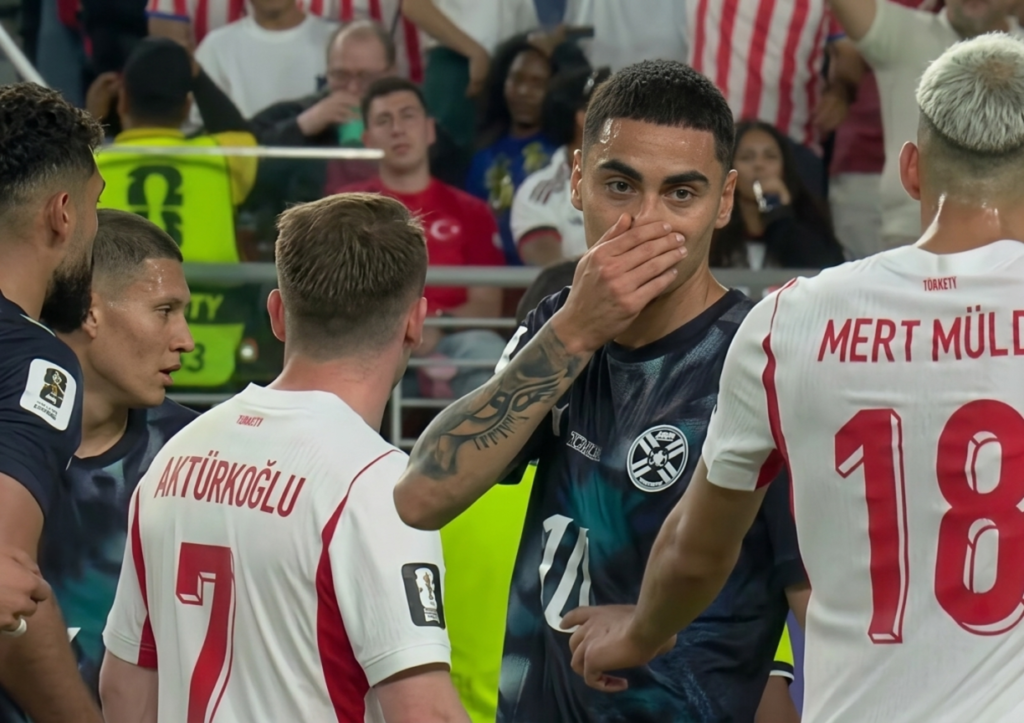
Santa Clara, California — There is a particular kind of image that football produces only a handful of times in a single tournament: a player frozen mid-walk, hand still hovering near his face, eyes somewhere between disbelief and resignation, teammates closing ranks around him not to celebrate but to console. That was the scene at the San Francisco Bay Area Stadium on the night of June 19, 2026, when Paraguay’s veteran attacking midfielder Miguel Almirón became the answer to a trivia question nobody wanted to be remembered for. He is the first player in the history of the FIFA World Cup to be sent off for covering his mouth during an on-field altercation — the inaugural casualty of what football’s governing bodies have officially filed away in their statute books, but what the sport’s rank and file have already nicknamed the “Prestianni Rule.”
The label is unofficial, born on social media and adopted almost instantly by broadcasters, but its origin story is entirely real, and understanding it is the only way to make sense of why a thirty-two-year-old, soft-spoken playmaker from Asunción — a player better known for setting up goals than for picking up cards — suddenly found himself at the center of a debate about football’s relationship with discrimination, video review, and the limits of subjective officiating. This piece sets out to do three things: reconstruct exactly what happened in Santa Clara and why; trace the rule back to its source in a bitter European night several months earlier; and, most importantly, examine what the precedent set by Almirón’s dismissal actually means for the remainder of this World Cup, for the players who will be judged under the same law in the weeks ahead, and for the long-term character of a sport now armed with a tool explicitly designed to punish concealment rather than the words being concealed.
The Sixty-Four Seconds That Almost Didn’t Matter
Paraguay’s night began about as well as it possibly could. Sixty-five seconds after kickoff, Matías Galarza buried an early opener that sent the Paraguayan bench into raptures and appeared to settle the nerves of a team that had been thumped 4-1 by co-hosts the United States in its opening fixture. For a team appearing at its first World Cup since 2010, the fast start represented exactly the kind of statement Paraguay needed after a chastening opener.
Then came stoppage time at the end of the first half. Following a foul near midfield, Almirón and Turkish full-back Mert Müldür exchanged words. As the conversation grew heated, Almirón raised his hand to his mouth while speaking — a gesture so habitual in football that it has barely registered as notable for decades, a way of shielding a private remark, an insult, a tactical instruction, or nothing at all from lip-reading cameras and opposing ears alike. Müldür immediately turned to referee Iván Barton and gestured for action. Barton, working in consultation with the video assistant referee, walked to the pitch-side monitor, reviewed the replay, and emerged with his arm raised: a straight red card, no caution, no second look. Paraguay would play the entire second half with ten men.
What makes the sequence remarkable is not the severity of whatever was said — neither club nor governing body has alleged that Almirón directed anything racist, homophobic, or otherwise discriminatory at Müldür — but the fact that, under the newly written Law of the Game, intent and content are almost beside the point. The trigger is the gesture itself, performed during a clearly antagonistic exchange. Paraguay coach Gustavo Alfaro summed up the mechanical nature of the decision afterward: there was, in his own words, simply nothing to be done once the letter of the law had been applied. Paraguay held on, somehow, for a 1-0 win that eliminated Türkiye from group-stage contention and kept their own campaign alive — but the result was almost an afterthought next to the disciplinary history being written in real time.
Where the Law Was Born: A Night in Lisbon
To understand why a simple hand-to-mouth gesture now carries World Cup-ending consequences, it is necessary to travel back to February 2026 and a Champions League knockout-stage playoff between Benfica and Real Madrid at the Estádio da Luz. Vinícius Júnior had given Real Madrid the lead in the 50th minute and celebrated by dancing near the corner flag — a piece of showmanship that Benfica’s players found needlessly provocative. What followed has become one of the most analyzed flashpoints in recent European football: as players converged near the touchline, Benfica’s young winger Gianluca Prestianni was filmed leaning toward Vinícius and speaking directly to him while covering his mouth with the collar of his own shirt. Vinícius reacted instantly, pointing toward Prestianni and sprinting to the referee, visibly distressed. Play was halted for ten minutes while match officials activated anti-discrimination emergency protocols, and Vinícius initially refused to continue.
The accusation, corroborated at the time by Real Madrid teammates Kylian Mbappé and Aurélien Tchouaméni, was that Prestianni had called Vinícius a racial slur. What gave the episode its lasting significance, however, was the fact that the covered mouth made the allegation almost impossible to verify through lip-reading or broadcast audio — precisely the kind of evidentiary gap that has bedeviled discrimination cases in football for years. UEFA’s ethics and disciplinary body opened a formal investigation, and weeks later, Prestianni himself supplied an account that shifted the entire framing of the case: according to reporting at the time, he told investigators that he had not used a racial term at all, but rather a homophobic slur in Spanish. UEFA’s disciplinary panel ultimately concluded that the conduct was, in fact, anti-gay rather than racial in nature — a finding made under Article 14 of UEFA’s disciplinary code, which treats both categories of discriminatory abuse with an identical sanctions framework.
The punishment that followed struck many observers, including some inside Real Madrid’s own dressing room, as unexpectedly lenient. Prestianni was given a six-match suspension, but three of those matches were suspended for a two-year probationary period, and the ban included time he had already served provisionally during the original investigation. In practical terms, the Argentine winger needed to sit out only two further fixtures unless he reoffended. Benfica, for its part, mounted a vigorous defense of its player throughout the process, while then-Benfica manager José Mourinho publicly suggested that Vinícius’s own celebration had provoked the confrontation — though Mourinho also stated plainly that Prestianni’s career would be effectively over if the original racism allegation had been substantiated. UEFA separately fined Benfica for discriminatory chanting from sections of its own support during the match, layering an additional institutional embarrassment onto an already toxic night.
It was in the aftermath of this single incident — replayed endlessly, dissected from every camera angle, and ultimately impossible to resolve definitively because the words themselves had been physically hidden from view — that FIFA president Gianni Infantino began publicly pushing for a structural fix. Speaking before the punishment was even finalized, Infantino argued for a doctrine of presumption: if a player feels compelled to hide his mouth while speaking to an opponent in a heated moment, the act of concealment itself should be treated as sufficient grounds for a sending-off, on the theory that a player with nothing discriminatory or abusive to hide would have no reason to cover his face in the first place.
How a Lisbon Flashpoint Became a Global Law
Infantino’s argument did not stay rhetorical for long. The International Football Association Board — the body that, alongside FIFA, holds sole authority to amend the actual Laws of the Game — had already scheduled discussion of mouth-covering conduct at its February Annual General Meeting, and the Prestianni-Vinícius case gave that discussion unmistakable urgency. At a special meeting held in Vancouver in late April 2026, ahead of the FIFA Congress, the IFAB unanimously approved a new provision, framed in characteristically careful regulatory language: at the discretion of the competition organizer, any player covering their mouth in a confrontational situation with an opponent may be sanctioned with a red card.
Several features of that wording matter enormously for how the rule plays out in practice, and they deserve to be spelled out plainly because they are routinely flattened in casual coverage. First, the rule is not a blanket prohibition on covering one’s mouth; players still routinely shield their lips from television cameras or lip-readers while discussing a free-kick routine with a teammate, or while exchanging a private joke, and none of that triggers sanction. Second, the operative trigger is the word “confrontational” — a subjective, context-dependent standard that places enormous interpretive weight on the on-field referee and, by extension, the video assistant referee reviewing the replay. Third, the rule was explicitly scoped for implementation at the 2026 World Cup as a flagship application, but because it was passed as an amendment to the actual Laws of the Game rather than as a one-off tournament regulation, leagues and competitions around the world are now free — and in many cases expected — to adopt it as well in the upcoming season.
The IFAB passed a second, related amendment at the same Vancouver meeting, giving referees discretion to issue red cards to players who walk off the pitch in protest of a decision, along with team officials who incite such a walkout. Both changes were marketed by FIFA as a coordinated package aimed at curbing what the federation has called inappropriate and discriminatory conduct, but it is the mouth-covering provision that has captured public attention, almost entirely because of the speed and high profile of its first application.
There is a layer of irony sitting underneath all of this that is almost too tidy for fiction. Gianluca Prestianni, the player whose name now informally attaches to the rule, was named in Argentina’s preliminary World Cup picture but ultimately left out of Lionel Scaloni’s final squad — meaning the suspension that triggered this entire regulatory chain has, as of this writing, still gone unserved at the international level, even as a completely unconnected Paraguayan midfielder became the first man in football history to be punished under the law that bears his name.
A Reluctant Trailblazer: Who Is Miguel Almirón?
Almirón’s red card landed with particular weight because of who he is within Paraguayan football, not merely what he did on a Friday night in Northern California. Born into a family of modest means in Asunción’s San Pablo neighborhood — his father working extended security shifts, his mother employed at a supermarket, seven family members sharing three bedrooms — Almirón was repeatedly judged “too frail” by youth coaches and rejected by one of the country’s biggest academies before finding a foothold at Cerro Porteño. He moved to Argentina’s Club Atlético Lanús in 2015, helped the club to a league title the following year, and was signed by expansion side Atlanta United ahead of Major League Soccer’s 2017 season, where he quickly became one of the league’s most electric attacking talents, winning MLS Cup in 2018 and earning back-to-back selections to the league’s Best XI.
That form earned him a club-record £21 million move to Newcastle United in January 2019 — at the time the highest fee ever paid for an MLS player — and Almirón spent six seasons in the Premier League, making 223 appearances across all competitions, scoring 30 goals, and becoming enough of a cult favorite among Newcastle’s supporters that they composed a chant in his honor. His best individual campaign came in 2022-23, when he scored eleven Premier League goals as Newcastle finished fourth and qualified for the Champions League for the first time in two decades; that October he was named the league’s Player of the Month. He returned to Atlanta United in January 2025 in a deal worth a reported ten million dollars, was named team captain, and led the club in goal contributions during the 2025 MLS season.
At international level, Almirón has long carried more responsibility than his understated public profile might suggest. He made his Paraguay debut in 2015, has captained the national side on multiple occasions since 2022, and arrived at the 2026 World Cup with more caps than all but one of his teammates and as the squad’s all-time leading scorer in the current cycle, with nine international goals. This tournament marked his first World Cup appearance — a milestone that, for a player who had already spent more than a decade as one of Paraguay’s most important attacking pieces, carried unmistakable personal significance. Watching him cover his face after the sending-off in Santa Clara, hand pressed to his mouth in a gesture that visually echoed the very infraction he had just been punished for, was its own small piece of unintentional symbolism — a player who had waited his entire career for this stage now forced to watch the second half of his second group match from the locker room.
A Pattern, Not an Anomaly: Almirón and the New Era of Video Scrutiny
What sharpens the storyline further is that this was not Almirón’s first brush with the tournament’s expanded video-review architecture. In Paraguay’s opening match against the United States, video review overturned an initial yellow card shown to American defender Tim Ream and instead booked Almirón for simulation, after officials determined he had exaggerated contact to win a free-kick. Two matches into his first World Cup, then, Almirón had already been carded twice — once for diving, once for concealment — both decisions reached only after VAR intervention reversed or shaped the on-field call. It is a small but telling data point about how thoroughly video review has reordered the calculus of risk for players at this tournament: fouls, gestures, and reactions that might once have drawn a private word from the referee, or nothing at all, are now subject to forensic, frame-by-frame reconstruction with disciplinary consequences attached.
Alfaro, visibly protective of his player in the aftermath, told reporters that Almirón was emotionally shaken in the dressing room and that the coaching staff intended to rally around him rather than allow him to dwell on guilt. Alfaro went further, articulating a worry that many longtime observers of the sport share: that the accumulation of discretion-driven red-card categories — leaving the pitch in protest, covering the mouth, simulation — risks something subtler than mere strictness. “The fear I have is that football loses its essence,” he said, a concern less about any single decision than about the cumulative texture of a game increasingly adjudicated through slow-motion replay and probabilistic judgment calls rather than the split-second instincts that have historically defined refereeing.
The Messi Problem: Why Subjectivity Is the Rule’s Greatest Vulnerability
Within hours of Almirón’s sending-off, a parallel image began circulating across social platforms: Lionel Messi, captured during Argentina’s own opening match, with his hand raised to his mouth while speaking to a teammate or opponent. The juxtaposition — global superstar seemingly performing an identical gesture without consequence, while a far less famous Paraguayan midfielder was sent off for what looked, to the untrained eye, like the same motion — generated an immediate wave of commentary along the lines that the law somehow exempted the sport’s biggest names. One widely shared reaction distilled the sentiment bluntly: the suspicion that the law applies to everyone except Messi.
The actual explanation is more mundane than conspiratorial, but it exposes the structural fragility at the heart of the new rule. The IFAB’s text does not punish mouth-covering as a category of physical behavior; it punishes mouth-covering specifically within a “confrontational situation.” Messi’s gesture, as best as can be determined from available footage, occurred outside any visible dispute or hostile exchange — the conversational equivalent of shielding a tactical aside, which the law explicitly permits. Almirón’s gesture occurred in the middle of an active, heated exchange that Müldür himself flagged to the referee in real time. The law, in other words, is not actually inconsistent on its face; what it is, unavoidably, is interpretive. It asks a human referee, often working in the chaos of a contested midfield skirmish, to make an instantaneous character judgment about the emotional temperature of an exchange and then retroactively justify that judgment to a video review panel.
This is precisely the quality that makes the Prestianni Rule simultaneously well-intentioned and structurally precarious. Its purpose is unimpeachable: discriminatory abuse hidden behind a raised hand or shirt collar has been one of the most persistent and least solvable problems in football’s long, uneven effort to police bigotry on the pitch, precisely because broadcast audio and lip-reading evidence — the tools usually used to adjudicate these allegations — are rendered useless the moment a player learns to cover his mouth. By making the act of concealment itself punishable, rather than requiring proof of what was actually said, the rule sidesteps an evidentiary problem that had stalled previous disciplinary cases, including the original Prestianni-Vinícius dispute itself, where investigators were ultimately forced to rely on the accused player’s own account of what he had said rather than any verifiable record.
But that same design choice — penalizing the gesture rather than the speech — necessarily produces collateral consequences for players whose underlying words were entirely benign. Nothing in the public record suggests Almirón directed anything discriminatory, or even particularly inflammatory, at Müldür; by every account so far, this appears to have been a heated but otherwise ordinary piece of on-field needling that happened to coincide with an instinctive, half-conscious hand gesture many players have performed thousands of times in their careers without a second thought. He was punished not for what he said, but for the manner in which he said it — collateral damage absorbed by the broader, defensible goal of closing a discriminatory-abuse loophole. Whether football’s stakeholders ultimately judge that trade-off acceptable will likely depend on how often it recurs, and how unevenly it gets applied across different referees, confederations, and broadcast contexts over the coming weeks and seasons.
The Numbers Behind the Headline: What Almirón’s Absence Actually Costs Paraguay
Strip away the symbolism, and the red card carries a concrete competitive price that data-driven projection models have already begun to quantify. Before the sending-off, statistical models — including the widely cited projection system maintained by The Athletic — gave Paraguay roughly an 84 percent likelihood of advancing out of Group D. The win over Türkiye, secured despite playing the entire second half a man down, actually improved that outlook rather than damaging it: with the United States having already clinched top spot in the group by beating Australia 2-0, Paraguay’s victory eliminated Türkiye from contention entirely and left Paraguay needing only a draw against Australia in their final group match to all but guarantee passage to the knockout rounds, with models placing that probability near 99 percent in the event of a draw. A defeat to Australia, however, would be considerably more punishing: Paraguay’s goal difference, dragged into negative territory by the 4-1 opening loss to the United States, would leave their hopes of qualifying as one of the tournament’s best third-placed teams sitting closer to a 44 percent likelihood — a swing of roughly fifty-five percentage points between the two outcomes.
Almirón will not be on the field for that decisive match. The one-match automatic suspension attached to any red card means he is unavailable for Paraguay’s June 25 fixture against Australia at the same San Francisco Bay Area venue, a contest that will effectively determine second place in Group D and, by extension, the seeding and opponent Paraguay would face heading into the Round of 32. For a Paraguayan side appearing at its first World Cup in sixteen years, every points table permutation and every available attacking option carries outsized stakes — and the absence of the squad’s most experienced outfield player and its joint-leading scorer for the cycle is not a trivial loss, even with Alfaro publicly framing the team’s response as an opportunity for other players to step forward.
There is also a less quantifiable but still real risk hanging over Almirón’s tournament. FIFA’s disciplinary committee retains authority to extend a player’s suspension beyond the automatic minimum if it judges the underlying conduct severe enough, meaning a knockout-stage ban for Almirón — should Paraguay advance without him — has not been definitively ruled out as of this writing, even though early reporting suggests Alfaro and Paraguayan federation officials are hopeful any additional sanction will be minimal. The uncertainty itself functions as a quiet tax on the team’s planning: Paraguay’s coaching staff must now prepare contingencies for a knockout run that might or might not include their captain-in-waiting and emotional centerpiece.
The Precedent Problem: What Almirón’s Case Teaches Referees, Players, and Federations
Every new law in football’s rulebook needs a first application to become real rather than theoretical, and the manner of that first application inevitably shapes how the rule is perceived, taught, and enforced for years afterward — sometimes more than the text of the law itself. The fact that the inaugural sending-off under the Prestianni Rule involved no proven discriminatory language, a relatively low-profile confrontation between two players not previously known for disciplinary trouble, and a result that fortunately did not cost the offending team the match, has already begun shaping the public narrative around the rule in a particular direction: not as a triumphant vindication of football’s anti-discrimination machinery, but as a cautionary tale about how broadly the net can be cast.
That narrative matters enormously for how players around the world adjust their on-field habits in the weeks and months ahead. Coaches and federations watching from outside the United States will have absorbed a clear behavioral lesson from Santa Clara: any hand-to-mouth gesture performed during a recognizably heated exchange, regardless of actual content, now carries catastrophic tournament-ending risk. The most likely immediate consequence is not a reduction in discriminatory speech — players intent on directing genuine abuse at an opponent will simply learn to do so without the now-incriminating physical tell, rendering the rule’s central evidentiary workaround partially self-defeating over time — but rather a wholesale reduction in players covering their mouths at all, for any reason, during any moment of visible tension. Lip-reading specialists, broadcasters, and rival benches may, perversely, end up with a clearer audiovisual window into player conduct than they have ever had before, not because the rule successfully isolates discriminatory speech, but because it makes the broader gesture of concealment too dangerous to risk regardless of motive.
This dynamic places enormous pressure on referees and the video assistant referee infrastructure to calibrate consistently what actually counts as “confrontational” — a threshold that, as the Messi comparison demonstrated within hours of Almirón’s dismissal, is going to generate recurring public disputes precisely because it depends on perceived emotional tone rather than any measurable, video-verifiable criterion. Expect, over the remainder of this tournament and into the start of the 2026-27 club season across leagues that adopt the IFAB amendment, a steady stream of comparative highlight reels juxtaposing punished and unpunished mouth-covering incidents, each one testing whether match officials are applying a coherent standard or essentially making case-by-case calls that happen to look inconsistent in retrospect. The credibility of the entire rule — and, by extension, football’s broader anti-discrimination enforcement architecture — will rest heavily on whether referees across different countries, cultures, and competitions can converge on a shared, defensible reading of what “confrontational” actually means in practice, rather than each tournament or league effectively inventing its own threshold through accumulated, inconsistent precedent.
There is a longer historical echo worth noting here. Video assistant refereeing itself, when introduced at the 2018 World Cup, went through an almost identical credibility cycle: early, high-profile decisions that struck large portions of the viewing public as either overly pedantic or maddeningly inconsistent, followed by a gradual, multi-year process of refereeing calibration, public habituation, and incremental rule clarification that eventually settled the technology into something closer to broad, if imperfect, acceptance. The Prestianni Rule appears to be entering exactly that same early, turbulent phase, and Almirón’s case will likely be cited for years as the textbook first example — not necessarily because it was applied incorrectly, but because it was applied to a situation ambiguous enough to expose every fault line in the rule’s design simultaneously.
The Broader Stakes: Discrimination, Optics, and the Limits of a Strict-Liability Approach
It would be a mistake to treat this story purely as a tactical or refereeing curiosity, because the rule’s origin reaches into one of football’s most stubborn unresolved problems: the difficulty of proving discriminatory abuse when it occurs in real time, on a pitch, often drowned out by crowd noise and obscured by camera angles, leaving investigators to choose between competing, unverifiable accounts from players with every incentive to minimize their own exposure. The Prestianni-Vinícius case demonstrated this difficulty starkly — three separate Real Madrid players corroborated an allegation of racial abuse, yet the accused player’s own subsequent account, delivered once an investigation was already underway, shifted the official finding toward a different and ultimately more lightly sanctioned category of discriminatory conduct. Whatever one believes happened on that February night in Lisbon, the episode exposed a genuine institutional weakness: football’s disciplinary apparatus, for all its video technology, still struggles to establish facts when the central evidence — spoken words — can be physically hidden from every available recording device.
The mouth-covering rule represents football’s most direct attempt yet to close that evidentiary gap by changing the question being asked. Rather than requiring proof of what was said, it asks only whether concealment occurred during a recognizably hostile exchange — a strict-liability framework, in essence, that trades precision for enforceability. Strict-liability rules are not unusual in sport; doping regulations, certain match-fixing statutes, and various safety protocols operate on similar logic, holding individuals responsible for a triggering act regardless of underlying intent, precisely because requiring proof of intent in every case would make the rule functionally unenforceable. The tradeoff, as Almirón’s case illustrates vividly, is that strict-liability frameworks inevitably catch genuinely innocent or low-stakes conduct alongside the conduct they were designed to deter, and the resulting public perception of overreach can, ironically, undermine support for the underlying anti-discrimination goal rather than reinforcing it.
Football’s stakeholders now face a genuine governance choice in the coming months, separate from anything that happens on the pitch in the remainder of this tournament. They can hold the rule’s current broad wording in place and accept that a certain number of Almirón-style “false positive” sendings-off will occur as the cost of closing the discriminatory-abuse loophole, trusting that referees will gradually converge on a more predictable, narrower reading of “confrontational” through accumulated case law. Or they can revisit the IFAB’s wording after this World Cup concludes, perhaps introducing graduated sanctions — a caution for a first, ambiguous offense, reserving the red card for cases where some corroborating evidence of discriminatory content exists — that would reduce the rule’s blunt-force character at the cost of reintroducing some of the evidentiary problems it was designed to solve in the first place. Both paths carry real costs, and the debate triggered by a single Group D match in Santa Clara has, almost accidentally, become the live test case shaping which direction football’s regulators ultimately choose.
What Comes Next
Paraguay’s remaining task is straightforward on paper and considerably harder in practice: secure at least a draw against Australia on June 25 without their most experienced attacking presence on the field, in a match that will likely decide second place in Group D and shape the bracket both teams carry into the Round of 32. Alfaro has publicly expressed hope that any further disciplinary action against Almirón will be as limited as possible, allowing his captain-in-spirit to return for a potential knockout match, though that outcome remains in FIFA’s hands rather than Paraguay’s.
For the tournament at large, Almirón’s case has already done something that no amount of pre-event explainer journalism could have accomplished: it has made an abstract, recently passed regulatory amendment concrete, visible, and contested in the full glare of a World Cup broadcast. Every player at this tournament, and every coaching staff preparing a team for it, now has a vivid, specific reference point for exactly how aggressively the mouth-covering law can be applied, exactly how little room for ambiguity the rule’s wording leaves once a referee judges an exchange “confrontational,” and exactly how quickly the court of public opinion will scrutinize the next decision for consistency. Whether the Prestianni Rule ultimately succeeds in its founding purpose — protecting players from concealed discriminatory abuse — or becomes remembered primarily as a well-intentioned overcorrection that punished an unrelated piece of ordinary on-field needling, the answer will be written not in Vancouver boardrooms but in the dozens of similar, ambiguous flashpoints still to come across this tournament and the domestic seasons that follow it. Miguel Almirón did not ask to be the test case. But football, for better or worse, now has one.