THE MOMENT SPAIN’S FUTURE CRYSTALLIZED: LAMINE YAMAL’S WORLD CUP BREAKTHROUGH SIGNALS EUROPEAN DOMINANCE AHEAD

How an 18-Year-Old’s Historic Goal Against Saudi Arabia Demonstrates Spanish Technical Excellence and Generational Talent Development
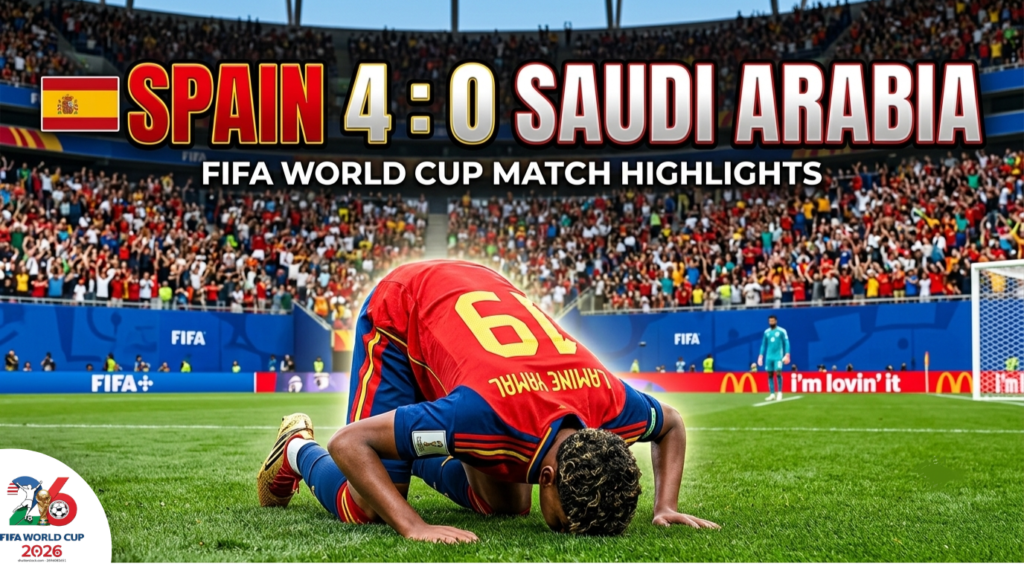
The tenth minute of Spain’s crucial World Cup group stage match against Saudi Arabia will be remembered as the moment when Spain’s tournament narrative shifted decisively from uncertainty to confident momentum. Lamine Yamal, the eighteen-year-old Barcelona winger making only his second appearance of the tournament, slid in at the back post to finish a perfectly weighted delivery from Mikel Oyarzabal, scoring his first World Cup goal and simultaneously rescuing Spanish ambitions that had appeared jeopardized by a disappointing goalless draw against Cape Verde in the opening round. The simplicity of the goal—a straightforward sliding finish at the back post—belied its significance. For Spain, the moment represented the arrival of the generational talent that had been carefully managed and prepared for this stage. For Yamal, the goal represented the arrival on the world’s greatest sporting stage of a player whose trajectory has already redefined expectations about how young players can contribute at the highest competitive levels.
Spain’s path to this match had been unexpectedly complicated. The Spanish team, reigning European champions from Euro 2024 and widely considered among the tournament favorites, had stunned observers by failing to break through the defensive organization of Cape Verde in their opening group match. Despite overwhelming possession statistics—Spain controlled the ball for seventy-two percent of match duration—and shooting volume that seemed sufficient for multiple goals, the Spanish attack had misfired. The team had generated twenty-seven shot attempts yet had not found the target even once. This outcome would have been unexpected under any circumstances; when the team in question was the technically proficient, possession-dominant Spanish side, the result seemed almost impossible. The draw left Spain level on one point with every other team in Group H, transforming a group that many analysts had assumed Spain would dominate into a genuinely competitive and wide-open situation where advancement was far from guaranteed.
The uncertainty that resulted from the Cape Verde draw created a specific context for the Saudi Arabia match. Spain could not afford another disappointing outcome. The dynamics of the expanded World Cup format, with advancement determined by the top two teams from each of twelve groups plus the eight best third-placed teams, meant that even a second draw might not guarantee progression. Additionally, Spain’s confidence heading into the tournament had been based on the assumption of dominant performances that would suppress opponents and generate comfortable victories. The Cape Verde result had undermined that psychological foundation. Players and coach Luis de la Fuente faced genuine pressure to restore the attacking efficiency that had been absent against the African debutants.
The decision to start Lamine Yamal represented both recognition of this pressure and faith in the young player’s ability to provide the attacking breakthrough that Spain required. Yamal had not played competitive football since April due to a combination of hamstring and groin injuries that had sidelined him through the entire injury rehabilitation period. Most teams would have chosen conservatism, gradually integrating such a player through substitute appearances across multiple matches. Spain, however, recognized that Yamal’s technical qualities and capacity to exploit defensive space through combinations of dribbling and positioning offered precisely the attacking dynamism that had been absent against Cape Verde. De la Fuente made the calculated decision that starting Yamal represented the optimal pathway to unlocking the Saudi Arabian defense, accepting the injury-management risk as worthwhile given the tournament context.
The Saudi Arabia team that Spain faced had created its own narrative of competence and resilience. New manager Georgios Donis, who had assumed the position only two months before the World Cup, had organized the team with remarkable discipline in their opening match. The surprise draw against Uruguay—a result that would have been considered highly improbable in pre-tournament analysis—provided genuine confidence to the Saudi squad. The historical precedent of Saudi Arabia’s memorable 2-1 victory over Argentina in the 1994 World Cup, combined with their draw against Uruguay, suggested that they possessed tactical organization and mental resilience that could complicate even technically superior opponents. The Saudi defensive approach relied on a compact shape designed to minimize passing lanes through the center of the pitch and force Spain to attempt wide play where defensive compactness could be maintained.
Against this organized defensive setup, Yamal’s involvement became the primary Spanish weapon. The combination of his ability to stretch lateral space through his pace and positioning, combined with his technical capacity to deliver precise passes to teammates positioned in vulnerable defensive areas, created numerical advantages in specific zones that Saudi Arabia could not simultaneously defend. The goal itself exemplified this dynamic. Oyarzabal had possession of the ball in a wide area, and rather than attempting to force a shot directly, he delivered a pass back across the Saudi penalty area to the far post. Yamal, having positioned himself to exploit the spatial vulnerability at the back post created by his wide movement forcing defensive attention, was able to convert the delivery with a simple sliding finish.
The goal energized Spanish attacking play in a way that the Cape Verde match had not achieved despite the overwhelming possession statistics. The psychological difference between struggling to score despite dominance and achieving an early breakthrough cannot be overstated. Once Spain had taken the lead, their attacking approach became progressively more fluid and efficient. The release of psychological pressure allowed the team to play with greater freedom and confidence. Oyarzabal, who had been criticized for his overall impact during the Cape Verde match despite numerous opportunities, responded to his own assist by scoring twice in rapid succession. The Spanish attacking performance in the first half following Yamal’s opening goal demonstrated the technical quality that had been obscured by the sterile dominance of the opening match.
The significance of Yamal’s goal extends well beyond the immediate tactical context of this specific match. At eighteen years old, Yamal has already accumulated a professional resume that would represent a lifetime achievement for most players. He made his competitive debut for Barcelona while still seventeen, has become a regular starter for one of the world’s most prestigious football clubs, and has already accumulated international experience at the highest level. His performance at Euro 2024, where he contributed meaningfully to Spain’s tournament victory, demonstrated that his technical abilities could function effectively against the best defensive organizations in European football. Yet the World Cup represents a different category of competition. The elevation from continental to truly global competition, the expanded talent pool, and the intensity of World Cup football represent a step change from even prestigious club competition or regional continental tournaments.
Yamal’s successful negotiation of this step change through his goal against Saudi Arabia provides objective evidence that his talent trajectory has not reached any plateau but continues ascending. For Spain, this has substantial long-term implications. The integration of young, talented players with high ceilings into the national team creates the foundation for continued competitive success across multiple World Cup cycles. The traditional Spanish model of possession-based football requires technically sophisticated players who can maintain ball possession under pressure and generate attacking opportunities through intricate passing combinations. Yamal represents precisely this profile of player. His development means that Spain possesses a generational talent around whom to build future competitive campaigns.
The broader context of Spanish football development deserves consideration. The eight members of Spain’s twenty-six-person squad who come from Barcelona represent a concentration of talent that provides institutional continuity and tactical coherence. Additionally, Spain’s exclusive selection of Barcelona players represents a unique moment in Spanish football history—for the first time in Spanish World Cup history, the squad contains no Real Madrid players. This concentration reflects Barcelona’s period of organizational effectiveness in youth development and player progression. It also reflects the gradual consolidation of football talent in elite institutional structures, a trend that extends well beyond Spain but has particular implications for a team that has built competitive success on the foundation of possession-based technical football.
The injury management that Spain demonstrated with Yamal provides insight into the sophistication of contemporary tournament preparation. Rather than deploying Yamal extensively in group stage matches and risk-ing re-injury that could sideline him for later stages, Spain carefully calibrated his minutes. Against Cape Verde, he received approximately twenty minutes of playing time to assess his physical condition. Against Saudi Arabia, he began in the starting lineup but with the expectation that he would be substituted after approximately sixty minutes to manage his workload. This approach represents recognition that the tournament’s structure, with knockout matches determining advancement, places greater competitive importance on later stages than on group matches. Sacrificing potentially incremental advantage in group matches to ensure player fitness for knockout football represents a rational optimization of competitive resources.
Spain’s dominant 4-0 victory against Saudi Arabia, built on Yamal’s breakthrough opening goal and sustained by contributions from Oyarzabal and others, provided the psychological reassurance that the Cape Verde draw represented a temporary aberration rather than evidence of fundamental team problems. The margin of victory—four goals—was decisive enough to restore confidence in the Spanish team’s technical capabilities and attacking proficiency. With this victory, Spain moved to four points from two matches, positioning themselves favorably for progression from Group H. More importantly, the performance restored the narrative arc that had been disrupted by the Cape Verde draw. Spain had reasserted the technical dominance and attacking efficiency that justified their pre-tournament status as significant contenders.
Looking forward across the tournament, Yamal’s emergence as a functional contributor rather than a project for future development changes Spain’s competitive calculus. Teams often rotate and manage younger players through group stage matches with expectations that they will achieve full availability for knockout football. Spain has essentially succeeded in accelerating this process. Yamal has already proven capable of functioning at World Cup level, has already scored a goal, and has already contributed to team victory. By the time Spain face Uruguay in their final group match and subsequently progress to knockout football, Yamal will have gained additional tournament experience and will have had his fitness progressively expanded. This represents an acceleration of his integration into the team compared to what would have occurred if Spain had continued managing him conservatively through multiple matches as a substitute.
The implications for Saudi Arabia were demonstrably negative. The defensive discipline that had produced a respectable draw against Uruguay proved entirely insufficient to contain the Spanish technical superiority once Spain found attacking rhythm. The four-goal margin represented a comprehensive dismantling of whatever organizational framework Saudi Arabia had attempted to implement. For Saudi manager Georgios Donis, the match represented a harsh reminder that the global gulf in technical football capabilities between the most elite national teams and those of more modest pedigree remains substantial. Despite Donis’s tactical organization and Saudi Arabia’s competitive achievement against Uruguay, when confronted with Spain’s combination of technical proficiency, attacking dynamism, and positional intelligence, Saudi Arabia possessed no adequate defensive response.
Yamal’s goal carries additional significance as a demonstration of the Spanish football development model’s continued vitality. Throughout the 2010s, Spanish football underwent criticism for over-dependence on possession-based approaches that could be disrupted by organized defensive compactness. The success of other nations employing different tactical philosophies suggested that Spain’s approach might have reached obsolescence. Yet Spain’s Euro 2024 triumph and their performance at the 2026 World Cup—despite the unexpected Cape Verde result—demonstrate that Spanish football remains competitive and continues evolving. The integration of younger players like Yamal, who combine the technical foundation of Spanish football tradition with pace and dynamism that addresses previous tactical limitations, represents the adaptive evolution of Spanish football.
The moment of Yamal’s goal, captured in the tenth minute of the Spain versus Saudi Arabia match at Atlanta’s Mercedes-Benz Stadium, crystallized multiple dimensions of contemporary football: the emergence of generational talent, the validation of institutional player development systems, the tactical evolution required to maintain competitiveness in modern football, the careful management of player fitness and injury recovery, and the reassertion of technical superiority when applied against opponents lacking equivalent capabilities. For Spain, the goal provided the psychological breakthrough required after the disappointment of the Cape Verde draw. For Yamal, the goal represented the public announcement of his arrival at the world’s greatest sporting stage, an announcement that he has answered the questions about whether his club-level performance would translate to international tournament football. For the broader context of world football, the goal represented one small moment in the ongoing evolution of tactical sophistication and talent development that characterizes the contemporary sport at its highest level.
SOURCES AND REFERENCES
- Al Jazeera – “Spain thrash Saudi Arabia 4-0 as Lamine Yamal scores his first World Cup goal” (June 21, 2026)
- World Soccer Talk – “Lamine Yamal and Mikel Oyarzabal lead Spain to 4-0 win over Saudi Arabia, seal Round of 32 World Cup 2026 spot” (June 21, 2026)
- ESPN – “Spain Group H analysis, lineups, and group stage progression” (June 2026)
- Wego Travel Blog – “Is Lamine Yamal Playing at the 2026 World Cup? Spain Squad, Latest Result and When to Watch” (June 2026)
- Official FIFA World Cup 2026 statistics and match records
- Spain national team official communications
- Barcelona football club official statements
This analysis is based on publicly available match data, official football statistics, and reporting from established sports news organizations as documented through June 21, 2026. The assessment reflects the state of the 2026 World Cup tournament as matches are being completed and recognizes that tournament outcomes and player development will continue to evolve as the competition progresses. This article is written for informational and analytical purposes to enhance understanding of football dynamics and player development rather than to predict specific tournament outcomes.