THE ENDURING LEGEND: HOW LIONEL MESSI’S RECORD-BREAKING WORLD CUP PERFORMANCE CONFIRMS HIS PLACE AS THE SPORT’S GREATEST GOALSCORER

Comprehensive Analysis of Messi’s Historic Achievement, the Records Shattered, and What His Dominance Means for Football’s Competitive Landscape
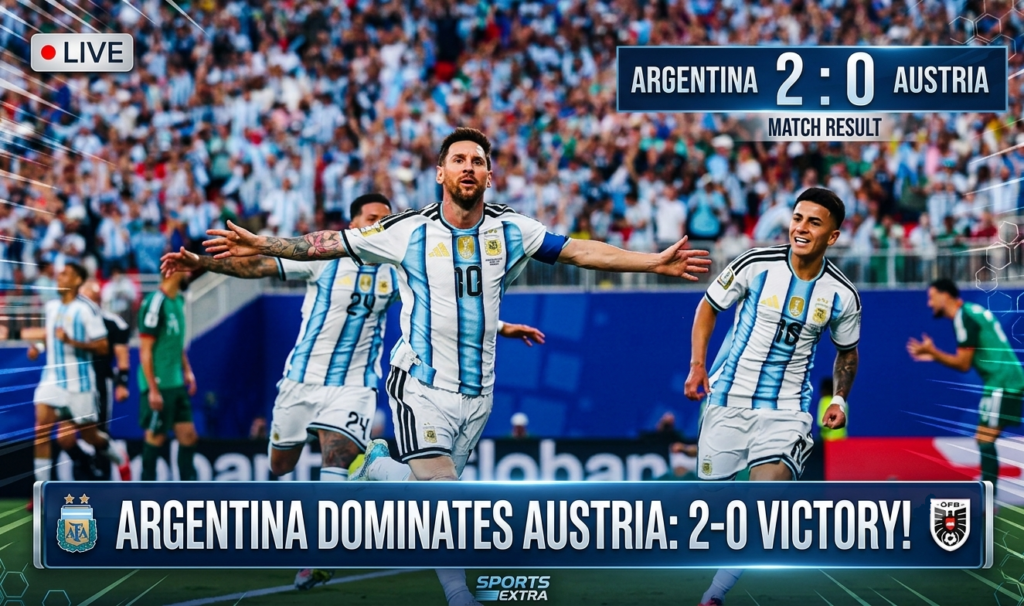
The moment arrived in the thirty-eighth minute of Argentina’s group stage match against Austria on June 22, 2026, in the controlled environment of Dallas Stadium in Texas. Lionel Messi, positioned on the edge of the Austrian penalty area, received possession and struck a ball with his renowned left foot with the precision and timing that have defined his career. The shot found the bottom-left corner of the goal past goalkeeper Alexander Schlager, and in that instant, football history was rewritten. With his seventeenth World Cup goal, the Argentine captain had surpassed Miroslav Klose’s long-standing record of sixteen goals that had stood as the benchmark for World Cup achievement for more than a decade. Remarkably, this momentous occasion represented merely the first of two goals Messi would contribute to Argentina’s comfortable 2-0 victory, as he added an eighteenth goal in the match’s final moments to seal his dominance of the record books.
The magnitude of Messi’s achievement cannot be fully appreciated without understanding the historical context against which it occurred. For twelve years, German striker Miroslav Klose’s record of sixteen World Cup goals had stood as seemingly insurmountable. Klose had represented one of the great goalscoring talents of his generation and had accumulated his goal total across four World Cup tournaments spanning from 2002 through 2014. The accumulation of sixteen goals across the sport’s most prestigious international tournament represented an extraordinarily rare achievement. Only a handful of players in football history have managed to score at even double-digit levels across their World Cup careers. The fact that the record had endured for more than a decade suggested that it might require another generation of goalscoring talent before it would be challenged. Yet Messi arrived at the 2026 World Cup with thirteen career World Cup goals already accumulated across five previous tournaments, positioning himself as a genuine threat to Klose’s record from the tournament’s commencement.
The path to this record-breaking moment had been marked by remarkable consistency across Messi’s extraordinary career. The Argentine had participated in every World Cup since 2006, missing the scoresheet only once across that eighteen-year span during the 2010 tournament in South Africa. This consistency of contribution across multiple generations of football represents a distinctive achievement in itself. Most goalscoring records are established by players whose primary focus during their careers centered on the sport’s most elite levels. Yet Messi established his record while simultaneously managing club commitments at the world’s most demanding institutions, while maintaining the role of national team captain with its attendant leadership responsibilities, and while adapting his playing style across multiple decades as the sport itself evolved. The cumulative effect of these sustained performances across such an extended timeframe distinguishes Messi’s achievement from those of other great goalscorers.
The immediate context for Messi’s record-breaking performance involved the curious circumstance that, despite his extraordinary opportunity to achieve this milestone, he had initially appeared unlikely to succeed on this particular occasion. In the ninth minute of the match, following a Video Assistant Referee intervention, the referee awarded Argentina a penalty kick. The entire Argentine team, the stadium crowd of 70,649 partisan supporters, and indeed football observers worldwide awaited what seemed an inevitable moment of historical fulfillment. Messi stepped forward to convert the penalty, yet in a striking departure from the script that seemed inevitably written, his attempt failed. His run-up was uncharacteristically tentative, and his execution proved insufficient, as the ball drifted wide of the target with agonizing imprecision. This penalty miss left observers questioning whether the moment of record achievement might need to be deferred.
Yet rather than confirming that the occasion was not meant to be, the missed penalty served merely to delay the inevitable. Twenty-nine minutes later, Messi engineered a different opportunity through superior positioning and technical execution. This time, he did not require the artificial advantage of a penalty kick but instead created his own opportunity through intelligent movement off the ball, receiving possession in a more advanced area and finishing with the left-footed accuracy that has characterized the best moments of his career. The contrast between the missed penalty and the successful goal illustrated an important dimension of Messi’s career longevity: his capacity to overcome setbacks and adversity through sustained excellence. Players less mentally resilient might have been diminished by the psychological impact of a missed penalty at such a critical moment. Messi instead responded by producing precisely the type of performance that has defined his greatness.
The achievement of surpassing Klose’s record proved even more historically significant when understood in its broader context. The first goal tied Messi with another legendary goalscorer: Marta of Brazil, who had accumulated seventeen World Cup goals across her international career. Marta’s achievement represented the highest goal total ever achieved in World Cup football by any female player, and her record had been acknowledged as one of football’s great achievements. By equaling Marta’s total, Messi joined a club of elite World Cup performers. His second goal against Austria, scored in the match’s final moments, elevated him to eighteen total World Cup goals, establishing him as the first male player to reach this threshold and surpassing Marta’s previous best. This distinction carries particular significance in contemporary football, where the professional recognition of women’s football has expanded dramatically and where comparative achievement across gender lines has become increasingly relevant.
The record-breaking performance came within the context of Messi’s already extraordinary performance at the 2026 World Cup. He had contributed three goals in Argentina’s opening match against Algeria, a dominant performance in a 3-0 victory that demonstrated his continued capacity to function at the highest level despite being thirty-eight years old. The hat-trick against Algeria had brought his career World Cup goal total to sixteen, equaling Klose’s previous record. The subsequent brace against Austria immediately elevated him beyond Klose’s mark while extending his tournament tally to five goals in just two matches. This goal-per-match average of 2.5 goals per game represents an extraordinarily efficient conversion rate and positions Messi as the leading candidate to win the tournament’s Golden Boot, awarded to the top goalscorer of the competition.
Beyond the raw scoring statistics, Messi’s record-breaking performance illuminates his sustained excellence at an age when most footballers have long since retired from the sport’s highest levels. At thirty-eight years old, approaching his thirty-ninth birthday, Messi continues to function as his nation’s captain, to lead by example on the pitch through intelligent play and decisive goal contribution, and to generate narratives around his individual performances that capture football attention worldwide. The number of outfield players who maintain genuine elite-level performance into their late thirties represents a remarkably small cohort. The fact that Messi has done so while simultaneously maintaining the physical and mental demands of being a World Cup contender speaks to extraordinary qualities of physical conditioning, professional dedication, and psychological resilience.
The circumstances surrounding Messi’s record also illuminate the broader competitive landscape of contemporary football. One significant narrative that emerged from Messi’s achievement concerned the rapidly emerging challenge to his newly established record from France’s Kylian Mbappé. At just twenty-seven years old, Mbappé has accumulated fourteen World Cup goals and continues to add to his total across the 2026 tournament. Mathematical projections suggest that Mbappé could potentially equal and surpass Messi’s record within the coming decade if he maintains even a modest goal-scoring pace at subsequent World Cup tournaments. This emerging potential competition adds a layer of narrative intrigue to Messi’s achievement. Rather than establishing a record that might endure indefinitely, Messi may have set a benchmark that a younger generation, embodied in players like Mbappé, will pursue and potentially surpass in years to come. The notion that Messi’s newly established record might be broken within his own lifetime or soon thereafter reflects the dramatic improvement in player longevity, professionalism, and the evolution of the sport at the highest levels.
The match itself, while dominated by Argentina in the crucial metrics of quality and decisiveness, carried sufficient intensity to merit description as bad-tempered by contemporary football standards. The physical nature of Austria’s defensive approach, while perhaps not crossing into the territory of genuine excess, created moments of friction and tension that resulted in multiple cautionary moments during the contest. Austria, under manager Ralf Rangnick, deployed a defensive strategy focused on compactness and prevention of clear-cut opportunities rather than on generating attacking momentum. This approach, while limiting Argentina’s opportunities for a more expansive performance, also meant that the match lacked the fluid technical character that might have been anticipated given the contrasting styles of the teams. Nevertheless, Argentina’s defensive organization and goalkeeper Emiliano Martinez’s assured performance ensured that Austria created only limited genuinely dangerous opportunities.
The broader implications of Messi’s record-breaking performance extend well beyond the immediate statistics and into questions of sporting legacy and historical assessment. Messi’s achievement of becoming the World Cup’s all-time leading goalscorer concludes a remarkable transformation in his historical positioning within football. Throughout his club career, primarily at Barcelona and subsequently at Paris Saint-Germain, Messi was often discussed primarily through the lens of his overall excellence, his technical proficiency, his creativity, and his role in collective success. The conversation about “greatest of all time” often emphasize elements beyond mere goal-scoring: his capacity to create opportunities for teammates, his soccer intelligence, his consistency across competitions and opponents, his leadership qualities. Yet this World Cup achievement, through the compelling narrative of a single, easily understood statistical record, provides a tangible and objective marker of his achievement across the sport’s most prestigious international tournament. It resolves, in concrete terms, an question that had animated football discussion for years: who is the greatest World Cup performer?
For Argentina specifically, Messi’s continued excellence provided essential reassurance as the team sought to progress through the group stage and ultimately defend the World Cup title won in Qatar four years previously. Argentina had entered the 2026 tournament as defending champions, carrying the psychological benefits of recent success but also the target that comes with defending incumbent status. The early accumulation of goals and the record-breaking performance provided a psychological boost and practical security in the group stage. With six points from two matches, Argentina had effectively secured passage to the knockout rounds and faced the remainder of the group stage from a position of comfort rather than pressure. The subsequent Round of 32 competition would require Argentina to perform against stronger opposition, but the foundation of advancement had been thoroughly secured.
The larger football landscape beyond Messi’s individual achievement included the broader competitive situation at the tournament. The early stages had produced multiple compelling narratives: the emergence of young talents like Lamine Yamal of Spain demonstrating that generational renewal was occurring even as Messi and Cristiano Ronaldo approached the end of their careers, the successful performances of various underdogs and surprise contenders, the continued dominance of historically strong football nations. Yet through all these competing narratives, Messi’s achievement in breaking the World Cup goalscoring record provided an overarching story that transcended national boundaries and spoke to the sport’s broader understanding of greatness. The capacity of a single player, at an advanced stage of his career, to continue producing at elite levels and to achieve records previously thought to be unreachable resonated across football’s global audience as a powerful testimony to his sustained excellence.
SOURCES AND REFERENCES
- Al Jazeera Sports – “Lionel Messi scores brace as Argentina beat Austria 2-0 at World Cup 2026” (June 22, 2026)
- FOX Sports – “Lionel Messi Breaks All-Time FIFA World Cup Scoring Record Against Austria” (June 22, 2026)
- Outlook Sports – “Messi Stands Alone: Argentine Legend Becomes FIFA World Cup’s All-Time Leading Goalscorer” (June 22, 2026)
- Olympics.com – “Lionel Messi becomes all-time leading FIFA men’s World Cup scorer” (June 22, 2026)
- HOLA – “Lionel Messi becomes FIFA World Cup’s all-time leading scorer with two historic goals against Austria” (June 22, 2026)
- FIFA Official – “World Cup 2026 Match Records and Statistics”
- Official World Cup 2026 Data and Broadcasting
This analysis is based on publicly available match data, official World Cup statistics, and reporting from established sports news organizations as documented on June 22, 2026. The assessment reflects the state of the 2026 World Cup tournament at the time of reporting and recognizes that tournament outcomes and player performance will continue to evolve as the competition progresses. This article is written for informational and analytical purposes to enhance understanding of football history and competitive dynamics rather than to advocate for specific outcomes or predictions.