THE FINAL EXAMINATION: HOW CRISTIANO RONALDO’S LIMITATIONS EXPOSE PORTUGAL’S VULNERABILITY IN WORLD CUP KNOCKOUT FOOTBALL

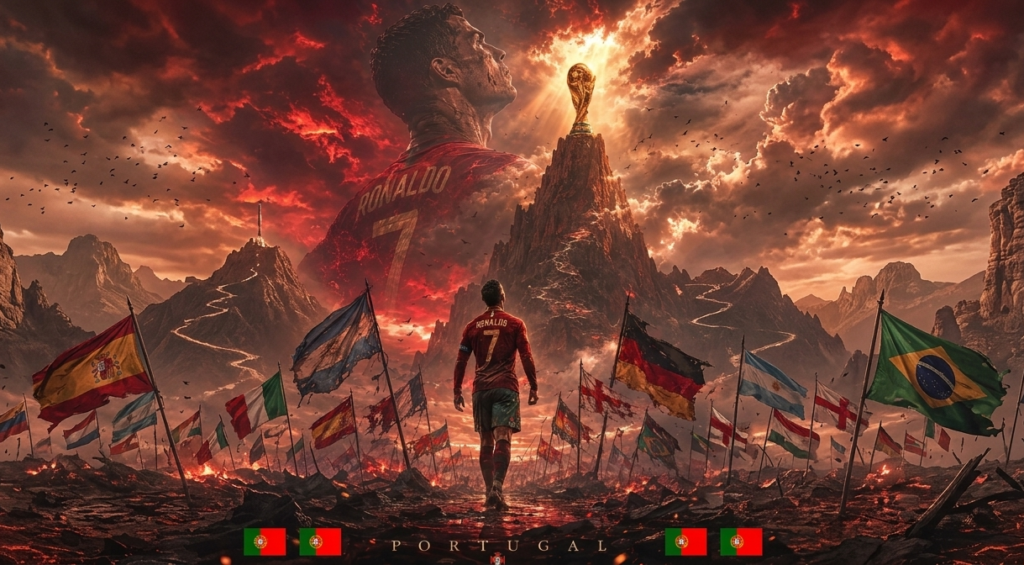
Comprehensive Analysis of Age, Tactical Constraint, and the Structural Disadvantages That Could Define Portugal’s Tournament Trajectory in Elimination Rounds
The assessment emerged from experienced football observers following Portugal’s disappointing group stage performance at the 2026 World Cup, where the nation managed only one victory across three matches despite possessing a squad widely regarded as one of the strongest in the tournament. Former football personalities and current analysts began articulating concerns that could be summarized as the central paradox confronting Portugal’s knockout stage aspirations: the presence of Cristiano Ronaldo, the nation’s greatest player and the world’s all-time international goalscorer, may represent more of a strategic liability than an asset when the team confronts elite opposition in elimination football. The characterization of his presence as an “inevitable disaster” for Portugal’s knockout stage prospects originated from a recognition that at forty-one years of age, operating within tactical constraints of his own creation, and carrying a historical record of consistent underperformance in knockout football, Ronaldo’s participation in the remaining tournament could paradoxically diminish Portugal’s probability of advancement.
The fundamental context underlying these assessments involves Ronaldo’s historically demonstrable difficulty in translating his exceptional group stage goalscoring capacity into knockout stage productivity. Across his remarkable international career spanning six World Cup tournaments, Ronaldo has accumulated eight goals in World Cup football. Yet this entire tally has come exclusively in group stage matches. He has never scored a single goal in World Cup knockout football despite participating in numerous knockout matches across his four previous World Cup appearances prior to 2026. This historical reality is staggering when examined against his overall international goalscoring record, where he has accumulated 143 goals across 229 appearances, establishing himself as the all-time leading international goalscorer in men’s football. The contrast between his group stage productivity and his complete absence of knockout stage goalscoring suggests that the conditions presented by knockout football contain some element that fundamentally undermines his effectiveness.
The 2026 group stage performance itself provided vivid illustration of the inconsistency that has increasingly characterized his tournament contributions. In the opening match against Democratic Republic of the Congo on June 17, Ronaldo managed an extraordinarily disappointing performance, generating three shot attempts, all of which missed the target, and squandering two close-range opportunities that might have constituted second-half winners. He was scoreless for the fifth consecutive World Cup match, extending a remarkable drought in major competitions that had now reached ten consecutive matches without goals. More troubling for Portugal’s longer-term prospects, his non-penalty goalscoring drought in major competitions extended back to June 19, 2021, a gap of nearly five years during which he had participated in World Cups, European Championships, and various other competitive tournaments without finding the target except through penalty kick conversions.
Yet rather than prompting considered assessment of whether a different tactical approach or personnel deployment might better serve Portuguese interests, coach Roberto Martinez had publicly defended Ronaldo’s continued presence in the starting lineup and insisted that maintaining him in the team represented the optimal strategic choice. Martinez had explicitly stated that “it makes no sense to get the best goalscorer in world football out in a game that you need goals,” a response that appeared to prioritize Ronaldo’s symbolic importance to the team over objective assessment of whether his presence was actually generating the attacking efficiency necessary for tournament advancement.
The subsequent redemptive performance against Uzbekistan, where Ronaldo scored twice in a 5-0 victory, temporarily eclipsed these concerns. The historic nature of becoming the first player to score in six World Cup tournaments provided a redemptive narrative and temporarily silenced critical voices. Yet the follow-up performance against Colombia, where Portugal managed only a goalless draw despite being heavily favored, reintroduced the fundamental concern: against organized defensive opposition of moderate quality, Ronaldo’s presence in the starting lineup appeared to constrain rather than enhance Portugal’s attacking efficiency.
The tactical limitations that increasingly defined Ronaldo’s contribution at this stage of his career reflected his profoundly diminished physical mobility compared to earlier phases of his career. The explosive pace and directional agility that had characterized his peak years had fundamentally deteriorated. At forty-one years of age, with limited capacity to operate effectively in the physical demands of elite football, Ronaldo functioned primarily as a focal point for aerial play and as a predatory presence in the penalty area. This created a strategic bottleneck in Portugal’s attacking approach. Because the tactical scheme necessarily required building play around Ronaldo’s limited mobility, opposing defenses could more readily predict and contain Portuguese attacking patterns. The team’s creative assets—including Bernardo Silva, Pedro Neto, Nuno Mendes, and Vitinha—were deployed in a manner designed to funnel possession and attacking opportunity toward Ronaldo rather than maximizing the team’s overall offensive efficiency.
Diego Forlan, the former Manchester United striker and 2010 World Cup Golden Ball winner, provided articulate analysis of this dynamic, characterizing Ronaldo as a “bottleneck” in Portugal’s attacking structure. Forlan observed that while Ronaldo retained predatory instinct within the penalty area, his lack of mobility prevented Portugal from stretching the pitch and creating space for other creative talents to operate effectively. The consequence was that Portugal’s attacking approach became increasingly predictable and defensively manageable. Elite opponents could effectively contain the team through compact defensive organization focused on preventing the delivery of crosses to Ronaldo and maintaining positional discipline to limit the spaces in which he operated.
The historical record of Ronaldo’s participation in knockout football at major tournaments revealed an even more alarming pattern. Beyond his complete absence of World Cup knockout goals, his performance in European Championship knockout football and other competitive elimination football had similarly failed to produce goalscoring returns consistent with his group stage productivity. This suggested that the psychological and tactical demands presented by knockout football—the elevated defensive intensity, the reduced margin for error, the requirement for sustained elite-level performance without the safety provided by the possibility of subsequent matches—represented challenges that Ronaldo had consistently struggled to overcome despite his extraordinary abilities in other contexts.
The broader squad composition appeared to create legitimate tactical alternatives that could potentially provide Portugal with enhanced flexibility in knockout football. Bruno Fernandes operated as an elite creative midfielder capable of generating attacking opportunity through passes, dribbling, and positioning rather than through direct finishing. Vitinha represented another high-level midfielder whose playmaking capabilities were increasingly constrained when tactical emphasis centered on Ronaldo as the primary attacking outlet. João Neves, the young Paris Saint-Germain midfielder, provided additional creative capacity that appeared underutilized in the tactical system designed around Ronaldo. The possibility existed that deploying a more balanced attacking approach, perhaps with Ronaldo utilized as a late-match substitute capable of providing fresh energy and predatory instinct rather than as a starting framework, might enhance Portugal’s probability of knockout stage advancement.
Yet this possibility confronted the psychological and political reality that Ronaldo represented far more than a footballer to Portuguese national consciousness. He had been the nation’s greatest international player for more than two decades. He had led Portugal to Euro 2016 victory, had captained numerous championship-caliber squads, and had established himself as a symbol of Portuguese football excellence recognized globally. The relationship between Ronaldo and the Portuguese football public transcended conventional player-team dynamics. The notion of reducing his role or removing him from the starting lineup confronted not merely tactical questions but fundamental questions about respecting the player whose extraordinary longevity and career achievements had defined Portuguese football for an entire generation.
The pressure that Ronaldo imposed on himself at this stage of his career had become evident through his emotional reactions to missed opportunities and disappointing performances. He had recognized that the 2026 World Cup likely represented his final opportunity to achieve certain ambitions that had eluded him throughout his career. Never having won the World Cup, never having scored in World Cup knockout football, never having delivered a decisive performance in a major tournament knockout stage—these represented genuine voids in an otherwise extraordinary record of achievement. The intensity with which Ronaldo approached the 2026 tournament reflected his desperate desire to add to his legacy before the opportunity disappeared forever.
Yet this desperation potentially represented a vulnerability rather than a strength. Elevated anxiety and pressure could undermine the composed execution that knockout football demanded. The psychological weight of knowing that a disappointing performance might represent the final significant tournament opportunity could produce the opposite of productive pressure—instead generating psychological tension that manifested as tentative execution, poor decision-making, and the kind of mechanical performance that manifested against Colombia in a goalless draw.
The prospect of Portugal facing genuinely elite knockout opponents—potentially France, Argentina, Spain, England, Germany, or other genuinely accomplished teams—would present the precise test case for whether Ronaldo’s continued deployment could generate sufficient tactical advantage to overcome the constraints that his presence imposed on the team’s broader attacking structure. In such matchups against world-class defensive organization, Portugal’s dependence on channeling attacking play through a forty-one-year-old player with diminished mobility and no historical record of knockout stage goalscoring appeared fundamentally problematic.
The longer-term implications of this situation extended beyond the immediate 2026 tournament into questions about Portuguese football’s trajectory and development. The extraordinary investment of emotional and tactical capital in a single player at the advanced stage of his career meant that Portugal had potentially delayed the full integration of younger creative talents and attacking options. Players like Vitinha, João Neves, and others represented the future of Portuguese football, yet their development and integration into the team had been constrained by the persistent emphasis on Ronaldo as the central tactical figure. If Portugal’s 2026 tournament concluded disappointingly—a possibility that seemed increasingly likely based on group stage evidence—the nation would face the transition to a post-Ronaldo era without having thoroughly developed and integrated the alternative attacking approaches that would be necessary in that subsequent chapter.
SOURCES AND REFERENCES
- Al Jazeera – “What Went Wrong for Cristiano Ronaldo in His First World Cup 2026 Match?” (June 18, 2026)
- ESPN – “Portugal Boss Martinez: ‘No Sense’ Taking Out Misfiring Ronaldo” (June 18, 2026)
- ESPN – “Portugal Have a Ronaldo Problem (Again) After Congo DR Draw” (June 18, 2026)
- Goal.com – “Cristiano Ronaldo’s World Cup Legacy: Portugal Icon Needs a Tournament to Match His Legendary Status in 2026” (June 2026)
- Yahoo Sports – “Diego Forlan Explains How Cristiano Ronaldo is ‘Hurting’ Portugal’s World Cup Bid” (June 2026)
- HITC – “Cristiano Ronaldo’s Portugal Tipped to Be Eliminated From World Cup by ESPN Pundit” (June 2026)
- Al Jazeera – “Ronaldo Scores Twice as Portugal Thrash Uzbekistan 5-0 at World Cup 2026” (June 23, 2026)
- Euronews – “Ronaldo Fails to Score in Disappointing Portugal Opener” (June 18, 2026)
- ESPN – “Cristiano Ronaldo’s Portugal Were Prepared for Social Media Backlash at World Cup” (June 2026)
- Official FIFA World Cup 2026 Statistics and Match Records
- Portugal National Team Official Communications
This analysis is based on publicly available match data, official World Cup statistics, and commentary from established football analysts and former players as documented through June 2026. The assessment reflects the state of Portugal’s tournament performance and Ronaldo’s role within the team as of mid-tournament and recognizes that tactical decisions and match outcomes will continue to evolve as the tournament progresses. This article is written for informational and analytical purposes to enhance understanding of football tactical dynamics and tournament competitive challenges rather than to provide predictions of specific match outcomes or advocate for particular personnel decisions.