Purbaya Confident IHSG Will Rise Again: Indonesia’s Economic Fundamentals Remain Solid Despite Market Volatility

Finance Minister Dismisses Short-term Market Panic, Points to Strong Domestic Fundamentals
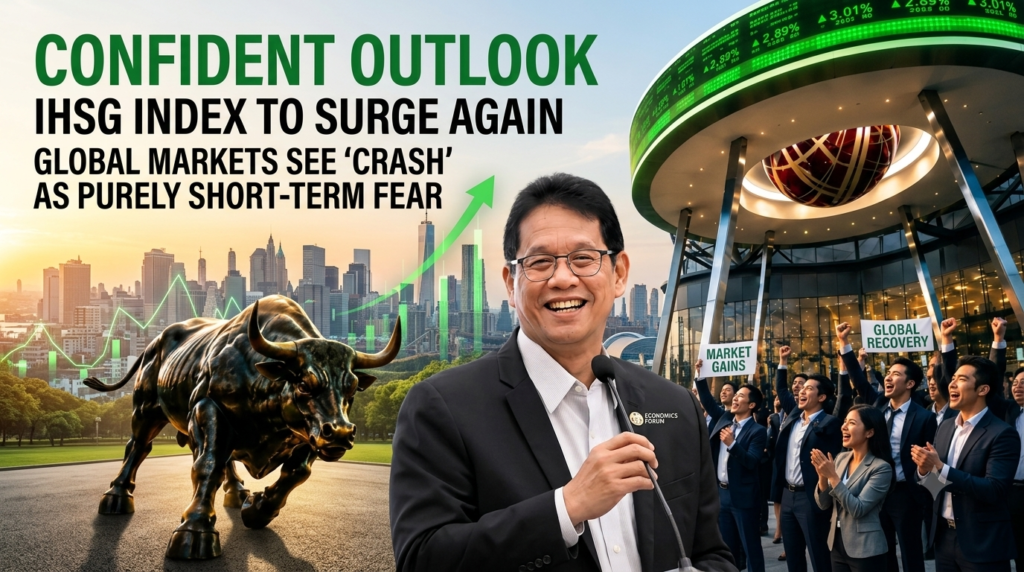
Finance Minister Purbaya Yudhi Sadewa has projected Indonesia’s economy will grow by 5.4 percent in 2026, with first-quarter economic growth recorded at 5.61 percent, higher than last year’s growth of 5.11 percent year-on-year. Against a backdrop of recent market turbulence, Purbaya has emerged as a steady voice of optimism, insisting that investor fear is temporary and that Indonesia’s economic fundamentals remain robust.
“I am confident IHSG will rise again. The foundation of our economy is solid. Don’t be afraid, the fundamental economy is good—this is just short-term fear from investors. The economic foundation is good, there is no problem,” Purbaya stated in a recent market forum, reassuring both domestic and international investors.
Recent Market Turbulence and Recovery Signs
The Indonesian stock market has faced considerable headwinds in recent months. As of June 11, the Jakarta SE Composite (IHSG) stood at 5,886.03, down 0.28%, with the index having declined 14.76% over the past month and 20.34% over the past three months. The volatility reflects broader global concerns and domestic market adjustments.
However, signs of recovery are emerging. Indonesia’s IDX Composite bounced back 1.2% to 5,405 in early Tuesday trade, halting a five-session slide as bargain hunters stepped in after the index touched its weakest since late 2020 in the prior session. Sentiment brightened after reports showed that tax revenue surged in the first five months of 2026, with the government hailing it as evidence of economic recovery.
Indonesian equities jumped 1.5% to 5,988 in early Thursday trade, marking a third consecutive session of gains as local sentiment was buoyed after the government scrapped its planned mining profit-sharing scheme and eased coal and nickel output quotas to stabilise industry, while Finance Minister Purbaya unveiled nine fiscal measures to cushion global uncertainty.
Understanding the Disconnect: Market Sentiment vs. Economic Reality
Purbaya’s confidence stems from a crucial distinction between short-term market psychology and long-term economic fundamentals. Financial markets, driven by sentiment and fear, often react disproportionately to negative news regardless of underlying economic health.
Economic Growth Trajectory Remains Positive
The Ministry of Finance has targeted this year’s inflation rate to remain at 2.5 percent, with the latest projection as of May 2026 standing at 3.08 percent, while also maintaining that high economic growth is supported by increased household consumption, investment, and accelerated government spending.
Finance Minister Purbaya Yudhi Sadewa expects Indonesia’s economy to grow by more than 5.5 percent in the third and fourth quarters of 2026, with the government aiming to push growth toward 6 percent.
Government Fiscal Measures Show Resilience
Rather than scaling back economic support during turbulent times, Purbaya unveiled nine fiscal measures specifically designed to cushion the impact of global uncertainty on Indonesia’s economy. This proactive stance demonstrates governmental commitment to maintaining economic momentum despite external headwinds.
Monetary Stability and Domestic Liquidity
Bank Indonesia noted strong growth in adjusted base money (M0), which rose over 14% for a second straight month. This monetary expansion provides crucial liquidity support for economic growth and represents confidence in Indonesia’s financial system stability.
Why Fundamentals Matter More Than Headlines
Purbaya’s position reflects what experienced investors have learned throughout market history: short-term volatility rarely signals long-term economic decline. Several factors underscore the resilience of Indonesia’s economic base:
1. Sustained Household Consumption
Indonesia’s consumer market continues to be the engine of growth. With a population exceeding 270 million and a rapidly expanding middle class, domestic consumption remains the primary driver of GDP growth. Unlike export-dependent economies, Indonesia’s consumption-led growth model provides inherent resilience against external trade disruptions.
2. Diversified Economic Base
Indonesia’s economy is not dependent on a single sector. Manufacturing, services, agriculture, mining, and tourism all contribute substantially to economic output. This diversification means downturns in one sector can be offset by strength in others, creating a more stable overall economic trajectory.
3. Strategic Natural Resource Wealth
Finance Minister Purbaya Yudhi Sadewa voiced strong optimism that stricter enforcement of natural resource export proceeds will inject vital foreign exchange liquidity into the domestic market and help reverse the rupiah’s recent decline, labeling the policy a strategic pillar for reinforcing Indonesia’s external economic resilience.
4. Government Commitment to Fiscal Discipline
Purbaya noted that the economic growth rate stands at 5.7 percent in the fourth quarter of 2025, adding that Indonesia is poised to record even higher growth without compromising fiscal discipline, with the fiscal deficit remaining below three percent, keeping it within safe limits.
International Validation of Economic Strategy
Despite criticism of World Bank projections, Purbaya pointed to stronger underlying economic momentum, noting that Indonesia’s growth is projected to reach 5.5% to 5.6% in the first quarter of 2026, with potential to exceed that range. Purbaya received positive feedback from global rating agencies, with Indonesia securing a positive assessment from the World Bank and S&P Global Ratings regarding its fiscal strategy.
Indonesian Finance Minister Purbaya Yudhi Sadewa defended his economic track record and said he’d stay in his job after the rupiah plunged, pointing to inflows into the debt market as proof investors remain optimistic, noting that government bonds and central bank debt securities saw inflows in the second quarter through early June.
Historical Context: Markets Recover, Fundamentals Persist
Indonesia’s financial history provides perspective. The nation has weathered the 1998 Asian Financial Crisis, the 2008 Global Financial Crisis, and the 2020 pandemic shock. In each instance, investor sentiment reached panic levels, yet those who maintained faith in Indonesia’s fundamental economic strength and long-term growth trajectory ultimately prospered.
Indonesia’s economy has demonstrated resilience, with Q1 2026 growth tracking toward a robust 5.5% to 5.6%, with the underlying economy defined not by what we predict, but by the resilience of the people who keep it moving.
Employment and Social Stability
The favorable economic growth rate of 5.7 percent generated 1.9 million new jobs and reduced unemployment to 7.46 million, lowering the open unemployment rate from 4.91 percent in August 2024 to 4.85 percent a year later.
This employment growth remains crucial for maintaining domestic consumption levels and social stability, both essential ingredients for long-term market recovery.
What Investors Should Consider
Purbaya’s message to investors centers on several practical principles:
1. Distinguish Between Noise and Signal
Daily market movements often represent noise rather than meaningful information about underlying economic health. Investors should focus on quarterly economic data, employment figures, and government policy rather than daily price movements.
2. Recognize Asymmetric Risk
When markets plunge 20-30% on sentiment alone, yet economic fundamentals remain solid, long-term investors face asymmetric risk/reward dynamics—potential downside becomes limited while upside remains substantial.
3. Think in Time Horizons
Household consumption has risen 4.89 percent year-on-year, supported by increased mobility, expanding digital transactions, and government policies that strengthened purchasing power, while government consumption climbed 5.49 percent. These trends develop over quarters and years, not days or weeks.
4. Position for Recovery, Not Perfection
Markets don’t require perfect economic conditions to recover. They require confidence that fundamental conditions will improve from current depressed levels.
The Road Ahead
Finance Minister Purbaya Yudhi Sadewa has unveiled the government’s strategic roadmap to accelerate national economic growth. Rather than reactive crisis management, the government is pursuing proactive acceleration of growth initiatives.
The international investment community increasingly recognizes this distinction. Despite recent rupiah weakness and market volatility, substantial capital continues to flow into Indonesian bonds and longer-dated securities, indicating that sophisticated investors remain confident in Indonesia’s medium-term prospects.
Conclusion: Confidence Grounded in Data
Purbaya’s confidence in the IHSG’s recovery does not rest on wishful thinking but on documented economic performance. Strong economic growth supported by household consumption, government spending, and investment momentum, combined with management of state budget performance, reflects stable economic fundamentals.
The finance minister’s core message is straightforward: separating the signal from the noise, economic fundamentals remain solid. Markets that have plunged on temporary fear represent opportunities for patient investors who understand the distinction between volatility and deterioration.
As Purbaya succinctly stated: “The economic foundation is good, there is no problem.”
For those with conviction in Indonesia’s long-term trajectory, the current market environment may indeed represent exactly what investors have historically sought—a significant discount on a growing economy with sustainable fundamentals.
Sources and References
- ANTARA News – “Indonesia’s Purbaya forecasts 6 percent economic growth in 2026”
- TEMPO.CO – “Indonesia’s Purbaya Projects 5.4% Economic Growth in 2026”
- ANTARA News – “Indonesia sees Q3-Q4 2026 growth above 5.5 percent”
- ANTARA News – “Purbaya confident natural resources reform to help stabilizing rupiah”
- Bloomberg – “Purbaya Slams ‘Sell Indonesia’ Narrative, Points to Bond Inflows”
- Trading Economics – “Indonesia Stock Market (JCI)”
- MSN Money – “Jakarta SE Composite (IHSG)”
- Jakarta Globe – “Purbaya Says World Bank May Have Miscalculated Indonesia Growth Outlook”
- Syarif Hidayatullah State Islamic University – “Purbaya Was Right: Indonesia’s Economy Outgrows World Bank Expectations”