Wine, Tech, and the Art of the Ultimatum: Trump’s 100% Tariff Threat Puts France on the Edge of a Trade War

As world leaders gather at the 52nd G7 Summit in Évian-les-Bains, President Donald Trump has issued his sharpest ultimatum yet to French President Emmanuel Macron — scrap a 3% digital services tax on American tech giants, or watch a century-old transatlantic wine trade be obliterated overnight.
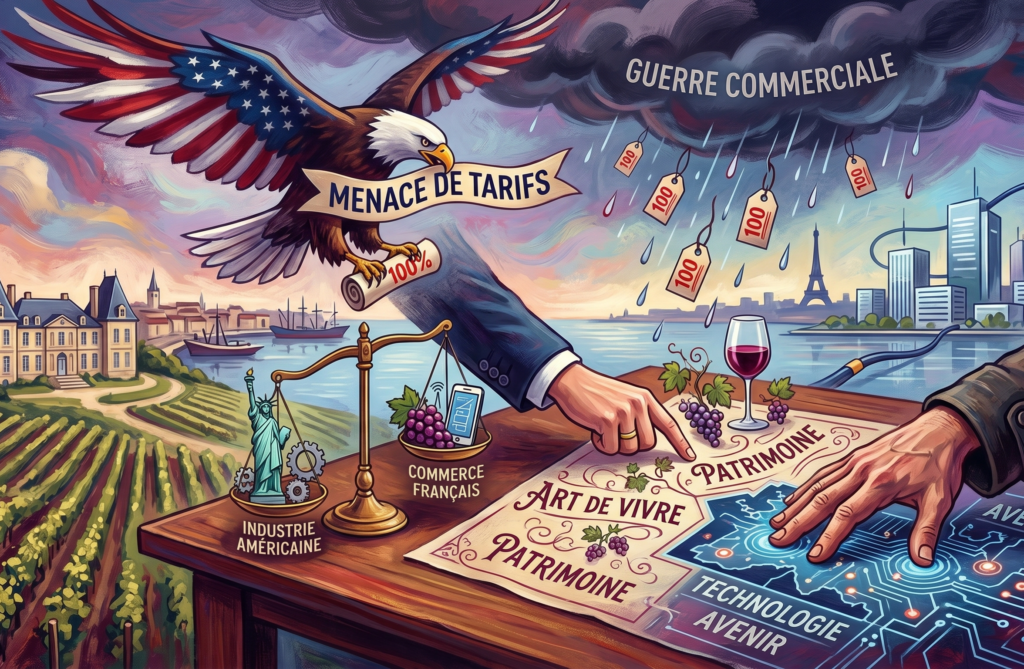
On the shores of Lake Geneva, where the mountains of the Alps mirror themselves in glassy water and the French town of Évian-les-Bains prepares to host some of the world’s most powerful leaders for the 52nd G7 Summit, a fresh storm has broken — not from the weather, but from Washington. President Donald Trump, speaking in a pointed interview with the New York Post published on Monday, June 15, 2026, has threatened to impose sweeping 100% tariffs on all champagnes and wines exported from France to the United States unless Paris immediately eliminates its digital services tax on American technology companies. The ultimatum, blunt and unapologetic in Trump’s characteristic style, has reignited one of the most combustible fault lines in the transatlantic relationship: the long-simmering dispute over whether France — and by extension, Europe — has the right to tax Silicon Valley’s profits on its own soil.
The warning did not arrive in a vacuum. It landed just hours before the opening of a G7 summit already burdened with a packed geopolitical agenda — the war in Ukraine, a fragile U.S.-Iran memorandum of understanding, the irrepressible rise of artificial intelligence, and persistent global economic imbalances. Yet Trump’s wine gambit, deployed with the casual authority of a dealmaker who knows his opponent’s vulnerabilities, has immediately threatened to overshadow all of it, placing Macron — who is hosting the summit on his home soil — in a diplomatically precarious position from the very first hours.
“I asked him not to charge American companies, and if they do, I have no choice but to charge a 100% tariff on all champagnes and all wines coming out of France.”— President Donald Trump, in an interview with the New York Post, June 15, 2026
The Ultimatum, Word for Word
In the New York Post interview, Trump stated his position with characteristic bluntness, leaving little room for interpretive ambiguity. “I asked [President Emmanuel Macron] not to charge American companies, and if they do, I have no choice but to charge a 100% tariff on all champagnes and all wines coming out of France,” the President told the paper. He then added, with the casual finality of a man who believes the math is simple: “All [Macron] has to do is get rid of the sales tax, and he wouldn’t have that kind of pressure.”
The message is unambiguous: France must choose between its digital levy and the American market for its wines. For France’s celebrated wine industry, that is not a hypothetical dilemma — it is an existential one. The American market accounts for approximately one-fifth of all global French wine sales, representing roughly $2 billion in annual exports. A 100% tariff would effectively price most French wines out of reach for ordinary American consumers, dealing a catastrophic blow to thousands of small and large producers across Bordeaux, Burgundy, Champagne, and beyond.
Neither the White House nor the Élysée Palace issued an immediate response to requests for comment following the publication of Trump’s remarks. But the diplomatic temperature in Évian-les-Bains rose measurably from the moment the interview circulated on Monday morning.
Key Numbers at a Glance
- Tariff Threatened100% on all French wines and champagnes entering the United States
- Current Wine Tariff15% — the rate set under the 2025 U.S.-EU trade deal struck in Scotland
- Annual Export Value~$2 billion (French wine to U.S.) — roughly 1/5 of France’s total global wine sales
- DST Rate3% levy on gross French digital revenues earned by qualifying tech companies
- DST Revenue Threshold>€25 million in France AND >€750 million worldwide
- EU Alcohol to U.S. (2024)~€9 billion ($10.46 billion) across all alcoholic beverages, per Eurostat
- Wine Export DropFrench wine to the U.S. fell 15.9% in value in 2025, to €1.9 billion from €2.4 billion (AAWE data)
What Is France’s Digital Services Tax — and Why Does Washington Hate It?
To understand the current standoff, one must go back to 2019, when the French National Assembly approved the country’s digital services tax (DST) — a 3% levy on the gross revenues generated in France by large technology companies whose global revenues exceed €750 million and whose French revenues exceed €25 million. The legislation was designed to address what French officials and economists saw as a glaring injustice: the ability of tech giants, predominantly American ones, to generate enormous profits from French users and French data while legally booking those profits in low-tax European jurisdictions like Ireland or Luxembourg, minimizing their French tax burden to near zero.
The companies most directly affected are the crown jewels of American corporate capitalism: Amazon, Meta (the parent company of Facebook and Instagram), and Alphabet (Google’s parent). Between them, these three firms have built global advertising empires and logistics networks whose revenues flow through France in enormous volumes. Paris argued, with some reasonableness, that its citizens should not be left to subsidize the profit margins of foreign corporations through the provision of infrastructure, education, and consumers while those corporations contributed little to the national treasury.
Washington’s response was predictable and fierce. American trade officials, across both Democratic and Republican administrations, have consistently framed France’s DST as discriminatory — a targeted strike at U.S. companies dressed up in the neutral language of tax reform. The argument runs that because the revenue thresholds were set high enough to exclude nearly all European companies but capture virtually every major American tech firm operating in France, the tax functions as a de facto trade barrier, violating the spirit if not the letter of international trade agreements.
A Dispute That Has Outlasted Administrations
This is far from the first time the issue has produced fireworks. In late 2019, the Trump administration — in its first term — threatened retaliatory tariffs of up to 100% on French wine, cheese, and other luxury goods in direct response to the DST. A temporary truce was reached at the 2019 G7 Summit in Biarritz, when French Finance Minister Bruno Le Maire and U.S. Treasury Secretary Steven Mnuchin hammered out a compromise: France would credit companies the difference between the DST and whatever global tax mechanism was eventually designed by the Organisation for Economic Co-operation and Development (OECD). Trump, characteristically, declined to declare the wine threat definitively off the table, even as Macron proclaimed that the two leaders had reached a deal.
The intervening years produced more negotiation than resolution. Hopes were briefly raised when the OECD, in 2021, reached a landmark agreement among more than 130 countries on a global minimum corporate tax of 15% — a framework that was, in theory, supposed to make individual national DSTs redundant. But implementation has been patchy, geopolitically fraught, and chronically delayed, and France has not repealed its digital tax. This has left the bilateral dispute festering like an open wound that each new Trump overture proceeds to tear further.
2019 — DST Enacted
France’s National Assembly approves the 3% digital services levy. The U.S. immediately objects, and the USTR opens a Section 301 investigation. Trump threatens 100% wine tariffs. A temporary G7 truce is brokered in Biarritz.
2021 — OECD Global Tax Deal
Over 130 countries sign onto a 15% global minimum corporate tax framework, intended to eventually render national DSTs unnecessary. France does not repeal its levy, pending implementation.
January 2026 — Board of Peace Threat
In his second term, Trump revives the wine-tariff threat, this time floating a 200% rate, after Macron declines to join Trump’s proposed “Board of Peace” initiative.
2025 — U.S.-EU Trade Deal
Trump and European Commission President Ursula von der Leyen agree a trade framework in Scotland, setting a 15% tariff on EU wines and spirits into the U.S. France begins lobbying to push this rate to zero.
June 15, 2026 — 100% Ultimatum
On the opening day of the G7 in Évian-les-Bains — hosted by France — Trump tells the New York Post that France must scrap its DST or face 100% tariffs on all wine and champagne entering the United States.
The Human Stakes: A $2 Billion Industry Caught in the Crossfire
For the diplomats and trade lawyers who navigate these disputes, the numbers are instruments of leverage. But for the vignerons of Burgundy, the négociants of Bordeaux, and the maisons of Champagne, they represent something far more immediate: livelihoods, legacies, and in some cases, the survival of family estates that have existed for generations.
France’s wine industry exported roughly €1.9 billion ($2.2 billion) worth of wine to the United States in 2025, according to data from the American Association of Wine Economists (AAWE), citing France’s Directorate-General of Customs and Indirect Taxes. That figure itself already represents a 15.9% decline in value from 2024’s €2.4 billion — a drop the AAWE noted may be attributable to existing tariff pressures, a broader consumer shift toward cheaper wines, or some combination of the two. The trend line, in other words, is already heading in the wrong direction for French exporters before Trump’s latest ultimatum.
A 100% tariff would not merely depress sales. It would, for most producers, effectively shut the American market. A bottle of Burgundy that currently retails for $40 in the United States would, under such a tariff regime, need to be priced at something closer to $70 or $80 to preserve the importer’s and retailer’s margins — a price point that would deter the vast majority of casual American wine drinkers. Champagne, already a premium product, would face similar distortions. The brands that could theoretically absorb the shock — the Dom Pérignons and the Petrus — are not the ones that depend on the American middle class. The ones that do are the mid-range producers who have spent decades building brand recognition in the U.S. market. For them, 100% tariffs would not be a headache; they would be a death sentence.
Importantly, certain products — including Remy Martin cognac and authentic champagne — are, by law, required to be produced in specific European regions. There is no American substitute. A 100% tariff on French champagne does not redirect consumer spending toward a competing domestic product; it simply eliminates a category from the market, or transforms it into an ultra-luxury item available only to the very wealthy.
Alcohol is among the EU’s top exports to the United States, worth approximately €9 billion — nearly $10.5 billion — in 2024 alone. The stakes for European producers could hardly be higher.— Eurostat data, cited by Reuters, June 15, 2026
The G7 Context: A Summit Already Under Strain
The timing of Trump’s ultimatum is striking even by the standards of an administration that has repeatedly used international summits as leverage points in bilateral negotiations. The 52nd G7 Summit, running from June 15 to 17, 2026, in Évian-les-Bains, is being hosted by France — which took over the G7 presidency from Canada in 2026. Macron has designed a packed and ambitious agenda: support for Ukraine in the fifth year of Russia’s war; the implications of Trump’s U.S.-Iran memorandum of understanding; global economic imbalances; and the governance of artificial intelligence. The protection of children online and digital infrastructure are also on the docket. Notably, according to Reuters, the official agenda does not include the taxation of digital giants — a detail that now feels less like an oversight and more like a deliberate French attempt to steer the summit away from a subject on which it is acutely vulnerable.
Against the backdrop of the serene alpine lake, other G7 leaders — from Canada’s Mark Carney to Germany, Italy, Japan, and the United Kingdom — will be watching the Franco-American tension closely. Leaders from India, South Korea, Kenya, and Brazil have also been invited as guests. The summit is the second time Évian-les-Bains has hosted a major world leaders’ gathering, having previously been the site of the 29th G8 Summit in 2003.
For Macron, the dynamic is diplomatically toxic. He is the host — the man responsible for the summit’s atmosphere, optics, and outcomes. A public capitulation to Trump’s wine tariff threat on his own home turf would be politically devastating domestically, appearing as humiliation on a stage of his own choosing. Refusal, on the other hand, risks a genuine trade escalation that would harm French industry and potentially destabilize the broader U.S.-EU trade relationship, which Trump and European Commission President Ursula von der Leyen worked to stabilize with a trade framework agreed last summer in Scotland. That agreement set a 15% tariff on EU wines and spirits entering the United States — a rate France has been actively lobbying to reduce to zero. A 100% tariff would not merely undo that progress; it would shatter it.
Why a 3% Tax Is Worth a 100% Trade War
To outside observers, the arithmetic might seem bewildering: why would the United States threaten to crater a $2 billion bilateral wine trade over a 3% tax on digital revenues? The answer lies in what the DST represents symbolically and structurally, not merely what it collects in revenue.
For American tech companies and the administrations that have championed their interests, France’s DST is not an isolated measure — it is the leading edge of a global trend. Dozens of countries, from the United Kingdom to India to Kenya, have implemented or are contemplating their own versions of digital services taxes. If France’s DST survives without meaningful U.S. retaliation, it signals to the world that such taxes are permissible; that the United States will tolerate them; and that the era of American tech companies operating effectively tax-free in foreign jurisdictions is over. From Washington’s perspective, that cannot be allowed to stand, regardless of the size of the French levy itself. The 100% wine tariff is not really about wine — it is about precedent, power, and the rules of the global digital economy.
From Paris’s perspective, the logic runs equally deep. France’s DST exists because the existing international tax architecture, designed in an era of physical goods and factories, is structurally incapable of equitably taxing companies whose entire value proposition is digital — companies that can serve 60 million French users without a single significant French employee or taxable French asset. The OECD’s global minimum tax deal was supposed to fix this, but its implementation has been glacial. Meanwhile, French hospitals, schools, and infrastructure are being partly financed by French taxpayers while trillion-dollar corporations that profit from French consumers pay vanishingly little into the French treasury. The DST, from this view, is not a trade weapon. It is an assertion of sovereign fiscal dignity.
An Old Pattern, a New Escalation
What distinguishes Trump’s June 2026 ultimatum from earlier iterations of this dispute is its timing and its escalatory trajectory. The Trump administration’s first term produced threats of 100% wine tariffs in 2019, which were ultimately avoided through the Biarritz compromise. In January 2026, just months after beginning his second term, Trump raised the ante to 200% wine tariffs — that time, in the context of Macron’s refusal to join an altogether different American diplomatic initiative, the so-called “Board of Peace.” The fact that he has now returned to the 100% figure in the context of the DST dispute specifically suggests this is not a momentary escalation but a considered and sustained pressure campaign.
The 15.9% decline in French wine exports to the U.S. in 2025 also suggests that the existing tariff environment — even before any new threats — is already reshaping trade flows. Whether that decline is attributable to tariffs, shifting consumer preferences toward more affordable domestic and international wines, or some blending of the two is, according to the AAWE, not yet clear. But the trend is unmistakable, and for French exporters, it is alarming even in the absence of further escalation.
What Happens Next?
Several scenarios present themselves as the G7 leaders settle into the Alpine setting of Évian-les-Bains. The most optimistic involves a repeat of the 2019 Biarritz dynamic: a high-level bilateral meeting between Macron and Trump on the sidelines of the summit, a private understanding, and a public softening of language from Washington that stops short of an explicit withdrawal of the threat. France and the United States have navigated this particular dispute before, and there is institutional memory — in both treasuries and trade ministries — of how to walk it back without either side appearing to have blinked.
A second scenario involves a formal French offer to accelerate the implementation of the OECD global minimum tax framework in exchange for a temporary American pause on tariff threats. This would require coordination with other EU member states and the European Commission, complicating the diplomacy considerably, but it would give both governments a face-saving mechanism: France has not repealed the DST; it has simply made its supersession by an international agreement more imminent.
A third and darker scenario is genuine deadlock. If Trump is not satisfied with a procedural compromise, and if Macron judges that any visible capitulation carries too high a domestic political cost, the summit could end without resolution — leaving the tariff threat hanging over the French wine industry and the broader transatlantic trade relationship for months. Given the volatility that has characterized U.S. trade policy throughout Trump’s second term, that is not a scenario that can be dismissed.
There is also, lurking in the background, the question of European solidarity. If the United States imposes 100% tariffs specifically on French wine, other EU member states will face a strategic choice: treat this as a bilateral Franco-American matter, or respond with the collective trade leverage that only the EU can bring to bear. European Commission President von der Leyen has, throughout Trump’s second term, sought to balance firmness with pragmatism — to deter American escalation without provoking a full trade war. A 100% tariff on French wine would test that balance severely.
The Deeper Question: Who Gets to Tax the Digital Economy?
Behind the immediate drama of diplomatic ultimatums and wine prices lies a question that will define the international economic architecture for decades: in a world where the most valuable companies are digital and borderless, who has the sovereign right to tax their revenues, and on what basis?
The United States has answered this question, implicitly, by insisting that its companies cannot be subjected to unilateral national digital taxes — that any global tax framework must be genuinely multilateral and internationally agreed, not designed by individual countries in ways that happen to target American firms. France has answered it differently: that sovereignty over digital revenues generated from French citizens belongs to France, and that waiting indefinitely for a perfect multilateral solution while American companies accumulate ever-larger profits is not a viable policy.
Trump’s 100% tariff threat is, in this light, more than a bilateral dispute about wine and tech. It is the latest and sharpest iteration of a fundamental disagreement about the rules of the global economy in the digital age — a disagreement that the G7, for all its nominal power and collective GDP of over $50 trillion, has proven unable to resolve cleanly in the seven years since France first enacted its digital services tax.
The bottles of Bordeaux and the flutes of Champagne that may or may not become luxury items by summer’s end are, in this sense, proxies for something much larger: the question of who governs the internet economy, and who pays for it. The answer, hammered out on the shores of Lake Geneva or deferred again to some future summit, will matter far beyond the vineyards of France or the campuses of Silicon Valley.
The bottles of Bordeaux and the flutes of Champagne are proxies for something much larger: the question of who governs the internet economy, and who pays for it.— World Economic Dispatch Analysis, June 15, 2026
Reporting and Attribution
This article draws on reporting by Reuters correspondents Chandni Shah in Bengaluru and Sybille de La Hamaide in Paris, as well as original reporting by CNBC, the New York Post, France 24, The Statesman, and the American Association of Wine Economists. Trade data cited from Eurostat and France’s Directorate-General of Customs and Indirect Taxes. Neither the White House nor the Élysée Palace responded to requests for comment at the time of publication. This article will be updated as the G7 summit in Évian-les-Bains progresses.