THE REVOLVING DOOR: HOW BRITAIN’S POLITICAL INSTABILITY DEEPENS AS PM STARMER STEPS ASIDE AFTER LESS THAN TWO YEARS IN OFFICE

Comprehensive Analysis of Governmental Transition, the Structural Challenges Facing the UK Political System, and the Long-Term Implications of Rapid Leadership Succession
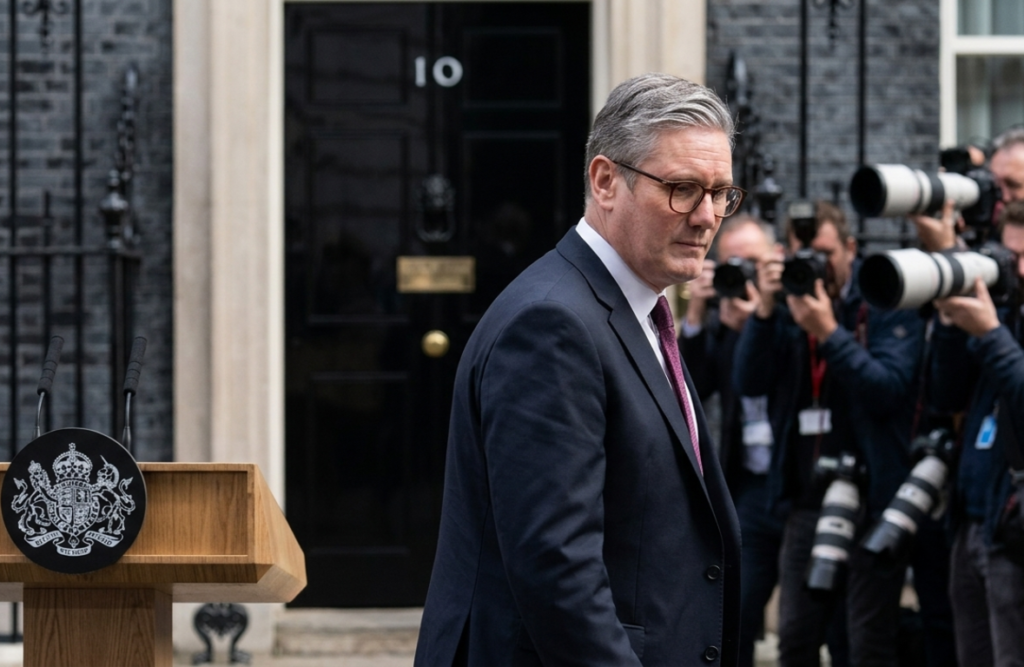
The announcement arrived on the morning of June 22, 2026, outside the Georgian grandeur of 10 Downing Street, delivered with visible emotional weight by the individual who had occupied that address for less than two years. Prime Minister Keir Starmer, his voice containing notable emotion, declared that he had concluded he was not the person best positioned to lead the Labour Party into the next general election. The decision represented a dramatic reversal from Friday, when the same individual had insisted he would “not walk away” from a leadership challenge. Yet the intervening days, marked by accelerating momentum behind his principal rival Andy Burnham and the by-election victory that had cleared Burnham’s path to Parliament, had created a political dynamic sufficiently powerful to compel Starmer’s capitulation. His resignation on June 22 meant that Britain would mark the moment with a stark and troubling statistic: the country would prepare to receive its seventh prime minister in ten years, a turnover rate that suggested not merely normal political competition but something more fundamental about the difficulty of governing contemporary Britain.
The announcement of Starmer’s resignation carried profound implications that extended well beyond the immediate question of who would succeed him as leader of the Labour Party and thus as Prime Minister. The period spanning from June 2016—when Britain voted to leave the European Union—through June 2026 had proven extraordinarily turbulent, with the political system producing a succession of leaders each confronting challenges that had proven too substantial to manage within mandates of meaningful duration. The accumulation of seven prime ministerial transitions within a single decade represented an extraordinary concentration of governmental discontinuity. Most functioning democracies experience comparable levels of leadership change distributed across multiple decades rather than compressed into a single ten-year period. The rapidity of transitions suggested that structural challenges confronting the British political system had perhaps become too substantial for any individual leader to overcome through conventional governing approaches.
Starmer’s particular path to resignation illuminated important dimensions of contemporary British political dynamics. He had inherited the Labour Party in 2020 in the aftermath of Jeremy Corbyn’s catastrophic 2019 general election defeat, taking over a party that by his own characterization was “politically, financially, and morally bankrupt.” The reconstruction of the Labour Party had represented a sustained effort requiring disciplined focus and considerable institutional repair. By 2024, Starmer’s efforts had generated sufficient public confidence to produce a decisive general election victory. Labour secured 174 seats of absolute majority in the House of Commons, a substantial improvement over the previous government’s position. The election results suggested genuine public appetite for change and willingness to embrace a Starmer-led government.
Yet within eighteen months of this ostensible mandate, the political circumstances had deteriorated so substantially that Starmer’s continuation in office had become untenable. The local elections conducted in May 2026 had produced particularly disastrous results. Labour lost 1,496 council seats across the country, while the Reform UK party, a populist movement focused on immigration restriction, had achieved remarkable gains for a relatively new political force, winning 1,453 councillor positions and taking control of fourteen local councils. These results were widely interpreted as a referendum on Starmer’s leadership specifically rather than on Labour Party positioning generally. The scale of the defeat had shaken confidence among Labour members of Parliament, with dozens issuing public calls for Starmer’s resignation. Cabinet ministers had begun departing the government in succession, each departure accompanied by public expressions of lost confidence in Starmer’s leadership.
The most visible manifestation of this deterioration came when the top two defence officials in the United Kingdom—positions of substantial institutional importance—resigned on June 11, accusing Starmer of failing to allocate sufficient resources to the Defence Investment Plan. The resignation of such senior officials represented a statement not merely about funding disagreement but about fundamental loss of confidence in ministerial leadership. These resignations were not isolated. Safeguarding Minister Jess Phillips had departed, stating that “deeds, not words, are what matter.” Wes Streeting, former Health Secretary and previously considered a potential rival for the Labour leadership, had made public statements that it was “clear that Keir will not lead the Labour Party into the next general election.”
Against this backdrop of deteriorating political support, Andy Burnham—the former mayor of Greater Manchester and a prominent figure within the Labour Party’s left wing—had orchestrated his return to Parliament through a special election in Makerfield, a suburban Manchester constituency. The special election had become necessary through a coordinated maneuver: a Labour member of Parliament who held the seat had resigned specifically to create the vacancy that would allow Burnham to contest the by-election. Burnham’s decisive victory in the by-election on June 18 had transformed him from mayor of a regional city to an immediately viable alternative to Starmer. Within days, the political momentum had become irresistible. Wes Streeting, who might have positioned himself as a rival to Burnham, instead endorsed Burnham’s leadership candidacy. The explicit calculation was clear: a contested leadership election would consume party resources and create internal division, whereas an uncontested transition to Burnham could be accomplished within weeks.
Starmer’s resignation announcement, delivered on Monday morning, effectively conceded this political reality. He stated that he had “heard the answer from my parliamentary party” regarding whether he was best positioned to lead into the next general election, and that he accepted “that answer with good grace.” The phrasing suggested not enthusiastic agreement but rather recognition of political inevitability. He pledged to remain in office until a successor was formally chosen by the Labour Party through a scheduled process. Nominations would open July 9 and close July 16, with a new leader to be selected by September 1 if a contest emerged. Given Burnham’s overwhelming political dominance and the apparent absence of serious rival candidates, the process could potentially conclude much sooner.
The economic implications of this political transition received immediate attention from financial markets. Sterling declined 0.19 percent against the United States dollar in the wake of the announcement, a modest movement but one indicating that currency markets registered some negative sentiment regarding the political development. The yield on ten-year United Kingdom government bonds—critical indicators of the cost at which the government could borrow funds—remained essentially flat at approximately 4.845 percent. This apparent stability in bond yields despite significant political transition suggested that markets retained some confidence in British institutional structures’ capacity to manage governmental transition in an orderly fashion.
However, the long-term implications of this latest transition carried deeper concern. The underlying reality was that Britain had experienced seven prime ministerial changes across ten years—a frequency that suggested something more fundamental than normal political competition. The string of prime ministers who had occupied 10 Downing Street since the Brexit referendum revealed a pattern of individuals confronting challenges that had overwhelmed their capacity to govern. David Cameron had resigned after losing the 2016 Brexit referendum, the event that triggered the entire sequence of subsequent transitions. Theresa May had spent three challenging years attempting to negotiate Britain’s departure from the European Union before stepping down. Boris Johnson had occupied the office for approximately three years before being forced to resign following revelations about his handling of personal misconduct allegations. Liz Truss had become the shortest-serving prime minister in British history, lasting merely fifty days before her market-alarming budget plans forced her resignation. Rishi Sunak had led the Conservatives to decisive electoral defeat in 2024. Starmer had lasted approximately nineteen months before succumbing to internal party pressure.
The pattern suggested that no single leader had possessed the combination of skills, political capital, and favorable circumstances necessary to lead Britain through the accumulated challenges confronting the nation. Brexit had generated years of complex negotiation and fundamental uncertainty about Britain’s future positioning in global affairs. The subsequent economic pressures, including inflation concerns, energy market volatility, and the transition toward renewable energy sources, had created circumstances in which no leader could deliver the rapid improvement in living standards that the population desired. The expectations generated by electoral promises and campaign rhetoric had consistently collided with the practical constraints of governing a large, complex democracy during a period of substantial economic transition.
Starmer himself had inherited these accumulated challenges, having promised during the 2024 campaign that his government would deliver “change” and improvement in the cost of living and economic conditions. The failure to deliver these improvements rapidly enough had generated disappointment among voters and within his own parliamentary party. The polling data revealed the scope of this disappointment. An Ipsos poll published on Friday suggested that 52 percent of the British public thought Starmer should step down as prime minister, with only 35 percent believing he should continue—a margin suggesting genuine loss of public confidence within less than two years of taking office.
The emergence of Reform UK as a significant political force had further complicated Starmer’s position. The populist party, focused particularly on immigration restriction, had captured substantial support from former Conservative voters as well as from traditional Labour constituencies in working-class areas. Starmer’s attempts to adopt tougher rhetoric on immigration had failed to halt Reform’s rise, instead contributing to a perception that the government lacked clear strategic direction. The party had simultaneously alienated progressive voters who had supported his leadership election within Labour while failing to prevent the rightward shift among traditional Conservative voters that Reform had exploited.
Andy Burnham, Starmer’s likely successor, inherited a substantially similar set of challenges. Burnham had first sought the Labour leadership sixteen years earlier without success. His current opportunity to assume the premiership came through political circumstances that had generated sufficient party desperation to embrace a figure previously rejected by Labour members. Yet Burnham would confront the same underlying structural challenges that had overwhelmed Starmer: the necessity of delivering rapid economic improvement in circumstances where global economic pressures limited governmental control over inflation and living standards; the need to manage expectations that had been elevated through electoral campaigning; the requirement to maintain party unity while addressing legitimate disagreements about policy direction.
The longer-term implications of this pattern of rapid leadership succession extended into questions of British governance itself. The capability of any governmental system depends partly on the capacity of leaders to develop expertise, to build relationships with international counterparts, to establish sustained policy directions that can survive transitions between administrations. When leadership transitions occur with the frequency Britain has experienced across the past decade, these advantages dissipate. International partners never develop fully confident relationships with British leaders, knowing that transitions could occur rapidly. Domestic policy initiatives struggle to gain traction when leadership changes interrupt implementation. Institutional memory and policy coherence deteriorate as new leaders replace existing teams.
The political system itself appeared to have developed pathological characteristics. The ease with which party MPs could initiate challenges to sitting leaders of their own party meant that any leader facing declining popularity faced immediate risk of removal. This created incentives for short-term political posturing rather than sustained policy implementation. A leader seeking to avoid removal by their own party might prioritize popularity-building measures over policies that might be more economically sound but politically unpopular in the short term.
SOURCES AND REFERENCES
- NPR – “Keir Starmer has resigned, paving way for a 7th U.K. prime minister in 10 years” (June 22, 2026)
- ABC News – “UK Prime Minister Keir Starmer announces resignation with ‘good grace'” (June 22, 2026)
- CNN – “Keir Starmer resignation: UK to get seventh PM in seven years, as Andy Burnham likely to replace him” (June 22, 2026)
- Al Jazeera – “Why has Keir Starmer resigned as UK prime minister, and who will take over?” (June 22, 2026)
- CNBC – “UK PM Starmer resigns as Britain faces its seventh leader in 10 years” (June 22, 2026)
- NBC News – “Keir Starmer resigns as British prime minister, clearing the path for the country’s 7th leader in a decade” (June 22, 2026)
- TIME – “Starmer Resigns as Britain Prepares for Its Seventh Leader in 10 Years” (June 22, 2026)
- Official UK Government Statements and Parliamentary Records
- Ipsos Polling Data (June 2026)
This analysis is based on publicly available news reporting, official government statements, and polling data as documented on June 22, 2026. The assessment reflects British political conditions at the time of reporting and recognizes that governmental transitions and political circumstances will continue to evolve. This article is written for informational and analytical purposes to enhance understanding of British political dynamics and governance challenges rather than to advocate for specific political outcomes or positions.