The Maestro’s Final Note: Remembering Alan Greenspan and the Enduring Lessons of an Extraordinary Economic Life

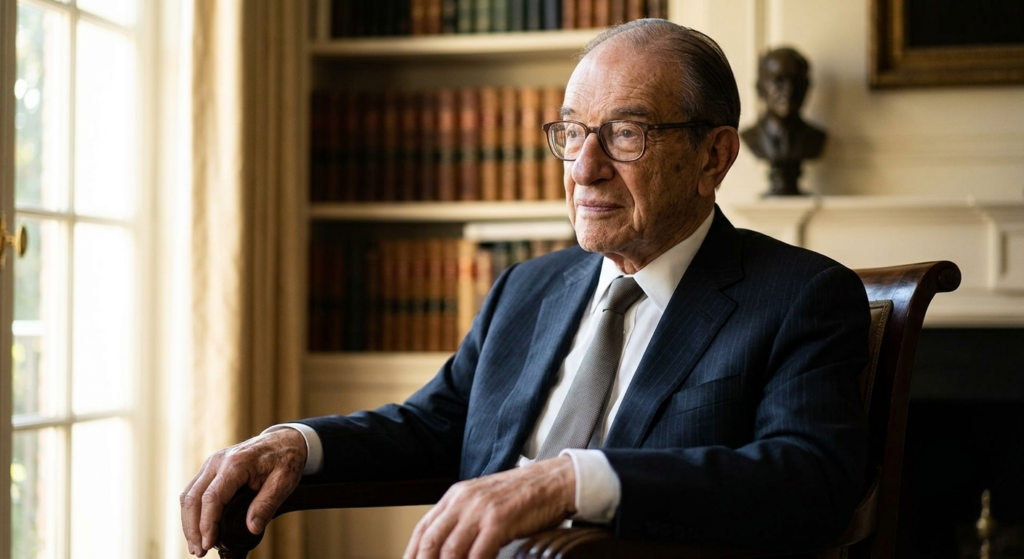
Alan Greenspan died on Monday at the age of 100, passing away at his home from complications of Parkinson’s disease — a quiet ending for a man who, for nearly two decades, could move global financial markets with a single carefully chosen phrase. His wife of 29 years, NBC News correspondent Andrea Mitchell, announced his passing in a statement that was equal parts tender and historically aware. “He was a giant of a man who helped shape the U.S. economy for decades under presidents of both parties,” she wrote, “but was always honest in acknowledging his mistakes.” In a single sentence, Mitchell captured both the towering stature and the complex moral arithmetic of one of the most consequential careers in the modern history of finance.
The Federal Reserve, the institution Greenspan led for 18 and a half years across the administrations of Ronald Reagan, George H.W. Bush, Bill Clinton, and George W. Bush, issued a statement praising him Monday. “Chairman Greenspan’s legacy endures at the Federal Reserve — in those he mentored directly, in the economists and public servants he inspired, and in the frameworks and practices he helped shape.” It was, like so many official tributes, accurate in what it said and careful about what it left unsaid. Because the full story of Alan Greenspan is richer, more complicated, and ultimately more instructive than any institutional statement can capture.
He was born on March 6, 1926, in the Washington Heights neighborhood of New York City, the son of a stockbroker father who left the family when Greenspan was young and a mother who raised him largely alone during the lean years of the Great Depression. That formative backdrop — growing up in an era when economic disruption was not abstract data but a lived daily reality — shaped the young Greenspan’s intellectual fascination with how economies actually function. He showed mathematical aptitude from an early age, and in his teens briefly attended the Juilliard School, playing jazz saxophone and clarinet with ambitions of a professional music career. That musical discipline — the ability to read complex structures while improvising within them, to sense where a composition is heading before it arrives — would prove a surprisingly apt preparation for the job that eventually defined his life.
He studied economics at New York University, earning a bachelor’s degree in 1948 and a master’s in 1950, then began doctoral work at Columbia University under Arthur F. Burns, who would later become a Federal Reserve chairman himself. The intellectual genealogy is striking: a student of one Fed chairman would become the most consequential Fed chairman of the modern era. In the early 1950s, Greenspan became an associate of the writer and philosopher Ayn Rand, whose philosophy of self-interest and laissez-faire capitalism would leave a lasting imprint on his worldview and, eventually, on the regulatory posture of the central bank he would lead. He embraced some of her beliefs and paid tribute to her in his 2007 memoir — a tribute that would later become one of the most analyzed footnotes in the literature of the 2008 financial meltdown.
From Consulting Rooms to the World’s Most Powerful Economic Post
Before his ascent to the Federal Reserve, Greenspan built a distinguished career as a private economic consultant, co-founding and running the consulting firm Townsend-Greenspan & Co. for 21 years. He served as chairman of the Council of Economic Advisers under President Gerald Ford from 1974 to 1977, gaining his first systematic exposure to the machinery of federal economic governance. He advised on Richard Nixon’s 1968 presidential campaign and moved in and out of official circles for the better part of two decades before President Reagan nominated him to lead the Federal Reserve in 1987, succeeding the formidable Paul Volcker.
Volcker’s legacy was itself immense. He had broken the back of the double-digit inflation of the 1970s through a brutal but ultimately successful program of monetary tightening that drove interest rates to historically elevated levels. The discipline imposed on monetary policy in the Volcker-Greenspan era came from the desire to short circuit the process whereby expected inflation would rise with monetary stimulus and rising inflation. Stabilizing expected inflation in a way consistent with a return to price stability required preemptive increases in the funds rate. Greenspan inherited a central bank that had regained its institutional credibility on inflation — and understood, from the outset, that preserving that credibility was his most important task.
He was tested almost immediately. Just two months into his tenure, on October 19, 1987 — a day that became known as “Black Monday” — the Dow Jones Industrial Average plunged 22.6% in a single session. It remains, in percentage terms, the largest one-day decline in the index’s history. The causes were multiple and complex: portfolio insurance strategies, liquidity withdrawal, and a sudden loss of investor confidence that cascaded across global markets with a speed that surprised nearly everyone. The morning after, Greenspan issued a statement that would become a template for central bank crisis response: “The Federal Reserve, consistent with its responsibilities as the nation’s central bank, affirmed today its readiness to serve as a source of liquidity to support the economic and financial system.” The statement was ten words of substance wrapped in institutional language — but it was enough. Markets stabilized. The American economy emerged from the episode without a recession. The new Fed chairman had passed his first examination with distinction.
That response established a pattern that would define the Greenspan era and shape monetary policy long after his departure. When financial markets experienced severe downturns or sharp dislocations, the Federal Reserve would signal its readiness to supply liquidity and support stability. This implicit commitment — rooted in the 1987 response, reinforced after the 1998 near-collapse of hedge fund Long-Term Capital Management, and deployed again in the aftermath of the September 11, 2001 attacks — came to be called the “Greenspan put” by market participants. A “put” in financial terminology is an option that provides a floor under an investment’s value; the “Greenspan put” referred to the widely held expectation that the Fed would intervene to prevent catastrophic market declines. It was, in one sense, a tribute to Greenspan’s effectiveness as a crisis manager. In another sense, as history would later demonstrate, it was a source of moral hazard — a signal to market participants that extreme risk-taking would be cushioned by the central bank.
The Great Moderation and the Economic Miracle Nobody Appreciated at the Time
Between those early tests and the eventual reckoning that followed his tenure, Greenspan presided over what economic historians came to call the “Great Moderation” — a period stretching from the mid-1980s through 2007 that was characterized by unusually stable economic growth, low and declining inflation, and a relatively mild business cycle. Under the chairmanships of Paul Volcker and then Greenspan, and subsequently under Ben Bernanke in the early years, inflation was low and relatively stable, while the period contained the longest economic expansion since the end of World War II.
The statistics that defined Greenspan’s era at the Fed are genuinely extraordinary when examined against the historical baseline. During his tenure, unemployment fell below 4% — levels not seen since the late 1960s. The stock market reached what were then record highs. The federal government, under the fiscal discipline of the Clinton administration and the revenue windfall of the technology-driven productivity surge, began running budget surpluses rather than deficits. GDP contracted only once in nearly two decades — briefly and shallowly in 1991. Inflation, which had reached double digits in the late 1970s, was compressed and stabilized to such a degree that households and businesses made financial decisions without needing to build significant inflation premiums into their calculations. The most prominent feature of that era was persistently low inflation; it appeared that central banks could keep inflation low without compromising unemployment or economic growth.
There was, during those years, a remarkable sense that something genuinely new had been achieved in the science of economic management. In his 2003 presidential address to the American Economic Association, Nobel laureate Robert Lucas declared that “the central problem of depression-prevention has been solved.” It was a statement of professional confidence that would, within five years, look painfully premature — but it reflected the genuine intellectual atmosphere of the period. Greenspan was not merely presiding over a fortuitous run of good outcomes; he was actively managing monetary policy with a sophistication that earned him broad admiration across the ideological spectrum. He was renominated by George H.W. Bush, Bill Clinton, and George W. Bush — an achievement in bipartisan respect that is almost unimaginable in the political climate of the 2020s. Throughout his tenure, GDP contracted only once, in 1991. The era was known as the Great Moderation, featuring stability, relatively low inflation — only exceeding 5 percent once — and rising prosperity.
Greenspan himself identified the secret of this achievement with characteristic precision. Under his leadership, monetary policy fostered steady growth with low unemployment and price stability, defining the goals not in terms of abstract targets but in practical human terms: inflation should be low enough that households and businesses did not have to take it into account in making their decisions. He accomplished this by moving policy levers to preempt future moves away from price stability or full employment — which required acting on forecasts rather than waiting for problems to fully materialize.
He also transformed the institutional communications practice of the Federal Reserve in ways that outlasted his tenure and shaped every subsequent chairman’s approach. The central bank had never issued policy statements at the end of its rate-setting meetings until Greenspan instituted the practice in 1994. He began releasing minutes and transcripts of FOMC meetings with a regularity that previous chairmen had resisted. He championed what he described as a shift away from less informative Fed statements before the 1980s, pushing for greater transparency by central bankers. “You don’t want to surprise the markets unless there is a purpose to it,” he said in a Federal Reserve oral history in 2009. The irony, of course, is that Greenspan became almost as famous for his deliberate inscrutability in public remarks as for his commitment to transparency in institutional processes.
The Art of Deliberate Ambiguity: When “Greenspeak” Moved Markets
The public face of the Greenspan era — the image that lodged most firmly in the minds of investors, legislators, and ordinary Americans — was that of a bespectacled figure with an economy of language that was simultaneously illuminating and almost entirely impenetrable. Greenspan became legendary for elaborately constructed, nearly impenetrable public statements that ricocheted across world markets and forced traders to deconstruct their meaning.
He once acknowledged this tendency with characteristic wit, telling a congressional committee: “I know you believe you understand what you think I said, but I am not sure you realize that what you heard is not what I meant.” The remark was half-joke and half-serious description of a deliberate strategy. Mindful of his power to move markets, Greenspan typically resorted to careful ambiguity. A Washington Post column in 1997 captured the dynamic with a phrase that has endured: “With a couple of choice words he can momentarily send the stock market to heaven or hell.” Second to the president, Alan Greenspan was arguably the nation’s most powerful person.
The most famous exercise of that verbal power came on December 5, 1996, when Greenspan, speaking at a dinner hosted by the American Enterprise Institute, posed a rhetorical question that would echo through market history: “How do we know when irrational exuberance has unduly escalated asset values, which then become subject to unexpected and prolonged contractions?” Investors zeroed in on two words — “irrational exuberance” — and global markets fell sharply the following morning. The Japanese Nikkei dropped by 3.2%. European markets fell. The Dow opened lower. And then, within days, stocks recovered and continued climbing. The bubble Greenspan had cautiously identified did not burst until 2001, four full years later — long enough for some observers to conclude his warning had been premature, and long enough for the technology stock mania to grow far larger than it would have been had markets taken his signal more seriously.
The phrase “irrational exuberance” entered the permanent lexicon of financial markets. It described not just the specific condition of 1996 technology stocks but a recurring psychological pattern in investor behavior — the euphoria that builds during sustained bull markets, the suspension of historically grounded valuation discipline, the collective conviction that this time is genuinely different. As Fed chair, Greenspan also became known for understanding this psychological dimension more deeply than most of his contemporaries. He later told Fortune Magazine that as a younger economist he had discounted the role of human behavior in economics, believing it was “not worth evaluating.” But he later realized that “there were very important missing variables in the forecasting system, and these all related to systemic activities of human beings.” He concluded: “You can count that human beings will become euphoric on occasion, and in deep distress and fear. What you can count on is that will never change.”
That insight — articulated decades ago — resonates with particular force in the current environment of 2026, when AI-driven technology stocks have produced extraordinary gains and market participants across every asset class are navigating the tension between genuine structural transformation and the risk of price-insensitive enthusiasm.
The Shadow of 2008: A Reckoning That Greenspan Faced with Unusual Candor
No serious assessment of Alan Greenspan’s career can avoid the 2008 reckoning — the financial system near-collapse that unfolded two years after his January 2006 departure from the Fed and that subjected his policy legacy to the most severe retrospective scrutiny in the history of American central banking.
The chain of causation identified by critics runs through two specific policy episodes. The first was the extended period of historically low interest rates that followed the dot-com bust and the economic disruption of late 2001. The Federal Reserve reduced the target federal funds rate from 3.5% in January 2001 to 1% by June 2003, providing stimulus to counter economic weakness. That one-percent rate persisted for a full year before the Fed began gradually raising it. Critics argued the prolonged period of inexpensive borrowing encouraged investments in risky mortgage-backed securities and fueled an unsustainable rise in housing prices that, when it inevitably reversed, cascaded into a systemic financial disruption of historic proportions.
The second policy episode was Greenspan’s long-standing philosophical resistance to financial sector regulation — rooted in his Ayn Rand-influenced conviction that market participants, particularly financial institutions protecting their own shareholders’ capital, would exercise self-discipline more effectively than regulatory frameworks imposed from outside. This view, which seemed well-supported by decades of evidence during the Great Moderation, proved to have a fatal blind spot: it did not adequately account for the complexity of financial innovation, the extent to which risks could be distributed and obscured through derivatives structures, and the potential for rational individual decisions to produce irrational collective outcomes.
The 2011 bipartisan Financial Crisis Inquiry Commission was unsparing in its assessment. It determined that the upheaval was triggered in part by Greenspan’s failure to discourage trade in securities backed by subprime mortgage loans amid an unsustainable housing expansion, and by his promotion of financial industry deregulation. “More than 30 years of deregulation and reliance on self-regulation by financial institutions, championed by former Federal Reserve chairman Alan Greenspan and others… had stripped away key safeguards, which could have helped avoid catastrophe.”
What distinguished Greenspan’s response to these criticisms from the defensive postures many public figures adopt was a willingness — measured, qualified, but genuine — to acknowledge the intellectual error at the heart of his approach. Testifying before Congress in October 2008, under pointed questioning from Representative Henry Waxman, Greenspan said: “I made a mistake in presuming that the self-interests of organizations, specifically banks and others, were such as that they were best capable of protecting their own shareholders and their equity in the firm.” Coming from a man who had begun his career as a devoted reader of Ayn Rand and spent decades as among the most committed believers in market self-correction, it was, as one observer noted, a statement of unusual intellectual courage.
He did not stop at the confession. Characteristically, Greenspan felt compelled to understand why he had been wrong — not just to acknowledge the error but to build an improved analytical framework on its foundations. His 2013 book “The Map and the Territory” explored this question, arguing that traditional economic forecasting had failed to account adequately for the psychological dynamics of euphoria, risk appetite, and sudden fear that drive financial market behavior. The book ended, characteristically, on an optimistic note: the events of 2008 and their aftermath provided economists with more data and better understanding of how humans behave, and the field would do better in the future. It was vintage Greenspan — intellectually restless, empirically grounded, and fundamentally forward-looking even when discussing past failures.
Former senior Fed official Stephen Oliner offered perhaps the most balanced verdict: “I think the deification that came just before the financial episode was never really deserved, and I think the lambasting that he took after he left was never fully deserved either.” It is a judgment that captures the genuine complexity of a career that produced extraordinary achievements and genuine failures in nearly equal measure.
The Greenspan Legacy in the 2026 Context: A Conversation That Has Not Ended
It would be tempting to treat Greenspan’s death as the formal closing of a historical chapter — the end of an era whose lessons have been absorbed, processed, and institutionalized. The temptation should be resisted. The debates that his tenure provoked have not been settled. The institutional questions he raised about how central banks communicate, how they respond to asset price inflation, and how they balance financial stability against economic growth are among the most actively contested questions in monetary policy today.
Consider the position in which the Federal Reserve finds itself in June 2026. Under new Chair Kevin Warsh — the first new Fed chair in years and one whom Greenspan praised publicly near the end of his life — the institution is navigating an inflation environment that is the most persistent since the early 1980s. Core PCE inflation has risen from 3.0% in December 2025 to 3.3% in April 2026, well above the Fed’s 2% target. The Fed held its benchmark rate in the 3.50%-3.75% range at its June meeting while signaling that a rate hike by year-end is very much on the table. Nine of the FOMC’s voting members see at least one rate hike this year, with six expecting at least two. It is precisely the kind of environment — inflation above target, uncertain economic momentum, a new Fed leadership with an evolving communication philosophy — that Greenspan himself navigated repeatedly during his 18-year tenure.
Greenspan was one of the few Fed chairs that Kevin Warsh praised publicly at his swearing-in. The connection is more than ceremonial. Warsh has said that one of his goals is to reduce the Fed’s communications infrastructure, particularly the elaborate forward guidance practices that have characterized recent decades of Fed chairmanship. This is, in significant ways, closer to the Greenspan model than to the models of Bernanke, Yellen, or Powell — all of whom placed greater emphasis on transparency frameworks, inflation targeting mechanisms, and regular market guidance. Warsh even declined to submit a dot plot projection at the June FOMC meeting — a deliberate echo of Greenspanian ambiguity in a communications environment that has become accustomed to unprecedented specificity.
The irony runs deep. Greenspan himself introduced the post-meeting policy statements that became the foundation of modern Fed communications transparency. But he operated within those statements with a language of such careful construction that markets were perpetually engaged in interpretation rather than simple reception. The current Fed chair’s instinct to reduce the complexity and frequency of official guidance is, in a real sense, a return to first principles that Greenspan himself embodied — though the institutional environment in which Warsh operates is vastly more complex and globally integrated than the one Greenspan inherited in 1987.
There is another Greenspan legacy that resonates powerfully in the present moment: his long-standing conviction that technological innovation would prove disinflationary over the long run. Greenspan was among the earliest senior policymakers to argue, in the 1990s, that the productivity gains being generated by the information technology revolution would raise the economy’s non-inflationary growth potential — allowing the Fed to run a more accommodative monetary policy than traditional models would suggest appropriate. He was largely vindicated on that specific point during the 1990s expansion. Kevin Warsh has recently made a similar argument about artificial intelligence, suggesting that AI will ultimately have a disinflationary impact on the economy as rising productivity will help ease the cost of goods and services. Whether AI delivers on that potential at the speed and scale that technology optimists envision is among the defining economic questions of the current decade — and it is, in its essential architecture, the same question Greenspan was asking about computing and digital networks thirty years ago.
The Human Dimension: A Life Measured in More Than Policy Rates
Behind the institutional persona and the market-moving statements was a human being whose personal life contained its own forms of complexity and richness. Greenspan’s first marriage ended in divorce after less than a year. His intellectual circle in the 1950s centered on Ayn Rand’s philosophical salon, where he engaged with ideas about individual freedom and market efficiency that would shape his worldview for decades. He built a successful consulting business that spanned more than two decades. He served in government at the request of presidents across the political spectrum, navigating Washington’s institutional dynamics with the precision he brought to monetary policy.
In 1997, at the age of 71, he married NBC News correspondent Andrea Mitchell in a ceremony officiated by the late Supreme Court Justice Ruth Bader Ginsburg. Mitchell — twenty years his junior, and a formidable presence in Washington journalism in her own right — accompanied Greenspan through his final decade at the Fed and through the decades of post-retirement life that followed. In her tribute Monday, she offered a portrait of the man behind the oracle: “He had ‘irrational exuberance’ for baseball, the Washington Commanders, tennis, golf, and music, especially jazz. He will be remembered for his brilliance and his kindness.” The private Greenspan — the jazz musician, the baseball fan, the man who had loved numbers since childhood and never lost his appetite for economic data well into his 90s — is as much a part of the complete portrait as the public figure who shaped monetary policy for nearly two decades.
He remained intellectually active far into his retirement years, running his consulting firm Greenspan Associates, writing books, appearing regularly on television to comment on economic developments, and engaging with public debates about Federal Reserve independence. In January 2026, just months before his death, Greenspan signed a joint statement with other former Fed and Treasury officials defending the institutional independence of the central bank — his final act of public engagement in a debate about the very institution he had defined for a generation.
What Endures: The Architecture of a Central Banking Era
When the history of twentieth and early twenty-first century American capitalism is written with the full benefit of hindsight, Alan Greenspan’s place in it will be neither the uncritical veneration that preceded the 2008 episode nor the harsh dismissiveness that followed it. It will be something more nuanced and, in a sense, more instructive: a story of genuine intellectual achievement operating at the frontier of what was known, in a policy environment that was evolving faster than any model could fully capture.
His achievements were structural. He institutionalized post-meeting communications at the Fed, creating a standard for transparency that his successors built upon even as they modified its form. He navigated the 1987 market disruption with speed and composure that prevented a financial panic from becoming an economic disaster. He managed monetary policy through the longest economic expansion in American history, keeping inflation low enough that it ceased to be a dominant variable in household and business decision-making. He presided over a period of fiscal discipline, falling unemployment, and rising living standards that, whatever their mixed origins, were genuine accomplishments by any historical measure.
His failures were also structural. The same philosophical framework that made him a committed steward of price stability made him resistant to using the regulatory tools available to the Fed to constrain the financial innovation that was building systemic risk throughout the early 2000s. The same comfort with low interest rates as a stimulative response to economic weakness contributed to the housing expansion that, when it reversed, produced the worst financial disruption since the 1930s. And the same deference to market self-correction that animated his entire regulatory philosophy proved, in the specific context of complex structured finance products and misaligned incentives in the mortgage origination industry, to be inadequate to the scale of the challenge.
He acknowledged this, with more intellectual honesty than most public figures summon in analogous circumstances. “I made a mistake,” he told Congress in 2008, and then he spent years trying to understand the nature of that mistake at a level of depth that went beyond mere admission. In his writing and his public statements through the 2010s, Greenspan wrestled with the tension between the market efficiency frameworks that had guided him and the behavioral realities that those frameworks had failed to predict. It is, in microcosm, the central tension of modern economics — a field that has been in productive ferment on exactly these questions for the two decades since the financial disruption he played a role in enabling.
The Federal Reserve of 2026 operates in a world that Greenspan helped build, in ways both intended and unintended. Its commitment to price stability, its communication infrastructure, its role as lender of last resort during periods of acute market stress, and its sensitivity to asset price dynamics — all bear his fingerprints. The questions it is wrestling with today — how to communicate policy uncertainty, how to respond to supply-driven inflation, how to calibrate between financial stability and economic growth — are direct descendants of the questions Greenspan navigated through nearly two decades of trial, adjustment, and learning.
He lived to 100 years old, which is itself a fact that invites reflection. He was born during the Coolidge administration, when radio was the dominant mass communication technology and the Federal Reserve was barely a teenager as institutions go. He lived through the Great Depression, the post-war boom, the Great Inflation, the Great Moderation, the technology revolution, and the AI age that is now reshaping every sector of the economy he spent his life studying. He engaged with public economic debate until nearly the end — signing statements, appearing in interviews, following the data with the same appetite that had driven him since childhood.
In the end, the full measure of Alan Greenspan is perhaps best taken not from a single verdict about his legacy but from the scale and quality of the conversation his career provoked — and continues to provoke. He was, as John Williams of the New York Federal Reserve said Monday, someone whose dedication to the field of economics and to public service continues to inspire generations of central bankers. That inspiration is not diminished by the fact that some of what he inspired were cautionary lessons as well as models for emulation. The best teachers are often the ones who reveal, through the full arc of their careers, both the heights of what expert judgment can achieve and the limits of what any individual mind can reliably know.
The Maestro has played his final note. The music he made, and the silences between those notes, will be studied and debated for as long as there is a Federal Reserve, and likely beyond.
This analysis is intended for informational, educational, and journalistic purposes. It draws on public statements, historical records, and contemporaneous reporting to assess the life and legacy of Alan Greenspan (1926–2026).