Bank of America’s Hawkish Pivot: Why Wall Street’s Biggest Lender Now Sees Three Rate Increases Coming

For most of this year, the dominant question hanging over financial markets was how quickly the Federal Reserve would lower borrowing costs. That question has now been turned on its head. Bank of America, one of the largest and most closely watched research desks on Wall Street, announced this week that it expects the central bank to raise interest rates three separate times before the year is out — a complete reversal from its earlier outlook and a call that puts it well ahead of where traders and even the Fed’s own policymakers currently sit. The bank’s lead economist, Aditya Bhave, did not soften the message. In a note to clients, he wrote plainly that the Fed’s inflation problem has gotten unambiguously worse, a phrase that has since rippled through trading desks and financial headlines as shorthand for a broader repricing of risk now underway across bond and equity markets alike.
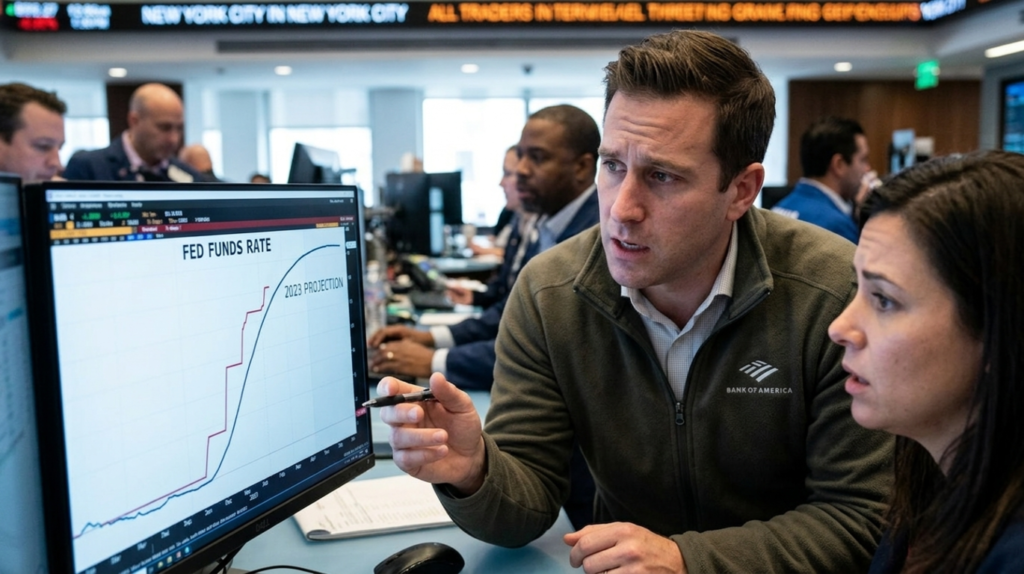
The specifics of the call are straightforward even if their implications are not. Bank of America expects quarter-point increases in September, October, and December, each adding 25 basis points to the benchmark federal funds rate and lifting it cumulatively by 75 basis points, from its current range of 3.50% to 3.75% up to 4.25% to 4.50%. That would not just halt the easing cycle the Fed pursued for much of last year; it would fully reverse it, undoing the three quarter-point reductions delivered in September, October, and December of 2025 that had brought the policy rate down from a much higher starting point. Bank of America now also says it expects the Fed to hold steady through 2027, pushing back any realistic prospect of rate relief to 2028 at the earliest — a timeline that, if it holds, would represent one of the longest stretches of restrictive monetary policy in the modern era of central banking.
The Inflation Data Driving the Reversal
The case Bank of America builds rests heavily on a single, uncomfortable data point: core measures of inflation are moving in the wrong direction at precisely the moment many forecasters expected them to keep cooling. The bank’s note pointed to core personal consumption expenditures inflation potentially reaching 3.5% for the month of May, nearly 70 basis points higher than the same period a year earlier. That is a meaningful reacceleration for a metric the Fed watches more closely than any other, and it arrives well above the central bank’s long-standing 2% target — a target the Fed has now missed for five consecutive years.
Bhave’s analysis identifies several distinct forces feeding into that reacceleration. Tariff-related cost pressures, which the Fed had previously been willing to treat as a temporary, one-time adjustment rather than a sustained inflationary force, appear to be proving more persistent and harder to look past than policymakers initially assumed. At the same time, a separate and previously reliable source of disinflationary relief — falling housing costs working their way through the broader price index — has largely run its course, removing a tailwind that helped pull headline inflation lower over the past two years. Compounding both of those factors, a range of core services prices, from insurance to general services spending, have proven unusually sticky, refusing to decelerate even as goods prices have behaved more predictably. Layered on top of all of this was a fresh supply-side shock tied to elevated energy costs, which added yet another layer of complexity to a Fed inflation outlook that was already under strain. Taken together, Bank of America argues, these are not isolated or temporary disturbances but a cumulative shift that justifies abandoning the easing bias the bank itself had held earlier in the year.
A New Fed Chair’s First Test
The timing of Bank of America’s pivot is inseparable from a parallel shift taking place inside the Federal Reserve itself. Kevin Warsh, who took over as Fed chair this year following his nomination by President Donald Trump, presided over his first policy meeting earlier this month, and the tone he set there appears to have done as much to move markets as the inflation data itself. The Federal Open Market Committee voted unanimously to hold the policy rate steady at 3.50% to 3.75%, marking a fourth consecutive meeting without a change. But it was Warsh’s accompanying remarks, rather than the decision itself, that caught economists off guard.
According to accounts of the post-meeting press conference, Warsh invoked the phrase “price stability” roughly a dozen times, a degree of repetition that struck seasoned Fed-watchers as a deliberate signal rather than a rhetorical accident. He suggested that current policy was not particularly restrictive given where inflation now stands, and he was noticeably more guarded than in previous public remarks about the disinflationary potential of artificial intelligence-driven productivity gains — a theme he had leaned on earlier in his confirmation process when expressing openness to future rate reductions. Bhave’s note offered a pointed interpretation of that shift, suggesting Warsh may be positioning himself as deliberately hawkish in his early months to establish credibility with markets and with inflation-focused colleagues on the committee, buying himself time until either price pressures ease on their own or internal staff analysis builds a stronger case for holding steady. Whether that reading proves accurate or not, the market reaction was immediate: futures pricing shifted to reflect a meaningfully higher probability of tightening later this year, and longer-dated Treasury yields moved higher in sympathy, with the 10-year note trading above 4.5% in the days following the meeting.
It is worth noting the layer of political complexity surrounding this moment. Warsh was nominated in January under different economic assumptions, at a time when many observers anticipated that inflation would continue cooling and that the central bank would have room to cut rates further as the year progressed. The administration has been a vocal and frequent advocate for lower borrowing costs throughout this period. That the Fed’s newly installed leadership is now signaling the opposite — a willingness to raise rates rather than cut them — sets up a notable divergence between the executive branch’s publicly stated preference and the direction the central bank appears to be leaning, underscoring the institutional independence that has long been considered a defining feature of American monetary policy, regardless of which administration is in office or what its preferences happen to be.
Why the Labor Market Matters Just as Much as Prices
Inflation data alone rarely moves a major bank’s interest-rate forecast this dramatically. What gives Bank of America’s call its force is that the labor market, the other half of the Fed’s dual mandate, has also been quietly strengthening in ways that remove much of the justification for last year’s rate reductions. Bhave’s note draws a direct line back to the rationale Fed Chair Jerome Powell offered at the time, framing the 75 basis points of cuts delivered in the back half of 2025 as a form of risk management undertaken in response to a visible slowdown in employment data. That slowdown, according to Bank of America, has now largely reversed itself. The unemployment rate currently sits roughly flat compared to where it stood a year earlier, even though the policy rate today is 75 basis points lower than it was then — meaning the labor market has firmed up even as monetary conditions have already eased. Separately, monthly job creation has continued at a pace many economists view as resilient, with May’s reading of roughly 172,000 new positions outperforming expectations, even if the gains were concentrated in a narrower set of sectors such as healthcare, hospitality, and local government employment rather than spread broadly across the economy.
Bank of America also revised its tracking estimate for second-quarter economic growth upward to an annualized 2.8%, citing a stronger-than-expected May retail sales report alongside favorable revisions to prior data. An economy growing at that pace, paired with a labor market showing renewed strength rather than continued softening, is simply not the backdrop against which a central bank typically continues cutting rates — and that combination, more than the inflation print in isolation, is what convinced Bank of America that the case for risk-management easing has expired and the case for what it now calls supply-shock management has taken its place.
The Energy Variable
No discussion of this year’s inflation trajectory is complete without addressing the role that international energy markets have played. Earlier in the year, a sharp escalation in tensions in the Middle East sent oil prices climbing rapidly, introducing a fresh and largely unanticipated source of cost pressure into an economy that was already grappling with tariff-related price increases. That energy-driven supply shock is precisely the kind of disturbance Bank of America’s note references when describing the Fed’s patience as having run out after a string of supply-side surprises. The central bank, in this framing, had been willing to treat tariff effects as transitory; a second, unrelated jolt to energy costs arriving on top of that appears to have tipped the balance toward a more defensive posture.
Not every forecaster agrees that this energy effect will prove durable enough to justify a full tightening cycle. Chen Zhao, chief global strategist at Alpine Macro, has taken a notably different view, arguing in a recent note that the easing of regional tensions could allow oil prices to retreat toward the $50 to $60 per barrel range, which would meaningfully relieve the very pressure Bank of America is citing as justification for its hawkish call. Zhao’s broader thesis holds that small businesses are already showing signs of strain, that artificial intelligence is contributing measurable productivity gains that should help offset cost pressures over time, and that wage growth is decelerating rather than accelerating — all of which, in her view, make the odds of the Fed actually following through on three separate rate increases this year considerably lower than Bank of America’s note suggests. This disagreement between two well-regarded research houses captures something important about the current moment: the underlying data supports more than one reasonable interpretation, and the next several months of inflation and energy-price readings will likely settle which view holds up better than abstract argument alone can.
Wall Street Is Not Fully on Board — Yet
One of the more revealing details in this story is the gap between Bank of America’s forecast and what financial markets are actually pricing in. According to data from the CME Group’s FedWatch tool, traders are currently positioning for at least one rate increase this year, most likely arriving in September, with better-than-even odds attached to a second move in December. That is a meaningfully less aggressive stance than Bank of America’s call for three separate hikes, and it suggests that while markets have clearly absorbed the shift away from expecting further cuts, they have not yet fully embraced the idea of a sustained tightening cycle. Bank of America’s own note leaves room for nuance as well — it characterizes a possible move as early as July as plausible but not the base case, suggesting the Fed is more likely to wait through the summer for additional data before acting, and flags the possibility that policymakers could even choose to delay action until after the November midterm elections to avoid the appearance of injecting monetary policy into electoral politics.
Bank of America is not alone in its repositioning, however, which lends the call additional weight beyond a single research desk’s house view. PGIM, the asset management arm of Prudential Financial, issued a similar revision in its midyear global market outlook, also now forecasting three rate increases this year. PGIM’s analysts described the labor market as sitting somewhere between stabilization and acceleration, and they specifically flagged the demand-side boost coming from artificial intelligence investment as a factor likely to keep upward pressure on inflation in the near term, even as the technology’s longer-run productivity benefits remain a separate and largely unresolved question. Notably, PGIM’s forecast includes an eventual reversal: the firm expects the Fed to walk back these increases with three rate cuts in 2027 and one additional cut in 2028, arriving at a terminal policy rate near 3.375% — a detail that frames the current hawkish turn as a temporary, if uncomfortable, detour rather than a permanent change in the central bank’s long-run direction.
What a Tightening Cycle Would Mean for Markets and the Real Economy
The practical consequences of a renewed tightening cycle, should it materialize as Bank of America expects, would extend well beyond the federal funds rate itself. Longer-term Treasury yields have already begun moving higher in anticipation, with the benchmark 10-year yield trading above 4.5% — a level that directly affects mortgage rates, corporate borrowing costs, and the valuation models underpinning a stock market that has climbed to repeated record highs over the past year. Equity markets, and particularly the more richly valued, rate-sensitive corners of the technology and growth sectors, tend to face the steepest repricing pressure when the market shifts from anticipating easier money to anticipating tighter money, since higher discount rates mechanically reduce the present value of future earnings that valuations depend on.
The commercial real estate sector offers a particularly clear illustration of how a delayed easing cycle compounds existing strain. Investors and property operators in that space have been positioning for rate relief for more than two years now, a holding pattern widely nicknamed “extend-and-pretend” within the industry, in which lenders repeatedly modify loan terms rather than force a reckoning while waiting for borrowing costs to fall. That patience appears to be running out. Reports from commercial property analysts describe banks and other lenders growing increasingly unwilling to wait, choosing instead to shed troubled debt and absorb losses now rather than continue extending terms in the hope that lower rates will eventually bail out underwater positions. A Bank of America forecast calling for higher rates, rather than the long-awaited relief, would extend that uncomfortable dynamic well into next year and likely accelerate further loss recognition across the sector.
At the same time, there is a countervailing force worth noting: corporate issuance of stock and debt has reportedly been running at a pace that could see companies raise trillions of dollars collectively this year, suggesting that despite the higher-rate outlook, capital markets remain remarkably open and functional. That combination — tightening monetary policy alongside still-robust capital-raising activity — is somewhat unusual and points to an economy where financial conditions, in aggregate, may not yet be as restrictive as the policy rate alone would suggest, which is itself part of the argument Bank of America and the new Fed chair appear to be making: that the current rate level simply has not been doing enough to slow things down.
A Divided Committee and an Uncertain Path Forward
The Federal Reserve’s own internal projections released after this month’s meeting reflect just how unsettled the outlook has become even among policymakers themselves. Roughly half of the eighteen Fed officials who submit projections indicated they expect at least one rate increase by year-end, while a smaller group anticipates rates remaining flat and a minority still see room for cuts. That kind of three-way split is unusual for a Fed seeking to project a unified policy direction, and it suggests that the debate playing out publicly between research houses like Bank of America, PGIM, and skeptics such as Alpine Macro is mirrored, almost exactly, inside the building where the actual decisions get made.
What happens next will depend heavily on a relatively narrow set of upcoming data releases: inflation readings over the summer months, particularly core PCE and CPI prints; monthly employment reports, with particular attention to whether May’s job gains broaden out across more sectors or remain narrowly concentrated; and energy price trends, which carry outsized influence over headline inflation in either direction depending on how international conditions evolve. Bank of America’s own framing leaves the July meeting as a live possibility rather than a certainty, which means the September meeting — by which point a full quarter’s worth of additional data will have accumulated — looks like the more decisive moment where the central bank either validates the hawkish case or finds enough cooling in the numbers to justify standing pat for longer.
The Bigger Picture
Stepping back from the month-to-month data points, what Bank of America’s forecast really represents is a recognition that the post-pandemic inflation story has not followed the clean, linear path many forecasters expected even a year ago. The initial 2021 surge, dismissed at the time as a temporary disturbance, proved durable enough to push price growth to a 40-year high and force a historically aggressive tightening cycle in response. That cycle succeeded in bringing inflation down from its peak, only for a fresh combination of tariff effects, an energy-related supply disruption, and unusually sticky services pricing to interrupt the descent before it reached the Fed’s target. Each time the inflation problem has appeared to be nearing resolution, a new and largely unrelated shock has arrived to extend the timeline.
That pattern carries a lesson that extends well beyond this particular forecasting episode. Modern inflation dynamics, shaped by global supply chains, energy markets, trade policy, and now the early economic effects of artificial intelligence adoption, appear considerably less predictable and more prone to sequential disruption than the relatively stable inflation environment that prevailed for much of the two decades before the pandemic. Whether Bank of America’s three-hike call proves correct, whether the more modest market pricing turns out to be closer to reality, or whether skeptics like Alpine Macro are ultimately vindicated by softer energy prices and improving productivity, the broader takeaway for households, businesses, and investors alike is the same: the assumption that inflation would settle back into a comfortable, predictable range without further disruption now looks considerably less certain than it did at the start of the year. For an economy and a central bank that have already spent five consecutive years missing a 2% inflation target, that uncertainty is, in itself, the story.
For everyday borrowers, the practical stakes of this debate are not abstract. A central bank that raises its benchmark rate by 75 basis points rather than cutting it would mean costlier auto loans, higher credit card financing charges, and mortgage rates that stay elevated for longer than many prospective homebuyers had been planning around. Businesses weighing expansion or refinancing decisions face a similar recalibration: the assumption that borrowing costs would gradually ease through 2026 and into 2027, which shaped countless corporate budgets and investment timelines earlier this year, now looks considerably less safe to rely on. That is precisely why a single research note from one bank’s economics desk can move markets as visibly as it has — it is not merely a forecasting exercise but a signal that the financial planning assumptions embedded across households and corporate balance sheets may need to be revisited.
There is also a longer historical thread worth keeping in view. Central banks have, at various points over the past several decades, been accused of either tightening too aggressively and tipping otherwise healthy economies into unnecessary slowdowns, or easing too quickly and allowing inflation expectations to become unanchored. Bank of America’s framing of the current moment as a shift from risk management toward what it calls supply-shock management is, in effect, an argument that the Fed cannot afford to repeat the mistake of treating successive cost shocks as individually transitory, even if each one in isolation might appear temporary. Whether that more cautious posture ultimately serves the economy well will likely become clear only in hindsight, once the current run of data has had time to play out and once it becomes evident whether inflation expectations among consumers and businesses have remained anchored near the Fed’s target or have begun drifting upward in ways that become self-reinforcing. For now, the most that can be said with confidence is that the easy consensus that defined the start of the year — gradual cuts, cooling prices, and a smooth glide path back to target — has given way to a far more contested and data-dependent debate, one that will likely keep economists, traders, and policymakers revising their views well into the autumn.