France vs Iraq: When Lightning Stole the Spotlight

There is a particular kind of silence that settles over a stadium when nature intervenes and reclaims authority over the spectacle humans have so carefully engineered. At Philadelphia Stadium on the evening of June 22, 2026, that silence descended on what had promised to be a straightforward Group I fixture at the 2026 FIFA World Cup. France, the defending champions and one of the tournament’s overwhelming favorites, were leading Iraq 1–0 at the halftime whistle — a scoreline built on a Kylian Mbappé strike of such brutal precision that it briefly threatened to make the evening’s most newsworthy storyline a simple, familiar one: the world’s most dangerous forward continuing to dismantle records with methodical efficiency.
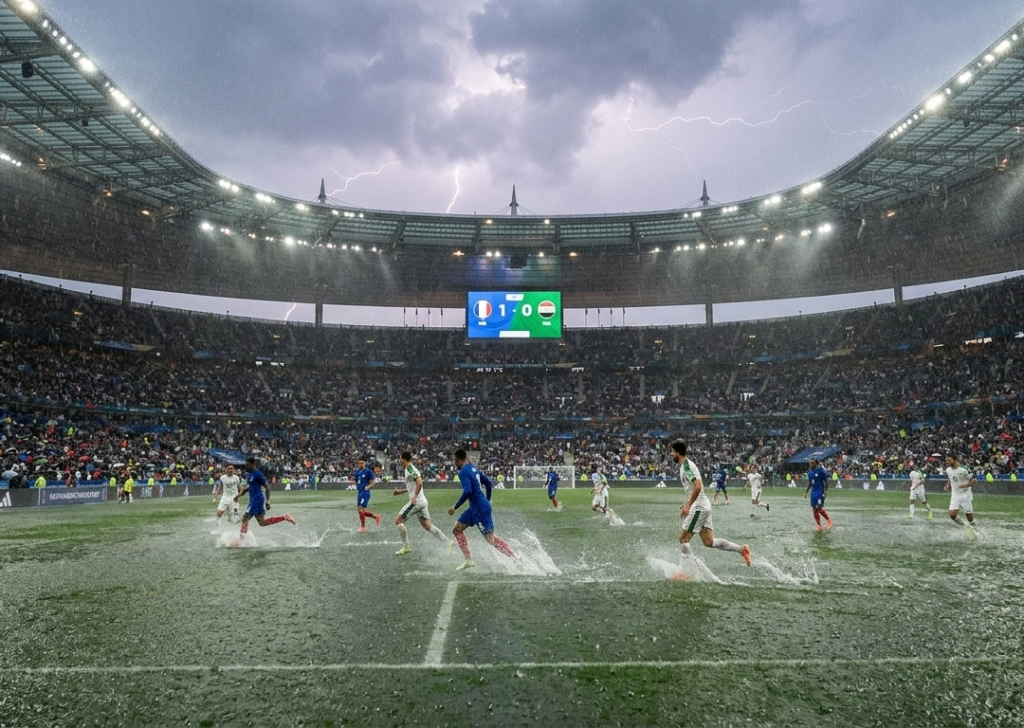
What followed the halftime interval was not the second half that 70,000 spectators had gathered to watch. Instead, the match between France and Iraq became the first fixture of the 2026 World Cup to be formally suspended due to severe weather — a distinction that will accompany this fixture in the tournament’s historical record regardless of how the remaining 45 minutes ultimately unfold. Interrupted since the end of the first half, the match between France and Iraq was not expected to resume before 1 a.m., according to an announcement from FIFA. The reason for the interruption: a downpour hit the pitch, but above all, lightning was spotted less than 13 kilometers from Philadelphia’s stadium.
The suspension was not entirely unexpected. In the days leading up to the fixture, meteorological warnings had been circulating widely among tournament organizers, host city officials, and media. It had already been known for several days that this match was under threat from particularly severe weather conditions. Thunderstorms, violent winds, heavy rain, and even isolated tornadoes were feared. But knowledge of risk does not diminish the operational and sporting complexity that materializes when the risk becomes reality at a FIFA World Cup — the planet’s most-watched recurring sporting event, staged before a global television audience measured in the hundreds of millions.
The Protocol That Stopped the World Cup
Understanding what happened at Philadelphia Stadium on Monday evening requires understanding the framework FIFA has built around electrical storm management at outdoor venues in North America — a framework that differs in important ways from the protocols common at European stadiums, and that carries implications for the entire tournament’s scheduling integrity.
While standard rainfall rarely stops a football match, the intense seasonal storms typical of North American climates bring a much higher risk of disruption. FIFA has made it clear that regular rain will not halt play, provided the pitch does not become completely waterlogged or hazardous. The operative threshold is not rainfall but lightning — the presence of electrical activity within a defined radius of the playing surface and spectator areas.
The standardized protocol, which is generally followed across the country, states that if lightning strikes within a certain distance from the stadium, there is a mandatory 30-minute delay. Should another strike be detected within the radius during that delay, the timer resets. That radius can vary by venue, location, and match officials, but it is usually either eight miles or 10 miles.
The rolling nature of that timer is the element that most significantly complicates operational planning. It is not simply a question of waiting 30 minutes from the moment of suspension and then resuming play. Every subsequent lightning detection within the defined radius resets the clock to zero — meaning that an active storm system can, in theory, hold a fixture in indefinite suspension for several hours. FIFA has confirmed there is no fixed, maximum duration a match can remain delayed before it is officially called off for the day. Instead, football’s governing body reviews every severe weather delay on a case-by-case basis, factoring in stadium logistics and fan transportation.
The practical consequence is that fans, players, coaching staff, broadcasters, and tournament administrators are all held captive to the meteorological data being fed into the stadium’s weather monitoring systems — with no clear endpoint visible until the storm system fully moves through the region. If a prolonged storm forces a permanent postponement, the match is typically rescheduled to resume the following day, picking up from the exact minute and scoreline. That provision — the ability to restart a suspended match from its precise point of interruption — is a crucial safeguard that ensures sporting integrity is maintained even when atmospheric conditions make same-night resumption impossible.
A severe Thunderstorm Warning was issued for the stadium, with winds of 60 mph and heavy rain. Fans in the open seating bowl were directed to evacuate to the stadium concourses and designated shelter facilities. The big screen inside the venue displayed evacuation advisories in the clearest possible terms. Lauren Lambrugo, chief operating officer of Philadelphia Soccer 2026, confirmed that the stadium would “start to evacuate to the main concourse and seek emergency shelter.” For the tens of thousands of spectators who had traveled to Philadelphia for what was meant to be a straightforward group-stage match, the experience of sheltering inside a stadium corridor while lightning illuminated the Pennsylvania sky outside represented a version of World Cup attendance that no ticket package had advertised.
Reports from inside the stadium in the hours following the suspension painted a picture of cautious patience. Fans began returning to their seats as the rain let up, but announcements over the PA system confirmed that the match remained under a Shelter in Place weather delay, with each new lightning strike resetting the mandatory waiting period. The FOX broadcast, which had been carrying the match for American viewers, remained on-air through the delay, providing updates and extended commentary as its production team navigated the logistical reality of live television being held hostage by an East Coast summer storm system.
Mbappé’s Strike and the Record That Was Already in Motion
Before the storm became the story, there was a goal — and the goal, like almost every goal Kylian Mbappé scores at a World Cup, carried historical weight that extended well beyond the three points France were accumulating in Group I.
Mbappé scored his 15th World Cup goal early in the first half against Iraq in 2026, a left-footed strike from just outside the penalty area that overpowered Iraqi goalkeeper Ahmed Basil, who got his fingertips on the ball, which found the back of the net. It was the kind of finish that looks effortless to spectators and represents years of technical refinement to the player executing it — a combination of body shape, timing, and raw velocity that, for Mbappé, has become almost routine at the sport’s highest level.
The goal was his 15th in World Cup football, a tally that places him in genuinely rarefied company. Mbappé trails the new all-time record holder by three goals, with Messi having surpassed Miroslav Klose’s previous record of 16 goals earlier the same day when he scored twice against Austria. The symmetry of the situation — Messi breaking the all-time record in Dallas at 1 p.m. Eastern while Mbappé was scoring his 15th goal in Philadelphia at 5 p.m. Eastern, on the same calendar day — is the kind of narrative gift that tournament historians rarely receive.
Mbappé is only three goals away from surpassing the all-time World Cup scoring record, at just 27 years old. That proximity to history, combined with France’s position as one of the tournament’s frontrunners, means every subsequent appearance carries a dual storyline: the collective ambitions of Les Bleus and the individual pursuit of an achievement that would cement Mbappé’s place alongside the sport’s most transcendent figures.
Mbappé’s 15 goals have come in just three World Cup appearances, which makes his rate of scoring historically exceptional. Brazil’s Ronaldo was the only player since 1998 to reach the same goal tally across his first two World Cups. The comparison with Ronaldo Nazário — widely considered among the greatest pure strikers in the history of the sport — is not given lightly. But in terms of the statistical pace of his accumulation, the parallel is genuine.
At the 2018 FIFA World Cup, Mbappé broke onto the international scene, scoring four goals as a 19-year-old and playing a key role in France’s championship run. During that campaign, he became only the second teenager to score in a World Cup final, finding the net in France’s 4–2 victory over Croatia. That debut set the trajectory. By 2022, he had scored seven goals in a single tournament — including a hat-trick in the final against Argentina that his team ultimately lost on penalties — and he entered 2026 as the player the world expected to eventually surpass every scoring record the World Cup had accumulated over nearly a century of competition.
For France, the goal against Iraq was also about more than Mbappé’s personal landmarks. France came into the game against Iraq atop Group I after a 3–1 win over Senegal that saw Mbappé score two goals. A victory in Philadelphia would put France on the verge of confirming their passage to the Round of 32, creating space for Didier Deschamps to manage his squad’s workload and preparation in the group’s final fixture. The 1–0 lead at halftime, and the manner in which France dominated the first half — outshots of 7–2 and a flow of possession that at times seemed to overwhelm Iraq entirely — suggested the second half, whenever it resumes, will determine the margin rather than the outcome.
Iraq’s Story: Resilience in the Face of Enormous Expectations
It would be too easy, and ultimately too reductive, to frame the France vs. Iraq fixture purely through the lens of European talent and individual record-chasing. Iraq’s presence at the 2026 World Cup is itself a sporting story of genuine substance — one that extends across decades of setbacks, administrative difficulties, and repeated near-misses in qualification campaigns.
The fixture marked the return of Iraq to the World Cup finals, their first appearance since 1986. Four decades is an almost inconceivably long absence from the sport’s premier stage — long enough for an entire generation of Iraqi players and supporters to have lived their entire football lives without a World Cup to attend or watch their national team participate in. The 2026 qualification earned under Australian manager Graham Arnold represented a breakthrough that carried enormous emotional weight for Iraqi football, whatever the results in the group stage ultimately produce.
Arnold’s decision to accept the Iraqi post reflected his belief in the quality of the talent available and the organizational improvements that had been made in the country’s football infrastructure. Players like Zidane Iqbal — born in Manchester and eligible for Iraq through family heritage — represent the kind of diaspora talent that has strengthened many national teams whose domestic player pools are limited by historical and economic circumstances. Iqbal plays his club football in Europe and brings with him technical qualities and tactical awareness shaped by elite-level European football environments.
The Iraqi team’s performance in the opening match of Group I — a 4–1 defeat to Norway — told one kind of story. But the manner in which they defended against France in the first 45 minutes on Monday evening began to tell another. The Lions of Mesopotamia had to be delighted they were headed to the dressing room down by just a goal. After Mbappé’s opening tally, France kept up the pressure, and it seemed like a second goal was coming soon. But Iraq stood firm and went into intermission with hope.
Standing firm against France for 45 minutes — conceding only one goal to a team that dominated possession, shots, and territory — is not nothing. It is, in fact, the kind of first-half performance that gives a coaching staff something meaningful to work with at halftime. Whether that relative resilience translates into a more competitive second half, once play resumes, remains to be seen. But the narrative of an Iraq national team restored to the World Cup stage, competing credibly against one of the tournament’s strongest sides, is one that deserves telling with proper context and respect.
Philadelphia and the American Summer: Why Weather Was Always Part of This Story
The disruption at Philadelphia Stadium on June 22 did not arrive without warning — either meteorologically or historically. The 2026 FIFA World Cup, shared across the United States, Canada, and Mexico, was always going to face the challenge of staging matches in North American summer conditions that differ meaningfully from the late-autumn, Mediterranean, or air-conditioned stadium environments in which recent World Cups have been played.
Roads leading to the stadium had standing water four hours before the scheduled 8 p.m. kickoff. The National Weather Service warned that showers and potential thunderstorms with high amounts of moisture were expected to move through the area, with rainfall rates that could produce up to around two inches per hour — rates capable of resulting in flash flooding mainly over urban and poor drainage areas.
Philadelphia in late June sits in a meteorological zone characterized by intense convective storms — the kind of rapidly developing thunder cells that can deposit enormous quantities of water and electrical activity in short windows without the extended warning signals that slow-moving frontal systems provide. The Delaware Valley’s geography, positioned between the Appalachian highlands and the Atlantic coast, creates conditions in which warm, moisture-laden air masses from the south collide with atmospheric instability to produce exactly the kind of storm system that arrived at Philadelphia Stadium on Monday evening.
For FIFA and the host city organizing committees, the weather factor was not a blind spot. FIFA had prepared weather disruption measures in advance, including protocols for fans being kept in concourses or emergency shelter facilities if lightning conditions developed. The fact that the disruption protocols were activated efficiently — with fans directed to shelter, PA announcements made clearly, and FIFA’s meteorological support team monitoring conditions in real time — reflects a level of organizational preparation that, while unable to prevent the disruption, managed its human safety dimensions responsibly.
The broader question for the remaining group-stage fixtures — and for the knockout rounds that will follow — is whether the weather disruption at Philadelphia represents an isolated incident or an early signal of a more systemic challenge. The United States hosts a significant portion of the 2026 group-stage fixtures, and many of the American host cities experience similar convective storm patterns during the summer months. Dallas, Miami, Kansas City, and other venues share Philadelphia’s exposure to afternoon and evening thunderstorm activity during peak summer weeks. The France vs. Iraq suspension is a reminder that tournament planners must treat weather contingency not as a theoretical edge case but as an operational probability that requires robust, pre-tested response infrastructure.
The Broadcast Dimension: A Global Audience on Hold
One element of the France vs. Iraq suspension that deserves specific analysis is its impact on the global broadcast and commercial infrastructure built around the fixture. The 2026 World Cup is the first edition of the tournament staged in a 48-team format, and FIFA’s commercial agreements with broadcasting partners across the world represent investments of enormous scale. When a match is suspended mid-broadcast, the ripple effects extend across time zones, advertising schedules, and editorial commitments that are planned months in advance.
France vs. Iraq was the first game of the 2026 World Cup that had been delayed due to weather. That “first” carries implications both for the specific fixture and for how subsequent weather events during the tournament will be managed at the broadcast level. FOX Sports, which holds the primary American broadcast rights for the 2026 World Cup, was carrying the France vs. Iraq match live when the suspension occurred. Its production team had to pivot from broadcasting match action to sustaining audience engagement through an indefinite delay — a situation that tests the depth of a network’s World Cup coverage infrastructure.
Globally, broadcast partners in Europe were facing the particular challenge of a scheduled match running deep into local morning hours. A fixture originally scheduled for an 8 p.m. Eastern start was already a late-night watch for audiences in France, where kick-off corresponded to 2 a.m. Central European Time. A suspension that pushed the second-half start beyond 1 a.m. Eastern — 7 a.m. in Paris — meant that French supporters wanting to watch their national team’s full match were navigating a schedule that reached into early morning. The passion of French football supporters is not easily defeated by inconvenient timing, but the broadcast and commercial planning built around a live match audience at reasonable local hours was clearly disrupted.
The commercial implications extend to the sponsorship ecosystem built around each World Cup fixture. Major global brands that purchase advertising inventory during World Cup matches make those investments on the basis of audience size and scheduling predictability. An indefinitely suspended match — with its audience fragmented across different moments of resumption, across platforms, and across time zones — creates a measurement and optimization challenge for commercial teams that standard scheduling does not produce.
Group I at the Intersection of Football’s Biggest Stories
Beyond the specifics of the suspension itself, the France vs. Iraq fixture sits at the intersection of multiple narratives that are defining the 2026 World Cup’s opening phase. Group I brings together France, Senegal, Iraq, and Norway — a collection of teams whose histories at the World Cup span from Iraq’s 40-year absence to France’s status as two-time champions to Norway’s return to the tournament for the first time since 1998.
The fixture also marked the return of Norway to the World Cup finals, their first appearance since 1998. Erling Haaland, the Manchester City forward who has spent the past four years reshaping every scoring record in club football, arrived at his first World Cup with the kind of anticipation that surrounds only a handful of players in each generation. Norway romped to a 4–1 win over Iraq in the opening group-stage fixtures, with Haaland grabbing a brace. The Norwegian striker’s presence in Group I creates a subsidiary records narrative alongside Mbappé’s: two of the most lethal forwards in the contemporary game, in the same four-team group, both motivated by individual milestones that align neatly with their teams’ competitive objectives.
The final group-stage fixture — France vs. Norway on June 26 — carries the potential to be one of the tournament’s early showcase matches: an encounter between two tournament heavyweights that could determine which of them faces a more favorable knockout round path. For Mbappé, a match against Norway and the Norwegian defense could provide the platform for the additional goals that close the gap to the all-time World Cup scoring record. For Haaland and Norway, the prospect of facing the world’s most defensively disciplined national team coach — Didier Deschamps has consistently organized France to be difficult to score against at tournaments — presents a different kind of test.
But all of that lies ahead. The immediate task is completing the 45 minutes that remain of the France vs. Iraq fixture, in whatever window Monday night’s weather system permits.
What Happens Next: The Protocol, the Players, and the Precedent
As of the time of this writing, the France vs. Iraq match remains in formal suspension, awaiting the meteorological all-clear that FIFA’s protocols require before play can safely resume. The players from both teams have retreated to their respective changing rooms. The stadium’s weather monitoring systems continue to track lightning activity in the surrounding region. Tournament officials and broadcast teams are coordinating contingency scenarios that range from same-night resumption within hours to a next-day restart that would pick up from the 45th minute with France leading Iraq 1–0.
FIFA has confirmed that any such postponed match would resume from the exact minute and scoreline at which it was interrupted — a provision that protects the sporting integrity of the result regardless of when play ultimately restarts. For France, the interruption freezes a 1–0 lead with 45 minutes of football remaining. For Iraq, it provides an unexpected extended interval — time to recover physically and tactically from a first half in which France’s pressure was sustained and relentless.
The disruption, while operationally disruptive, also provides a broader lesson about the nature of staging a global sporting event in open-air venues during the North American summer. Weather is not a complication to be managed away through better planning — it is an inherent feature of the environment that tournament architects chose when they selected these cities and these months. The protocols FIFA has put in place reflect genuine learning from how weather delays are handled across American professional sports — baseball, golf, American football — where such interruptions are accepted as part of the sporting experience rather than failures of organization.
For the players, the suspension represents a physical and psychological challenge that no training session fully prepares them for. Elite footballers maintain pre-match preparation routines built around precise timing: warm-up sequences, hydration protocols, tactical review sessions, and mental readiness rituals that are calibrated to peak at a specific moment. A halftime suspension of indefinite duration disrupts that calibration entirely. Returning to full competitive intensity after an hours-long interruption — in whatever conditions the Philadelphia atmosphere provides when play finally resumes — will require from both sets of players a form of adaptive concentration that tests their professional sophistication as much as their physical condition.
For Mbappé specifically, who entered the evening with 14 World Cup goals and now stands at 15 after his first-half strike, the resumption of the second half brings with it the mathematical possibility of goal 16 — the number that would draw him level with the new all-time record holder. Whether that particular landmark arrives in the remaining 45 minutes against Iraq, in the final group-stage match against Norway, or in the knockout rounds beyond, the pursuit is active, the trajectory is clear, and the gap is closing.
The Larger Meaning: Weather, Sport, and the Limits of Human Planning
There is something instructive in the image of one of the world’s most elaborately planned sporting events brought to a halt by a Pennsylvania thunderstorm. The 2026 FIFA World Cup represents billions of dollars of infrastructure investment, years of logistical preparation, and the coordinated efforts of three host nations, dozens of host cities, hundreds of corporate partners, and FIFA’s own global administrative apparatus. And yet, at the moment of maximum visibility — a prime-time group-stage fixture featuring one of the sport’s most marketable players in pursuit of historical records — the variable that ultimately controlled the evening was one that no amount of planning, investment, or organizational sophistication could override.
Nature does not negotiate with tournament schedules.
That is not a criticism. It is an acknowledgment of the honest relationship between outdoor sport and the environment in which it is staged. The protocols FIFA deployed on Monday evening at Philadelphia Stadium — the lightning monitoring, the shelter-in-place procedures, the rolling 30-minute timer, the provision for next-day resumption — reflect an institutional commitment to safety that supersedes the commercial and broadcast considerations that would otherwise push toward faster resumption. When those protocols prioritize the wellbeing of players, match officials, and 70,000 spectators over the convenience of a global television schedule, they are functioning exactly as they should.
The France vs. Iraq suspension will become a footnote in the 2026 World Cup’s eventual historical record — a curiosity, a weather delay, a night when Philadelphia’s summer storms interrupted a record-chasing performance by the world’s most clinical scorer. But looked at more carefully, it is also a reminder that the greatest sporting events on earth derive part of their power from the fact that they cannot be fully controlled. The storm that stopped the World Cup on June 22, 2026 was an inconvenience, an operational challenge, and a safety imperative all at once. It was also, in its uncontrollable force, a reminder of why sport played outdoors, under open skies, retains a quality of authentic experience that no amount of climate-controlled architecture can fully replicate.
The second half will resume. The goals may come, or they may not. France will almost certainly advance from Group I. Mbappé will continue his pursuit of history. And the 2026 World Cup will move forward — as it was always going to, storms notwithstanding.
This analysis is based on contemporaneous reporting, official FIFA communications, and publicly available match and meteorological data as of June 23, 2026. It is intended for informational and journalistic purposes.